
Forget the endless Zillow scrolling. Forget the heartbreak of losing another bidding war.
In a market as intense as Los Angeles, the real estate game is often won before it even starts. The secret? Learning how to find off market homes—the hidden inventory of properties that never get a public “For Sale” sign.
This isn’t just about snagging a deal; it’s about gaining a strategic upper hand in one of the world’s most competitive markets. When a property sells off-market, the deal happens privately between buyer and seller, far from the frenzy of the Multiple Listing Service (MLS). And it’s a lot more common than you think. In some pockets of LA, these private sales are a huge chunk of the action.
LA’s Best-Kept Secret: The Off-Market Advantage
So, why would anyone sell their home in secret, especially in a seller’s market like LA? The reasons are as diverse as the city itself, and they almost always come down to a need for privacy or convenience.
- Privacy is paramount. High-profile sellers, executives, or just regular folks don’t always want their personal business—and photos of their home—plastered all over the internet.
- Convenience is everything. Some sellers are dealing with messy situations, like a divorce or inheritance, and just want a quick, quiet sale without the circus of open houses and looky-loos.
- The property needs work. A house that needs a ton of repairs is a tough sell on the open market. Owners often prefer to sell “as-is” to an investor or a buyer who sees the potential, skipping the cost and time of renovations.
These situations create a parallel universe of hidden gems. For a smart buyer, this means less competition, more room for direct negotiation, and a real chance to find something that actually fits your needs without fighting off a crowd.
The real magic of off-market deals is that you’re not just buying a property; you’re often providing a solution to a seller’s unique problem. That’s the foundation for a win-win deal.
What Kind of Hidden Inventory Are We Talking About?
This exclusive world isn’t just one type of sale. It’s a whole spectrum of opportunities, and each requires a slightly different strategy to uncover. You’ll find everything from quiet “pocket” listings shared within a tight network of agents to probate sales that are legally required but rarely advertised to the public.
This guide is your playbook. We’re pulling back the curtain to show you the exact strategies, tools, and scripts you need to stop competing and start uncovering these opportunities.
Consider this your roadmap to finding LA’s under-the-radar real estate gems.
Your Digital Toolkit for Finding Hidden Leads
Before you burn a tank of gas driving through LA neighborhoods, let’s get one thing straight: your best leads are hiding in plain sight, just a few clicks away. Mastering a few key digital tools is what separates the hopefuls from the pros. It turns you into a data-driven detective, unearthing opportunities right from your desk.
This is about working smarter, not harder. It’s a targeted hunt to pinpoint motivated sellers before anyone else even knows a property might be available. Think of it as your digital command center for building a hyper-focused list of homes that will never see the MLS.
Tapping into Public Records Databases
The bedrock of any serious off-market search starts with public records. County databases are an absolute goldmine, but only if you know what you’re looking for. You aren’t just scrolling through names; you’re hunting for patterns that suggest a homeowner is ready to sell but hasn’t pulled the trigger yet.
Here are the signals I always look for:
- Long-Term Ownership: Someone who has owned their home for 25+ years could be an empty nester or retiree ready to downsize. This is a classic indicator.
- Absentee Owners: An owner with an out-of-state mailing address is often a tired landlord. An unsolicited offer to simplify their life can be incredibly appealing.
- Probate Filings: This is a sensitive area, but these public records mean a property is tied up in an estate. Heirs are often motivated to sell quickly to settle affairs and move on.
- Tax Delinquency or Liens: Nothing motivates a sale like financial distress. Records of unpaid property taxes or other liens can point you directly to a homeowner who needs a fast, cash-based solution.
This diagram breaks down the two main streams that feed the off-market pool.
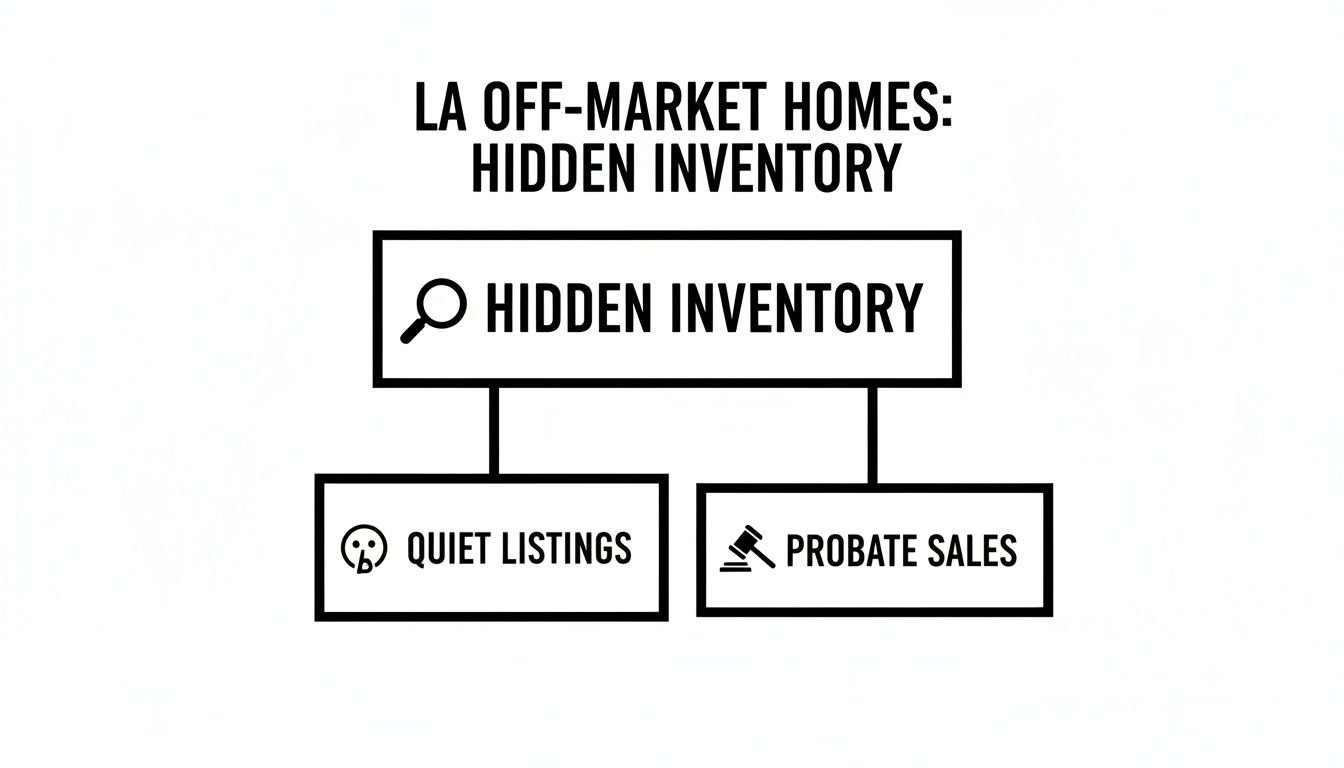
As you can see, both quiet listings and probate sales come from very different seller motivations, but they both create opportunities outside the traditional market.
Specialized Platforms and Foreclosure Services
Beyond digging through raw county data yourself, several online platforms are built specifically to do the heavy lifting for you. These services take public records and add powerful filtering and contact tools, saving you countless hours of mind-numbing research.
Platforms like PropStream or DealMachine let you apply incredibly specific filters to entire zip codes. Imagine searching for every single-family home in Silver Lake with an absentee owner who has held the property for over 15 years. That kind of precision is just impossible on the Zillows of the world.
The real power here isn’t just finding the properties. It’s the ability to build and export laser-focused lists that become the engine for your direct mail or outreach campaigns.
Another critical resource is foreclosure and auction websites. Sites like Hubzu often list properties in pre-foreclosure or at auction that haven’t hit the wider market. It’s a different buying process, for sure, but it’s a direct pipeline to distressed assets. If you want to get inside the seller’s head, you can learn more about what makes them tick in our detailed guide.
Comparing Off Market Prospecting Channels
Look, not all digital channels are created equal. Each one offers a different mix of lead quality, cost, and the sheer effort required. Picking the right tool depends entirely on your budget, your timeline, and whether you’re hunting for a Venice bungalow or a multi-family unit in the Valley.
This table is a practical breakdown to help you decide where to focus your energy.
| Channel | Potential Lead Quality | Cost and Effort | Best Suited For |
|---|---|---|---|
| County Public Records | High (raw data) | Low cost, high effort | The DIY investor who’s willing to dig deep and connect the dots manually. |
| Subscription Platforms | Very High (filtered data) | Monthly subscription, low effort | Buyers looking to scale their search and build targeted marketing lists fast. |
| Foreclosure/Auction Sites | Medium to High | Varies (free to browse) | Investors comfortable with the auction process and due diligence on distressed assets. |
| Real Estate Agent Network | High | Relational (no direct cost) | Buyers who want curated access to pocket listings and pre-MLS opportunities. |
At the end of the day, a multi-channel digital strategy is your strongest bet. When you combine the raw intel from public records with the efficiency of specialized platforms, you create a powerful system for consistently finding off-market deals and getting that crucial first-mover advantage.
Mastering the Art of Driving for Dollars

While databases and digital tools give you a massive head start, some of the most compelling off-market deals in Los Angeles aren’t hiding online. They’re right there, hiding in plain sight.
This is where the old-school, boots-on-the-ground hustle of driving for dollars comes in. It’s a timeless strategy for one simple reason—it flat-out works. This isn’t about taking a joyride through LA neighborhoods; it’s a systematic process for turning a simple drive into a lead-generation machine. You’re physically canvassing areas, spotting properties that show obvious signs of neglect or vacancy. Those signs are often screaming that there’s a motivated, and potentially flexible, seller behind the scenes.
Decoding the Signs of Opportunity
As you drive, you’re training your eye to spot the visual cues that a property isn’t getting the TLC it needs. These tell-tale signs often point to an owner who might be overwhelmed, absent, or facing a tough situation. This is where your ability to find an off-market gem really shines.
Keep your eyes peeled for these classic indicators:
- Overgrown Landscaping: We’re not talking about a slightly shaggy lawn. Look for knee-high weeds, dead trees, or bushes that are swallowing the windows.
- Visible Deferred Maintenance: Peeling paint, a tarp strapped to the roof, boarded-up windows, or a fence that’s given up the ghost all scream “neglect.”
- Piled-Up Mail or Newspapers: A mountain of mail spilling out of the mailbox is a dead giveaway that nobody’s home or checking in.
- Utility Notices: A bright orange shut-off notice from the DWP taped to the front door is a massive red flag for financial distress.
This grassroots strategy is still incredibly effective. It’s a direct way to find opportunities that others miss, especially in a tight market like Los Angeles where inventory can fluctuate dramatically.
Systematizing Your Search for Maximum Impact
Randomly driving around is a surefire way to waste gas and time. To do this right, you need a plan. The goal is to be methodical, not just lucky.
Start by picking specific neighborhoods to target. Whether it’s a pocket of Echo Park you know well or a few key streets in the Valley, focus your efforts. Drive every single street, block by block, almost like you’re mowing a lawn in a grid pattern. This ensures you don’t miss a thing.
When you spot a potential property, you have to capture the data instantly. Fumbling with a notepad is a thing of the past. Apps like DealMachine are built for exactly this, letting you pin a property on a map, snap a photo, and often pull up the owner’s info and public records right on the spot. This turns a simple hunch into an actionable lead in seconds.
Your goal isn’t just to find fixer-uppers. It’s to identify homeowners who aren’t on anyone else’s radar, giving you a direct line to a conversation before the property ever gets a whiff of the open market.
From Drive-By to Deal Pipeline
Once you’ve built a list of promising addresses, the real work begins. That organized list of distressed-looking properties is the foundation of your outreach campaign. You now have a hyper-targeted group of potential sellers who you know have a tangible reason to at least consider an offer.
This is the critical handoff from observation to action. You can use the information you gathered to craft a personalized direct mail piece or prepare for a respectful phone call. For a deep dive on turning these drives into deals, check out The Ultimate Drive for Dollars Playbook for some essential strategies.
Ultimately, mastering this technique is about more than just spotting an unkempt yard. It’s about recognizing the human story behind the property and positioning yourself as a potential solution. It’s this blend of keen observation and strategic action that uncovers great off-market deals in a city full of them.
Building Your Network to Unlock Doors
Data and drive-bys will fill your pipeline, but let’s be real. The truly exclusive off-market deals in Los Angeles—the ones that never see the light of day—are almost always unlocked by your network.
The off-market world runs on relationships. It’s a tight-knit ecosystem where opportunities get passed between trusted contacts long before they ever risk public exposure. If you want in, you have to become one of those contacts.
This isn’t about schmoozing at cocktail parties or collecting a fat stack of business cards. It’s about strategically building a small, high-quality team of insiders who see and hear things you can’t. When you become known as a reliable problem-solver, deals start coming to you. You become the first call, not an afterthought.
Assembling Your Off-Market A-Team
Finding off-market homes is a team sport, and you need to recruit the right players. Think about the professionals who are on the front lines, dealing with property owners at pivotal, often emotional, moments in their lives. Building a genuine connection with them is your golden ticket.
Your core network should absolutely include these people:
- Real Estate Agents: A well-connected agent is your single most valuable ally. They know about “pocket listings” and hear whispers about sellers who are just thinking about a sale. They are your guide and advocate, making sure every transaction is handled ethically and professionally.
- Probate and Estate Attorneys: When a property enters probate, these attorneys are the first to know. They often work with heirs who are highly motivated to sell an inherited property quickly and without the usual song and dance.
- Contractors and Handymen: Plumbers, roofers, and electricians are in and out of homes all day. They see deferred maintenance up close and are often the first to hear a homeowner complain about being “so done” with a property.
- Property Managers: These pros are the boots on the ground for absentee landlords. When an owner gets tired of managing a rental from across the country, the property manager is usually the one who gets that first, “Hey, I’m thinking of selling,” call.
But here’s the key: connecting with these professionals isn’t a one-and-done deal. It requires consistent, value-driven interaction.
The Give-to-Get Philosophy
The fastest way to get ignored is to walk into a new relationship with your hand out. The pros you want to connect with are busy, and their time is valuable. Your entire approach must be centered on providing value first.
Think about what they need. Can you refer a client to that probate attorney you just met? Can you send a small, high-margin job to that contractor? When you become a source of business for them, you instantly become a priority.
The rule is simple: Give first, give often, and the deals will follow. Your reputation as a reliable partner is your most valuable asset in the off-market game.
This simple shift transforms your network from a static list of contacts into a dynamic web of reciprocal relationships. You’re no longer just another buyer looking for a deal; you’re a serious player who brings value to the table. This is how you find the homes that nobody else even knows are for sale.
Tapping into the Investor Community
Beyond individual professionals, you need to plug directly into the local investor scene. This is where you’ll find the wholesalers—the specialists who are experts at sourcing deals and are always looking for reliable cash buyers to pass them to.
Start by showing up to local real estate investor meetups. Groups across Los Angeles meet regularly, and just being in the room is the first step. Don’t be a wallflower; introduce yourself, clearly explain your buying criteria, and more importantly, listen to what others are working on.
Online forums and social media groups are also massive hubs for deal flow. Find LA-specific real estate investing groups on Facebook or BiggerPockets. Jump into conversations, offer advice where you can, and make it known that you’re a serious buyer ready to close. When a wholesaler gets a hot lead, they need to move it fast. By being active and visible, you ensure your name is at the top of their call list.
Crafting Outreach That Actually Gets a Response

You’ve done the legwork. You’ve built your lists, driven the streets, and found a property that hits all the right notes. Now for the moment of truth: making contact. This is where most aspiring investors stumble, and it’s the single most critical step in turning a lead into a deal.
The secret isn’t some magic script or a slick sales pitch. It’s a total mindset shift. You’re not trying to buy a house; you’re offering a solution to a person’s potential problem. Every single piece of your outreach, from a letter to a phone call, has to be built on a foundation of respect, empathy, and a genuine attempt to connect.
The Art of the Personal Touch
Generic, mass-produced mailers get tossed straight into the recycling bin. Your first touchpoint has to feel personal and thoughtful, showing you’ve done more than just scrape a name from a database. Whether you’re sending a letter or picking up the phone, personalization is your greatest weapon.
- Reference the Property Specifically: Don’t just say “your house.” Mention “your property on Maple Avenue.” It immediately shows you’re focused on them, not just blasting a list.
- Keep it Simple and Sincere: Ditch the corporate jargon. Write like a real person who is genuinely interested in a conversation, not a faceless company.
- Offer Value, Not Just an Offer: Frame your outreach around making their life easier. Talk about a quick closing, buying the home “as-is” (so they don’t have to lift a finger on repairs), and covering all the closing costs.
This approach transforms you from an intrusive stranger into a potential problem-solver. It’s a subtle but powerful difference that will dramatically increase your response rate.
Your goal for the initial contact isn’t to negotiate a price. It’s simply to start a friendly, low-pressure conversation and earn the right to have a second one.
Direct Mail That Doesn’t Get Ignored
In a world of overflowing digital inboxes, a physical letter can cut through the noise. But for it to work, it has to look and feel different from the junk mail it’s sitting next to. Forget glossy postcards with cheesy stock photos. Think personal.
A simple, handwritten or hand-addressed envelope is 10x more likely to be opened. Inside, a brief, easy-to-read letter is all you need. Introduce yourself, explain why you’re writing, and clearly state how you can help. Always give them multiple ways to get back to you, like a phone number and a simple email address.
One of the best ways to find receptive owners is by looking at investor-held vacant properties. A recent report revealed that investors owned more than 882,300 vacant houses across the U.S. last year—a massive, hidden pool of opportunity. These “empty houses” are prime off-market candidates because investors often prefer to offload them quietly to free up capital. You can dig into these investor-owned opportunities from ATTOM Data Solutions to learn more.
Mastering the Phone Call and the Follow-Up
Picking up the phone can feel intimidating, but it’s often the quickest way to get a straight answer. The same rules apply: be respectful, be brief, and make it about them, not you. A simple, empathetic opening can make all the difference.
Try something like this: “Hi, my name is [Your Name]. I know this call is out of the blue, but I was calling about your property on [Street Address]. I’m a local buyer and was just wondering if you had ever considered a simple, private sale?”
Most owners will say no on the first try. That’s totally fine. The real magic is in the follow-up. A single attempt is almost never enough. A successful off-market strategy is a multi-touch campaign that plays out over several months. A follow-up postcard a few weeks later or another friendly call can catch a seller at the exact moment their situation has changed. For more ideas on what to say, you can check out our guide on real estate cold calling scripts.
Ultimately, you have to track your efforts. Note every call and letter in a simple spreadsheet. This keeps you organized, ensures you follow up consistently, and helps you see which approaches are actually working, turning your outreach from a shot in the dark into a reliable system for creating your own opportunities.
Your Off-Market Questions Answered
Diving into off-market deals feels like stepping into a hidden world. It’s thrilling, but I know it brings up a ton of questions. We get asked these all the time. Let’s cut through the noise and give you the straight answers you need to act with confidence.
Is It Legal to Contact Homeowners Directly?
Yes, absolutely. There’s no law stopping you from sending a letter or picking up the phone to see if a homeowner wants to sell. It’s completely legal.
But the how is everything. You have to handle this with respect and stay in full compliance with all Federal Fair Housing guidelines. Pushing too hard, being a nuisance, or saying anything misleading isn’t just bad business—it can get you into real trouble. Always respect their privacy. If they say no, thank them for their time and walk away.
The goal is to be a welcome solution, not an unwelcome problem. A professional, empathetic approach protects both you and the seller, laying the groundwork for a positive transaction. Working with a real estate agent ensures every communication is handled correctly and ethically from the start.
What Are the Biggest Risks of Buying Off-Market?
The biggest risks in an off-market deal almost always come down to one thing: due diligence. The property isn’t on the MLS, which means the information you’d normally see is either missing or hard to find. You have to become your own detective.
Here’s what you need to watch out for:
- Hidden Property Issues: Without a formal seller’s disclosure, you could be completely blind to major problems like a cracked foundation, ancient wiring, or a plumbing nightmare waiting to happen.
- Title and Lien Problems: The property could be tangled up with hidden liens, unpaid taxes, or other title defects that will become your very expensive problem the second you close.
- Getting the Value Wrong: Overpaying is a massive risk. Without public listing data and clear comps, it’s tricky to nail down a fair market value.
A professional home inspection and a thorough title search are non-negotiable. Don’t even think about skipping them. Your best defense is partnering with an agent who has a real track record with these kinds of deals. They bring a detailed checklist and a healthy dose of skepticism to protect your investment.
How Do I Figure Out a Fair Price?
Valuing an off-market home is both an art and a science. You can’t just pull a number out of thin air. You need a data-driven approach to make sure your offer is both competitive and smart.
First, your agent will run a detailed comparative market analysis (CMA). This isn’t just a quick Zillow estimate; it’s a deep dive into recent, verified sales of truly similar homes right in that neighborhood. This gives you a solid baseline for the home’s current value.
Next, you need a real-world estimate for repairs. Get a contractor you trust to walk the property with you and give you a detailed quote. That repair cost gets factored directly into your offer.
Finally, remember the massive value you’re bringing the seller. They’re saving 5-6% on agent commissions, skipping the stress of public showings, and getting the certainty of a quick, “as-is” sale. Your offer should reflect these benefits, creating a genuine win-win. An experienced agent can pull all this together and help you craft an offer that makes perfect sense for everyone.
Why Would Anyone Sell Their Home Off-Market?
This is the key question, isn’t it? The reasons a seller skips the open market usually boil down to three things: privacy, convenience, or a difficult personal situation.
I’ve seen it all, but these are the most common scenarios:
- Privacy: High-profile people, or just anyone who doesn’t want photos of their living room plastered all over the internet, will often choose a private sale.
- Sensitive Life Events: A seller might be going through a tough divorce, a job loss, or a health crisis. A quiet, discreet sale takes a huge amount of stress off their plate.
- Property Condition: The house might need a ton of work, and the owner either can’t afford the repairs or just doesn’t have the energy to manage them. Selling “as-is” to a buyer ready to take on a project is the perfect out.
- Inheritance: Heirs who inherit a property, especially if they live out of state, are almost always motivated to sell quickly and efficiently to settle the estate.
At the end of the day, these sellers are trading the potential for a slightly higher price on the open market for a fast, certain, and hassle-free sale. Understanding their motivation is everything. If you’re looking to streamline the paperwork, learning more about a wholesale real estate contract can be a great next step.
Ready to turn these insights into action and find your own hidden gem in Los Angeles? The team at ACME Real Estate combines local expertise with a powerful network to uncover opportunities others miss. Contact us today to start your off-market journey.
 ACME Real Estate | Los Angeles Boutique Real Estate Brokerage