
Ever driven through a neighborhood that just feels different? Less like a random collection of streets and more like its own self-contained town? You’ve probably stumbled upon a Master Planned Community (MPC), and you’re not alone in wondering what the big deal is.
These aren’t just subdivisions. They’re large-scale residential communities where everything—from the schools and shopping centers to the parks and trail networks—is intentionally designed as part of a single, cohesive vision before the first foundation is even poured. It’s a whole vibe, built from scratch.
More Than Just a Map
Think of a typical neighborhood as a playlist of random songs. Each house, park, and road was added over time without much of a central theme. An MPC, on the other hand, is like a concept album. Every single element, from the layout of the streets to the architectural styles, is deliberately chosen to create a unified and harmonious living experience.
Developers aren’t just building houses; they are quite literally curating a lifestyle from the ground up. This is a world away from how most cities grow organically. Instead of trying to squeeze new infrastructure like utilities and schools into existing areas, an MPC plans for everything upfront.
This methodical process ensures that as the community expands, the resources and amenities are already in place to support everyone. It’s the difference between playing a game like SimCity, where you place every building with a specific purpose in mind, versus just dropping new houses onto an already crowded map.
The Building Blocks of a Master Planned Community
So, what does all this careful planning actually mean for you as a resident? It means convenience, predictability, and a built-in sense of community. The core idea is to create a self-sufficient ecosystem where people can live, work, and play without constantly needing to drive somewhere else.
This all-in-one approach typically includes:
- Integrated Green Spaces: Parks, walking trails, and recreational areas aren’t just afterthoughts. They are woven directly into the fabric of the community.
- A Mix of Housing: Most MPCs offer a wide variety of home types—single-family houses, townhomes, condos—to appeal to different life stages and budgets.
- Commercial and Retail Hubs: On-site shopping centers, restaurants, and sometimes even office parks are part of the original blueprint.
Many of these communities are also designed to reduce car dependency for short trips. It’s common to see dedicated paths for golf carts or Neighborhood Electric Vehicles (NEVs), making a quick run to the community pool or grocery store incredibly easy.
To put it simply, here’s a quick snapshot of what defines these communities.
Master Planned Community at a Glance
| Characteristic | What It Means for You |
|---|---|
| Comprehensive Master Plan | Everything is designed upfront, creating a cohesive and predictable environment. |
| Wide Range of Amenities | Pools, parks, trails, and clubhouses are built-in from the start. |
| Self-Contained Living | Often includes its own shops, restaurants, and sometimes schools or offices. |
| Community Governance | A robust Homeowners Association (HOA) maintains standards and manages amenities. |
| Phased Development | The community is built in stages, allowing infrastructure to keep pace with growth. |
| Diverse Housing Options | You’ll find everything from apartments and townhomes to large single-family homes. |
At the end of the day, MPCs offer a lifestyle built by design, not by accident.
The ultimate goal of a master planned community isn’t just to provide housing; it’s to create a place. This means fostering social connections, promoting wellness, and ensuring long-term value through thoughtful design and consistent management.
For anyone who values structure, top-tier amenities, and a strong community vibe right outside their front door, an MPC is an incredibly attractive option. Understanding this core concept is the first step in knowing exactly what you’re looking for on your next property tour.
The Four Pillars That Define an MPC
So, what’s the secret sauce that turns a huge patch of dirt into a thriving master-planned community? It’s not just about building houses; it’s about architecting an entire lifestyle from the ground up. Four foundational pillars hold up every true MPC, turning a simple development into a cohesive, self-contained world.
Get these pillars, and you’ve got the blueprints to the whole concept. You’ll see exactly why these communities feel so different from your average subdivision. They are the essential ingredients that make sure everything just works.
The Master Plan: The Grand Blueprint
First up is the master plan itself. This isn’t a simple map; it’s a massive, long-term vision that dictates every single detail of the community’s development, sometimes for decades to come. Think of it as the architectural schematic for a skyscraper, but laid out over thousands of acres.
Before a single shovel hits the dirt, developers have meticulously planned out:
- Land Use Allocation: Where every residential neighborhood, shopping center, school, and park will be placed for maximum flow and convenience.
- Infrastructure Layout: The strategic placement of roads, utilities, and public services to support the entire community efficiently from day one.
- Architectural Guidelines: A set of standards for home styles, landscaping, and even paint colors to ensure a cohesive and appealing look.
This intense upfront planning is what prevents the chaotic, piecemeal growth you see in so many other places and creates that signature, unified feel. It’s all intentional.
This diagram shows how that high-level vision translates directly into the lifestyle residents experience.
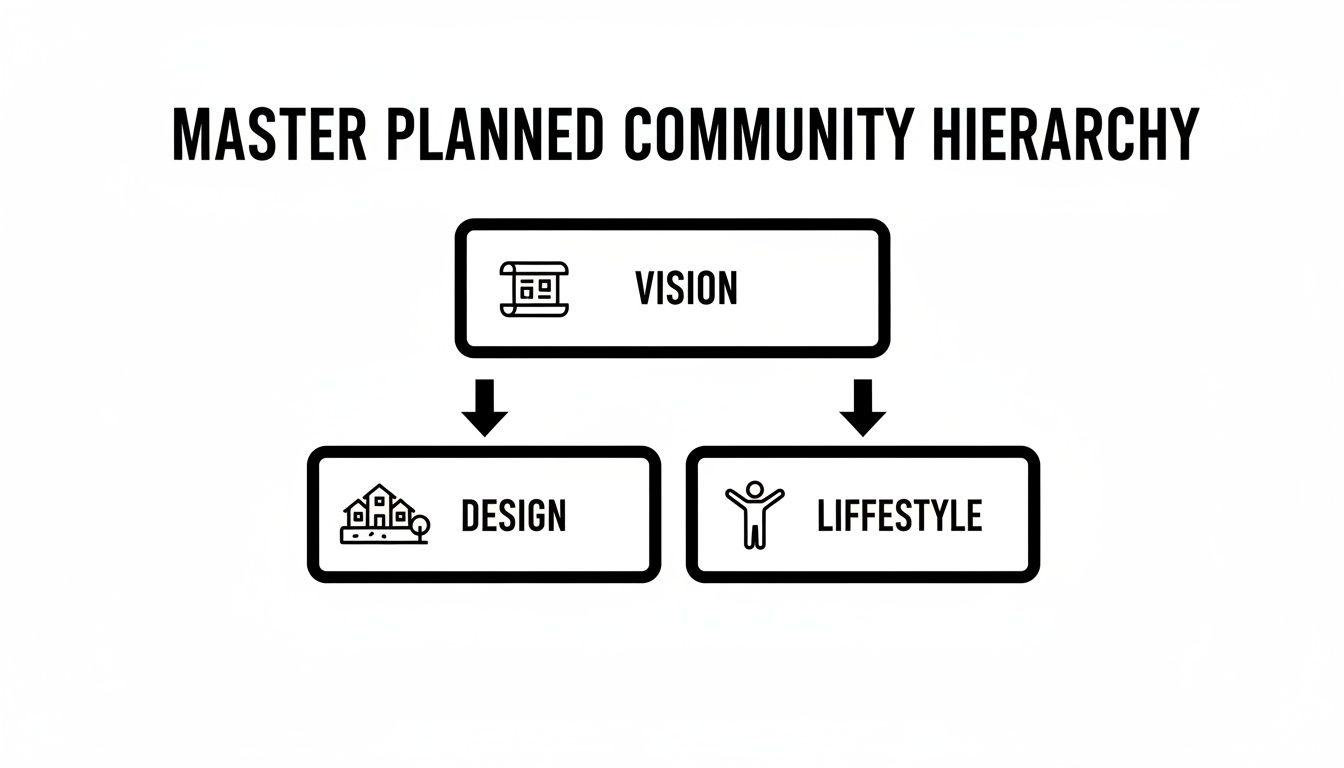
This top-down approach is designed to ensure the community’s design and amenities directly support the lifestyle it promises.
Extensive Amenities: The Lifestyle Engine
The second pillar is the insane array of amenities. This is where MPCs really flex their muscles, creating a resort-like vibe that a standard neighborhood just can’t touch. We’re not talking about a sad little playground with a couple of benches.
A master-planned community sells a lifestyle, not just a property. The amenities are the tangible, everyday proof of that promise, turning a home into a destination.
These amenities are built to be destinations in themselves, creating opportunities for neighbors to connect and live well. They often include everything from sparkling pools, state-of-the-art gyms, and community clubhouses to more lavish features like private lakes, championship golf courses, and miles of interconnected hiking and biking trails.
Phased Development: Strategic Growth
You don’t build a mini-city overnight. That’s where the third pillar, phased development, comes in. MPCs are built in strategic stages, often over many years, even decades. This allows developers to react to market shifts, introduce new home designs, and make sure infrastructure keeps pace with the growing population.
For a homebuyer, this means you can often find brand-new construction even in a community that’s been around for a while. Each new phase might bring in different builders, updated floor plans, or even a new set of neighborhood-specific amenities, keeping the entire community feeling fresh and dynamic.
Governance and HOAs: The Vision Keepers
Finally, the fourth pillar is the system of governance, usually managed by a Homeowners Association (HOA). The HOA is the enforcer, the entity responsible for upholding the original vision of the master plan long after the developer is gone. While HOAs can get a bad rap, in an MPC, their role is non-negotiable.
They manage and maintain all those amazing common areas and amenities—the pools, parks, and clubhouses—ensuring they stay in pristine condition. They also enforce the community’s covenants and restrictions, which is critical for protecting property values by maintaining a consistent look and standard of care throughout the neighborhood.
Historically, MPCs evolved from the mid-20th-century “new towns” designed to be an escape from urban chaos. Today, they’re essentially planned unit developments (PUDs) on a mega-scale. A PUD might be a small cluster of homes with a shared green space, but an MPC is a complete mini-city spanning thousands of acres. You can dig deeper into the history and scale of MPCs on Planetizen, which does a great job explaining the distinction.
Weighing the Pros and Cons of MPC Living
Life inside a master-planned community can feel like a permanent vacation, but let’s be real—is it the right fit for everyone? The answer comes down to a clear-eyed look at the trade-offs. It’s a fantastic lifestyle, no doubt, but it comes with a very specific set of rules and costs.
Let’s get into the good, the not-so-good, and the things that might drive you crazy, so you get the full picture.
The Upside: The Perks of Planned Perfection
The most obvious draw of an MPC is the access to incredible amenities. We’re talking resort-style pools, legit fitness centers, community clubhouses, and miles of perfect walking trails—all literally steps from your front door. The developer foots the massive initial bill, giving residents a lifestyle that would be impossible to create on their own.
But it’s more than just the bells and whistles. There’s a powerful, built-in sense of community. These neighborhoods are designed from the ground up to bring people together, with planned social events, farmers’ markets, and shared spaces that actually encourage you to meet your neighbors. This can be a huge plus for anyone new to an area or just looking to build connections.
Finally, those strict design standards and the HOA aren’t just for show; they actively work to protect property values. That predictable, well-kept aesthetic ensures the entire neighborhood stays desirable for years to come, offering a stability that’s tough to find elsewhere. Many MPCs also feature robust HOA security solutions, adding another layer of safety and peace of mind.
A master-planned community offers a compelling trade: you exchange a degree of personal freedom for a higher baseline of quality, security, and community. For many, this structure is exactly what provides an elevated, worry-free daily life.
The Downside: The Reality Behind the Resort Lifestyle
Now for the flip side. All those amazing amenities and perfectly manicured lawns come with a price tag, specifically HOA fees. These monthly or annual dues can be significant, covering everything from pool chemicals to landscaping crews and security patrols. You absolutely have to factor these recurring, non-negotiable costs into your budget.
This brings us to the rules. The HOA’s Covenants, Conditions, and Restrictions (CC&Rs) dictate a surprising amount of what you can and can’t do with the property you own.
- Exterior Modifications: Thinking of painting your front door a fun color or putting up a new fence? You’ll almost certainly need to get approval first.
- Landscaping Choices: The HOA likely has a specific list of approved plants, trees, and rules about lawn ornaments.
- Parking and Storage: Forget about parking your RV or boat in the driveway. There are often strict regulations on where extra or oversized vehicles can be stored.
For some, these rules create a uniform, “cookie-cutter” feel that feels restrictive. If you value total creative freedom over your property, the structured nature of an MPC might feel stifling. This trade-off is a key point to consider when you explore the pros and cons of condo versus house living, as both involve community rules but on very different scales.
On top of that, because MPCs require huge tracts of land, they are often located on the suburban fringe, further from the city center. This can mean a longer commute for work or a night out—a definite trade-off for the self-contained, peaceful environment they provide. You have to be honest with yourself: is the convenience of on-site amenities worth the potential inconvenience of a longer drive?
MPC vs. Subdivision: Unpacking the Key Differences
It’s easy to drive by a new development and lump it all into one category. But for a savvy homebuyer, drawing a hard line between a Master-Planned Community (MPC) and a typical subdivision isn’t just semantics—it’s a fundamental gap in philosophy, scale, and the lifestyle you’re buying into.
Think of it this way: a standard subdivision is like a playlist of random hit songs. Sure, they’re all houses, but they were likely built by different people at different times with no unifying theme. An MPC, on the other hand, is a concept album. Every single track—every park, home, and storefront—contributes to a larger, cohesive story.
Scope and Scale
The most glaring difference is the sheer scale and vision. A subdivision is almost exclusively residential, a collection of homes carved out of a piece of land. Its purpose really begins and ends with putting roofs over heads.
Master-planned communities are designed from the ground up to be miniature towns. They are born from a long-term vision that weaves together homes, shops, parks, and schools to create a self-sufficient ecosystem. They’re built to feel complete.
A subdivision is a place to live. A master-planned community is a way to live. The vision extends far beyond the property line, aiming to create a whole, integrated lifestyle for its residents.
This massive scale is what makes the whole thing work. Sprawling across 2,500 to 10,000 acres or more, these developments are meticulously orchestrated by a single developer to deliver a true live-work-play vibe. It’s a level of planning you just don’t see otherwise, a point driven home in expert reports like JBREC’s latest analysis of top communities.
Amenities and Lifestyle
This difference in scale flows directly into the amenities. If you’re lucky, a subdivision might have a small neighborhood park or a community pool. But in an MPC, the amenities are a cornerstone of the entire value proposition.
We’re talking resort-style pools, state-of-the-art fitness centers, community event lawns, extensive trail networks, and sometimes even golf courses or private lakes. These aren’t just perks; they’re core infrastructure designed to build a real community and genuinely enhance daily life.
To make the distinction crystal clear, let’s break it down head-to-head.
MPC vs. Subdivision: A Head-to-Head Comparison
This table cuts right to the chase, showing how these two development types stack up on the features that matter most to a homebuyer.
| Feature | Master-Planned Community (MPC) | Traditional Subdivision |
|---|---|---|
| Primary Goal | Create a complete, self-contained lifestyle and community. | Provide housing units in a residential-only area. |
| Scale | Vast, often thousands of acres with phased, long-term development. | Limited, typically focused on a single parcel of land. |
| Land Use | Mixed-use: residential, commercial, retail, and recreational. | Almost exclusively residential with minimal common space. |
| Amenities | Extensive and high-quality: clubhouses, pools, parks, trails, etc. | Minimal or non-existent; maybe a small park or playground. |
| Governance | Managed by a robust HOA to maintain the master vision. | May have a basic HOA, but with a much narrower focus. |
For anyone buying in a competitive market like Los Angeles, understanding this distinction is everything. It’s the difference between buying a house and investing in a fully curated lifestyle.
How MPCs Perform as a Real Estate Investment
Forget the resort-style pools and perfect landscaping for a minute. Let’s talk brass tacks. Are these communities actually a good investment? For anyone looking at real estate as a financial move—whether you’re a homebuyer or a seasoned investor—the answer is baked right into the MPC model.
The whole point of an MPC is long-term stability and value. The combination of controlled development, high-end amenities, and a strong HOA creates an environment where property values are just more resilient. Think about it. In a standard neighborhood, one neglected house with an overgrown yard can drag down the whole street. In an MPC, the strict aesthetic and maintenance standards act as a built-in insurance policy for your investment. That control creates predictability, and predictability drives steady appreciation.
The Demographic Edge
MPCs don’t just build houses; they build a specific kind of neighborhood that attracts a certain type of resident. These communities are magnets for people with higher-than-average incomes and education levels, which creates an affluent and stable consumer base. This demographic gravity makes the community’s own commercial and retail spaces more successful, building a self-sustaining economic ecosystem right where you live.
When you dig into the numbers, you see that MPCs essentially curate enclaves of educated, high-earning residents that often outperform the surrounding areas. It’s not uncommon to see a huge gap in educational attainment. One study, for instance, found that 63% of MPC residents had a bachelor’s degree, blowing past the local area’s 49% and the wider metro’s 41%. This is a powerful signal. You can learn more about the economic performance of master planned communities and see these trends for yourself.
Performance Metrics for Investors
If you’re looking at an MPC property strictly through an investment lens, the rental numbers are where it gets really interesting. All the things that pull in homeowners—the safety, the amenities, the lifestyle—also attract high-quality tenants who are usually willing to pay more for it. The result is strong rental demand and lower vacancy rates compared to properties just down the road.
An investor isn’t just buying a single-family rental in an MPC. They’re buying a rental unit packaged with a resort lifestyle, a built-in community, and a governance structure that protects its long-term appeal.
Here’s a real-world example from the Eastmark MPC in Phoenix. Multifamily rents there averaged 19% higher than in the neighboring cities of Mesa, Chandler, and Gilbert. Even better, its vacancy rate was a razor-thin 5.7%, while the surrounding areas averaged 8.9% and the entire Phoenix metro sat at 11.1%.
The data tells a clear story: the curated environment of an MPC can translate directly into better financial performance. That’s a massive advantage for anyone using Los Angeles real estate to build wealth. To really get into the weeds of evaluating a deal, check out our guide on how to conduct a real estate investment property analysis. The principles in there are exactly what you need when weighing the unique value of a home inside a master planned community.
Finding Master Planned Communities Around Los Angeles
All this talk about master plans and amenities is great, but what does it actually look like on the ground? Southern California is a breeding ground for these kinds of developments, with some of the most famous examples in the country. Let’s get tangible and explore a few of the big names around the greater Los Angeles area to give you a real feel for what they offer.
Just a heads-up: We’re steering clear of subjective labels to comply with Federal Fair Housing guidelines. Instead, we’ll stick to the facts—the features, the character, and the objective details that make each place what it is. This isn’t about crowning a “best” community, but about showing you the different flavors of MPC living available. From the manicured hills of Orange County to the sprawling valleys up in Santa Clarita, each one puts its own spin on the live-work-play concept.
Orange County Communities
Orange County is often seen as the heart of MPC development in SoCal. It’s home to some of the largest and most established communities you’ll find anywhere. These aren’t just subdivisions; they’re practically cities in their own right, complete with their own school districts, massive shopping centers, and an almost overwhelming list of things to do.
The most famous example is Irvine, which is essentially a city built from a collection of interconnected master-planned “villages.”
- Distinct Villages: Each village, whether it’s Woodbury or Portola Springs, has its own architectural vibe, its own parks, and its own schools. It creates this unique small-town atmosphere inside a much larger, cohesive city.
- Integrated Green Space: Irvine is famous for its commitment to open space. Thousands of acres are dedicated to parks, trails, and nature preserves, all woven directly between the residential areas.
- Business Hubs: Unlike many MPCs that are little more than bedroom communities, Irvine is also a major business and tech center. It truly delivers on the “live, work, and play” promise.
Another heavy hitter is Rancho Mission Viejo in South Orange County. It’s making a name for itself by focusing on multi-generational living and preserving huge swaths of open space called “The Reserve.”
Santa Clarita Valley and Beyond
If you head north of LA, the Santa Clarita Valley has exploded with new master-planned communities. These developments tend to attract people looking for more breathing room and a closer connection to nature, but who still need to commute into LA for work.
Take a place like Valencia. It was one of the first true MPCs in the region and has just kept growing. It’s known for its “paseos,” a network of walking and biking paths that connect homes to schools and parks. You can get around a huge chunk of the community without ever getting in your car.
The core promise of these communities is consistency and a high quality of life. The master plan is a guarantee that the parks you love today will still be there in twenty years, and the community’s character is protected by that shared vision.
For those willing to venture further east into the Inland Empire, communities like Ontario Ranch represent the next evolution of the MPC model. It’s one of the largest in Southern California, covering over 8,000 acres, and was built from the ground up with “gigabit” internet infrastructure. This focus on tech, combined with a huge variety of new homes, shows where the modern MPC is headed.
Getting to know these different examples can help you figure out what you’re really looking for. Your real estate agent can also give you more context on the areas surrounding these unique communities and help you find the one that matches your lifestyle.
Your Top Questions, Answered
If you’ve still got questions, you’re in good company. Thinking about a master-planned community is a big decision, and it’s smart to dig into the details. Let’s cut through the jargon and get straight to the answers buyers like you ask most.
This is your final gut-check before you dive in. Here are the real-world insights you need to feel confident about whatever you decide.
Are the High HOA Fees Actually Worth It?
It really boils down to what you’re paying for. Yes, HOA fees in a master-planned community (MPC) are almost always higher than in a typical subdivision. But you’re not just paying for someone to mow the grass in the common areas. You’re funding an entire lifestyle.
That monthly fee is what keeps the resort-style pools sparkling, the gym stocked with modern equipment, the parks immaculate, and the community events calendar full. It’s what pays for the meticulous upkeep that makes the whole place feel special.
Think of it this way: it’s a recurring cost, for sure, but it’s also the engine that protects the community’s unique vibe and works to keep property values stable for everyone.
You’re buying into convenience, quality, and a built-in social scene. For a lot of people, that’s a trade-off they’re happy to make.
How Much Can I Really Customize My Home?
Inside, your home is your kingdom. Go wild. The exterior, however, is part of a bigger picture. MPCs sell a dream of a cohesive, beautifully designed neighborhood, and that dream is protected by some pretty strict architectural rules.
You’ll still get plenty of ways to make the home your own from the builder’s menu:
- Multiple layouts and floor plans to choose from
- A curated selection of exterior color palettes
- Different upgrade packages for everything from flooring to kitchen fixtures
But you’re not going to be able to paint your house bright purple or add a second story on a whim. It’s the classic compromise: you give up a bit of your outer creative freedom in exchange for the long-term benefit of living in a neighborhood that always looks fantastic. That consistency is what props up everyone’s property values.
Are MPCs Just for Families With Kids?
That’s one of the biggest misconceptions out there, and it’s completely outdated. The new generation of MPCs is built for everyone. Seriously. Developers have gotten savvy and now design these communities to be multi-generational hotspots.
You’ll find dedicated 55+ active adult enclaves, sleek townhomes perfect for young professionals, and even stylish, low-maintenance condos that appeal to singles and empty-nesters. The whole “live-work-play” idea isn’t just for families—it’s for anyone who values convenience, amenities, and a real sense of community, no matter where they are in life.
Navigating the Los Angeles real estate market is complex, but you don’t have to do it alone. A knowledgeable real estate agent lives and breathes this stuff, and they’re here to help you find the right fit, whether it’s in a sprawling master-planned community or a hidden gem of a neighborhood. Start the conversation with us at https://www.acme-re.com.