
You did it. You survived the LA house hunt, your offer got the thumbs-up, and now you’re staring down the final stretch. This is the house closing process—or as we call it in California, escrow. Forget the idea of a single meeting where you sign one paper. This is the grand, carefully choreographed finale where the keys, the cash, and the deed all find their way to the right hands.
Think of it this way: your purchase agreement was a list of promises. Escrow is where every single one of those promises gets turned into reality, all under the watchful eye of a neutral third party who makes sure nobody gets burned.
The Grand Finale Of Your Home Purchase
The closing process is the engine room of your home purchase, where all the gritty, behind-the-scenes work happens to make that house legally yours. You’ve already ridden the emotional rollercoaster of open houses and negotiations. Now, it’s all about execution—a series of airtight steps designed to deliver a clean, legal transfer of property.
Here in California, this whole show is run by an escrow officer. They’re the impartial referee holding onto the deposit money, the loan funds, and all the critical documents. They don’t release a single thing until every last condition in your contract is met. This system isn’t just red tape; it’s a fortress built to protect everyone involved—you, the seller, and your lender.
Your Closing Team: Who’s Doing What
While your ACME Real Estate agent is the director of this production—quarterbacking the team and shielding your interests—a few other key players are busting their humps to get you those keys. Knowing who’s who and what they do demystifies the entire operation.
Here’s your closing-day crew:
- Escrow Officer: The impartial manager of the whole transaction. They handle the money, prepare closing documents, and make sure every box is ticked before the property officially changes hands.
- Lender/Mortgage Broker: The financial engine of your purchase. Their team finalizes the underwriting of your loan, draws up the final loan documents for you to sign, and wires the funds needed to seal the deal.
- Title Company: Think of them as the property’s private investigator and insurance provider. They dig through public records to make sure there are no hidden claims or liens on the property (this is called ensuring a “clear title”). Then, they issue title insurance to protect you and the lender from any future ownership disputes.
- Appraiser: An independent pro hired by your lender to confirm the home’s fair market value. This is a critical step that ensures the property is actually worth the price you’ve agreed to pay.
Understanding these roles helps make sense of what can feel like a mountain of paperwork and jargon. While there are many general real estate considerations, our team at ACME makes sure you always know who’s handling what and what’s coming next. For a much deeper dive into this part of the journey, we’ve broken down the entire escrow process in our detailed guide.
Your Closing Timeline From Offer To Keys
That moment your offer gets accepted is pure adrenaline. But it’s also the starting gun for the real race. Closing on a house isn’t a single event; it’s a 30 to 45-day marathon of moving parts, tight deadlines, and critical decisions. Think of it less like signing a paper and more like a carefully choreographed mission to launch you into homeownership.
This timeline is your game plan. We’re going to walk through the entire journey, from the “Congratulations!” call to the moment you get the keys, so you’re never left wondering what’s happening or what’s next.
Week 1: Opening Escrow And Kicking Off Due Diligence
The second the seller accepts your offer, your agent swings into action and opens escrow. This is the official start of the closing process. Your first big task is wiring your earnest money deposit, usually 1-3% of the purchase price, to the escrow company. This isn’t just a formality; it shows the seller you’re serious and puts some real skin in the game. That money is held safely by a neutral third party until closing.
At the same time, you’ll dive headfirst into your due diligence period. This is your chance to get under the hood of the property and find out what you’re really buying. The most important move you’ll make here is scheduling a professional home inspection. Seriously, don’t skip this. It’s your single best defense against discovering ugly, expensive surprises after it’s too late.
Key moves in Week 1:
- Sign the Purchase Agreement: Get the official contract signed and sealed.
- Wire Your Earnest Money: Transfer the deposit to the escrow holder.
- Schedule Inspections: Book the general home inspection plus any others you might need, like termite, sewer, or chimney inspections.
Weeks 2-3: Navigating Inspections And Appraisals
This is where things get interesting. The home inspection report will hit your inbox—a thick document detailing everything from minor cosmetic issues to potentially major problems with the foundation or roof. Don’t freak out. No home is perfect. Your agent is there to help you read between the lines and figure out what’s a big deal and what’s not.
Based on that report, you might send the seller a repair request. This can be one of the most intense negotiations of the whole deal. While that’s happening, your lender orders a home appraisal to make sure the house is actually worth the price you’ve agreed to pay. You can learn more about navigating the due diligence period and what to look for in our dedicated guide.
Week 4: Surviving The Underwriting Maze
Once inspections and the appraisal are done, your loan file gets handed over to the underwriter. This is the person who acts as the final gatekeeper for your mortgage, the financial detective who gives the ultimate “yes” or “no.” They will comb through every detail of your financial life—your income, your savings, your debts, your credit history. Everything.
During this week, you need to be a financial ghost. Don’t make any big purchases, don’t open new credit cards, and for goodness’ sake, don’t change jobs. The underwriter will almost certainly come back with “conditions,” which are just requests for more documents or explanations. Get them what they need, fast. Any delay here can push back your closing date.
Week 5: The Final Countdown To Closing
You’re in the home stretch. This week is all about final preparations. You’ll need to lock in your homeowner’s insurance policy, because your lender won’t fund the loan without proof of coverage. You’ll also get one of the most important documents in the entire process: the Closing Disclosure (CD). By law, you must receive this at least three business days before you sign.
Go over this document line by line with your agent. It breaks down all your final loan terms, your monthly payment, and every single closing cost. Make sure it matches the Loan Estimate you got at the beginning. This is also when you’ll get your final cash-to-close amount and arrange for a cashier’s check or a wire transfer to cover your down payment and closing costs.
Your very last step before signing is the final walkthrough, usually done 24-48 hours before closing. This is your chance to make sure the property is in the same condition as when you made your offer and that the seller completed any agreed-upon repairs. It’s the final check before you sign on the dotted line and make it yours.
Understanding Closing Costs And Your Final Bill
Let’s talk about the final bill—the one that stands between you and the keys to your new home. This part of the process, known as closing costs, can feel like a surprise pop quiz if you aren’t prepared. But it’s not meant to be mysterious. Think of it as a transparent breakdown of all the professional services needed to make your home purchase official and legally sound.
It’s a lot like the itemized receipt you get from a mechanic. You’ll see charges for parts (the title search), labor (the lender’s work), and various shop fees (escrow services). Each line item represents a real person doing a critical job to ensure your ownership is secure and your loan is properly recorded.
Decoding Your Closing Disclosure
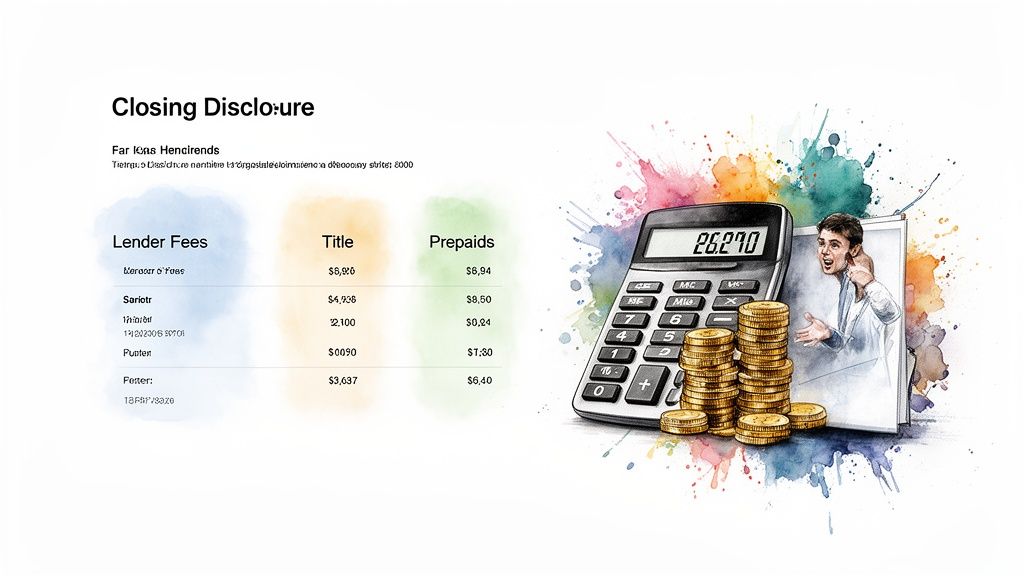
A few days before you sign your life away (just kidding… mostly), you’ll get a critical five-page document called the Closing Disclosure (CD). This is the final, official statement of your loan terms and total costs. Federal law mandates that your lender deliver this to you at least three business days before your signing appointment. This isn’t just a suggestion; it’s a crucial cooling-off period designed to give you time to review everything without pressure. Do not just skim this document. It’s your money on the line.
While the CD can look intimidating, the fees typically fall into three buckets:
- Lender Fees: These are the costs your mortgage provider charges for originating the loan. Think origination fees, appraisal costs, credit report fees, and underwriting charges.
- Third-Party Fees: This covers all the other professionals involved. It includes title search fees, title insurance premiums (for both you and the lender), and the escrow company’s fee for acting as the neutral third party.
- Prepaid Items & Reserves: This is money you pay upfront for future bills. It covers your first year of homeowner’s insurance, a cushion for property taxes, and the daily interest on your loan until your first official payment kicks in.
Your Closing Disclosure is the financial blueprint for this entire transaction. The single most powerful thing you can do is compare it, line-by-line, against the initial Loan Estimate you received. This is how you catch unexpected fees or errors before they become your problem.
Estimating Your Closing Costs In Los Angeles
So, how much cash do you actually need to bring to the table? A solid rule of thumb is to budget between 2% to 5% of the home’s purchase price for closing costs.
For a $900,000 home in Los Angeles, you should plan for a range of $18,000 to $45,000. It’s a wide range because the final number hinges on your specific loan, the title company’s rates, and how property taxes are prorated.
It’s critical to remember this estimate does not include your down payment. The final “cash-to-close” amount on your CD will be your down payment plus all closing costs, minus any credits you’ve already paid (like your earnest money) or negotiated (like seller concessions).
Who Pays For What?
In a typical Los Angeles real estate deal, costs are split between buyer and seller based on local custom. Of course, everything is negotiable, but here’s how it usually shakes out.
Below is a detailed breakdown of common closing costs in our market. It’s important to understand these fees, as they represent the real, tangible work being done behind the scenes to protect your investment.
Common Closing Costs In Los Angeles Explained
| Closing Cost Item | Who Usually Pays | Estimated Cost Or Calculation |
|---|---|---|
| Owner’s Title Insurance | Seller | ~0.2% – 0.5% of the sale price. This protects the buyer from future claims against the property’s title. |
| Lender’s Title Insurance | Buyer | ~0.2% – 0.5% of the loan amount. Required by the lender to protect their interest in the property. |
| Escrow Fee | Split 50/50 | Typically $2.00 per $1,000 of the sale price, plus a base fee of ~$250 per side. |
| Loan Origination Fee | Buyer | 0.5% – 1% of the loan amount. This is the lender’s fee for processing and underwriting the loan. |
| Appraisal Fee | Buyer | $600 – $900. An independent appraiser confirms the home’s value for the lender. |
| County & City Transfer Taxes | Seller | Varies by location. LA County is $1.10 per $1,000. City of LA adds $4.50 per $1,000. |
| Real Estate Commissions | Seller | Usually 5% – 6% of the sale price, split between the buyer’s and seller’s agents. |
| Recording Fees | Buyer | $100 – $250. The cost to officially record the new deed and mortgage with the county. |
While this table reflects LA customs, it’s not set in stone. Market conditions play a huge role.
A skilled agent can often find negotiating leverage that benefits you. For instance, in a slower market, getting the seller to contribute to your closing costs is a very real possibility. If you want to dive deeper into these strategies, our guide on how to negotiate closing costs can show you ways to potentially save thousands.
How To Navigate Common Closing Roadblocks
Even the most buttoned-up home purchase can hit some turbulence before landing. The final stretch to closing is where tiny issues can morph into giant hurdles, threatening to delay or even kill your deal. But knowing what might be coming turns panic into a game plan.
Think of it like flying into LAX. You might hit some air traffic, but an experienced pilot knows how to navigate it for a smooth landing. Your agent is that pilot, ready to handle the bumps in the road.
The Appraisal Gap Predicament
In a competitive market like Los Angeles, one of the most common snags is the appraisal gap. This is what happens when the bank’s appraiser decides the home is worth less than the price you agreed to pay. When that number comes in low, the lender will only approve a loan for that lower appraised value, leaving you to cover the shortfall.
Don’t panic—this isn’t an automatic deal-breaker. You’ve got a few paths forward:
- Renegotiate: We can go back to the seller and ask them to lower the price to match the new value.
- Cover the Difference: If you have the extra cash and you know the home is worth it, you can pay the difference out of pocket.
- Challenge the Appraisal: This is a long shot, but sometimes we can submit a rebuttal with better comparable sales data and get the appraiser to reconsider their valuation.
Just recently, we had a client at ACME Real Estate whose appraisal came in $25,000 short. We put together a solid case, highlighting specific features the appraiser missed, and successfully got the seller to meet us halfway. They split the difference, and we saved the deal.
Last-Minute Financing Scrambles
Your loan might feel like a sure thing, but it’s not truly final until the money is wired. Lenders can and do pull the plug at the last second. It could be a sudden drop in your credit score, an unverified source for your down payment funds, or an unexpected change in your job.
This is why we drill this into our clients: from the moment your offer is accepted until those keys are in your hand, you need to become a financial ghost.
Avoid making any large purchases, opening new credit cards, or changing jobs. The underwriter is watching your every move, and any sudden change can trigger a frantic, last-minute paper chase that can seriously delay closing day.
A simple rule of thumb? Run any potential financial change by your loan officer first, no matter how small it seems. This one habit can save you a world of stress.
When The Title Search Uncovers Ghosts
Another potential showstopper is a “cloudy” title. The title company’s job is to act like a property detective, digging through historical records to make sure the seller has the right to sell. Sometimes, they uncover ghosts from the past:
- An old, unpaid lien from a contractor.
- A surprise claim from a previous owner’s heir.
- Unpaid property taxes or an IRS lien.
These issues must be cleared before the property can legally become yours. While it’s on the seller to fix these problems, the process can drag on and cause major delays. A great agent stays on top of the title company, making sure any red flags are dealt with the second they appear so the timeline doesn’t spiral out of control.
It’s a sobering fact that a ton of deals never make it to the closing table. In July 2025, an estimated 58,000 home-purchase agreements in the U.S. were canceled, which is a staggering 15.3% of all homes that went under contract. As you can see from these housing market insights from KPMG, that means nearly one in six deals fall apart, often because of the exact roadblocks we just talked about. Having an expert team to navigate these challenges is your best defense against becoming another statistic.
Closing In The Digital Age In Los Angeles
The old picture of a closing day—a conference table buried under a mountain of paper, your hand cramping after hours of signing—is finally getting a tech overhaul, especially here in Los Angeles. The process isn’t stuck in the past anymore. It’s now a smart mix of digital speed and the essential in-person checks needed to keep everyone safe.
Think of it less like an ancient library and more like a modern bank vault. You can now upload sensitive financial documents straight to your lender and escrow officer through secure online portals. A lot of the initial paperwork can be signed from your couch using digital signature platforms.
The Rise Of The Hybrid Closing
While a completely remote closing is still pretty rare in California because of our notarization laws, the hybrid closing has become the new norm. It’s truly the best of both worlds. You’ll handle the bulk of the preliminary paperwork online, which saves a ton of time and trips across LA traffic.
Then, for the really critical documents that need a real, wet-ink signature and an in-person notary—like the deed and the mortgage note—you’ll just have one short, focused signing appointment.
Globally, technology is reshaping the final stretch of buying a home. For buyers in a place like LA, this means e-signatures and AI-powered document checks are becoming standard. This helps shrink the closing timeline from what felt like months down to a matter of weeks, all while keeping everything above board with regulators. Of course, as the closing process shifts online, knowing your way around digital documents is key.
This move to digital makes everything faster, but it also creates one massive risk you absolutely have to be prepared for.
Your Digital Fortress: Protecting Your Down Payment
The single biggest threat in any modern real estate deal is wire fraud. Scammers have become masters of impersonation. They create fake email addresses that look almost identical to your agent’s or escrow officer’s, then send you a last-minute email with “updated” wiring instructions. Their goal is to trick you into sending your life savings straight to their bank account.
Here’s the unbreakable rule: NEVER trust wiring instructions sent over email. Period. Before you transfer a single dollar, you must call your escrow officer on a phone number you know is legit—one from their official website or a number they gave you at the start of the process, not one from the suspicious email. You have to hear their voice and confirm the details.
To keep your money safe, treat these security steps as non-negotiable:
- Verify Verbally: Always, always call to confirm wiring instructions. This is the most important thing you will do to protect your down payment.
- Be Skeptical of “Urgency”: Scammers love to create a false sense of panic. Any email screaming about a last-minute change or demanding an immediate transfer is a giant red flag.
- Establish a Code Word: At the very beginning of escrow, set up a secret password with your agent and escrow officer. If you ever need to talk about sensitive info, use that code word to make sure you’re talking to the right person.
Technology has made closing on a house way more convenient, but that convenience demands that you be hyper-vigilant. At ACME Real Estate, we drill this security protocol into every single client conversation. We make it our mission to ensure your money gets exactly where it’s supposed to go—into your new home.
Your Ultimate Pre-Closing Checklist
The final week of closing can feel like a mad dash to the finish line. I’ve seen it a hundred times—buyers juggling movers, final paperwork, and a healthy dose of anxiety. But this is where a solid plan turns potential chaos into controlled confidence.
We built this checklist to cut through the noise and get you to the signing table without breaking a sweat. Think of it as your pre-flight check before you take off into homeownership. Let’s make sure you arrive completely prepared, with zero surprises.
This isn’t just some generic list; it’s your final mission briefing. Let’s get it done.
The Final Week Game Plan
In the days leading up to closing, your focus shifts from the big picture to the small details. The goal is simple: tie up every loose end so closing day is just about signing and celebrating.
- Confirm Your Cash-to-Close Amount: Look at your Closing Disclosure one last time. You need the exact dollar amount you’re on the hook for. Get in touch with your escrow officer to confirm the final figure and how they want to be paid (it’s almost always a cashier’s check or a wire transfer).
- Schedule Utility Transfers: Call the utility companies—water, gas, electric, trash, internet. Get the service transferred into your name, effective on your closing date. You don’t want to be celebrating your new home in the dark. Trust me, it happens.
- Arrange Your Final Payment: If you’re wiring the money, call your escrow officer using a number you know is legitimate to verbally confirm their instructions. Wire fraud is a massive, very real risk. Never trust wire instructions sent in an email. If you’re using a cashier’s check, grab it from your bank a day or two before you sign.
The Last 24 Hours: Final Walkthrough
This is it—your last chance to inspect the property before it’s officially yours. This isn’t another inspection; it’s a verification run. You’re making sure you’re getting what you paid for.
Your final walkthrough confirms two critical things: that the property is in the same condition as when you agreed to buy it, and that any contractually obligated repairs have been completed. It’s your final quality control check before signing on the dotted line.
During this walkthrough, make sure to:
- Check that all agreed-upon repairs are actually finished. Bring your repair request addendum with you.
- Verify that all appliances included in the sale are still there and in working order.
- Look for any new dings, scratches, or holes that might have appeared during the seller’s move-out.
- Ensure the sellers have cleared out all of their personal belongings. No old paint cans in the garage or junk in the attic.
What to Bring to the Signing Table
Your signing appointment is the grand finale. Come prepared. A simple folder with these few items is all you need to make sure everything goes off without a hitch.
Your Closing Day Carry-On:
- Government-Issued Photo ID: A valid driver’s license or passport for everyone signing the loan documents. Make sure it’s not expired!
- Your Final Payment: Bring the cashier’s check or have proof of your wire transfer ready to show.
- The Closing Disclosure: Have your copy on hand so you can reference it during the signing if you have any questions.
- Proof of Homeowners Insurance: Just in case, have your policy information handy.
The closing process has a lot of moving parts, but with ACME Real Estate on your side and this checklist in hand, you’re set. We’ve got your back, all the way to the finish line.
Burning Questions About The Closing Process
Even with the best roadmap, you’re going to have questions. This is a massive transaction, and it’s totally normal to want more clarity on the details. I’ve heard them all over the years, so let’s tackle a few of the most common ones I get from clients.
How Long Does The Closing Process Usually Take In California?
In California, a standard escrow period usually runs between 30 and 45 days. Think of this as the sweet spot for most transactions. Of course, every deal is different. If you’re coming in with an all-cash offer, you can blow through the process in as little as 10 days since you’re cutting the lender out of the equation.
On the flip side, some deals just need more time. If you’re using an FHA or VA loan, or if inspections turn up some chunky repair negotiations, you might be looking closer to 60 days. A good agent will help you nail down a realistic timeline in the purchase agreement right from the jump, so there are no surprises.
What Is A Final Walkthrough And Why Is It So Important?
The final walkthrough is exactly what it sounds like: your last chance to lay eyes on the property before it’s officially yours. It usually happens a day or two before you sign the final papers. This isn’t the time to bring in your inspector and start a new punch list; its purpose is much more targeted.
The final walkthrough is purely a verification step. You’re confirming the property is in the same condition as when you agreed to buy it, and that the seller has completed any repairs they promised to make.
This is your last line of defense against any eleventh-hour headaches. You’ll check to make sure no new damage happened while the seller was moving out and that the appliances that were supposed to stay are still there and working. Trust me, skipping this is a gamble you don’t want to take.
Can I Back Out Of The Deal Right Before Closing?
Look, you can technically walk away from a deal at any point before you sign on the dotted line. But trying to bail at the last minute can have some serious financial and legal blowback. Your power to walk away without penalty is completely tied to your contract contingencies.
If you decide to pull the plug for a reason that isn’t covered by an active contingency (like your inspection or financing contingency), you can kiss your earnest money deposit goodbye. In a worst-case scenario, the seller could even sue you for damages they suffered because you broke the contract.
It’s absolutely critical to know your contingency deadlines and to talk to your agent about any cold feet or major concerns before those safety nets expire. That way, you’re making decisions from a position of strength, not panic.
Navigating the wild ride of a house closing process demands an expert who lives and breathes the Los Angeles market. At ACME Real Estate, we make sure every question gets a straight answer and every detail is buttoned up, getting you from offer to keys without the drama. Start your confident home-buying journey with us today.