
Trying to navigate the Los Angeles real estate market can feel like deciphering a secret code. One of the most common—and most misunderstood—terms you’ll run into is “contingent.” A contingent offer isn’t a maybe; it’s a strategic move with built-in escape hatches.
Think of it as an ‘if-then’ deal: ‘I’ll buy your house IF these specific things check out.’
What ‘Contingent’ Really Means
When an offer is accepted with contingencies, it’s like putting a deal on hold while you do your homework. These conditions give you a legal and financial exit ramp if something unexpected pops up before closing. You’re not locked in. You’re protected.
This is absolutely critical in a market as fast and complex as Los Angeles. It’s not just a handshake deal; these conditions are spelled out in black and white in the legal paperwork. You can see exactly how these contracts are structured in our deep dive on what is a purchase and sale agreement.
Why This Is Your Best Friend in a Deal
At its core, a contingency is your personal due diligence checklist, baked right into the contract. It ensures you don’t get stuck buying a property with major, undisclosed problems.
Here are the most common safety nets buyers build into their offers:
- Financing: The deal only moves forward if your lender gives the final thumbs-up on the loan.
- Appraisal: The property has to appraise for at least the price you offered to pay. No overpaying.
- Inspection: A thorough home inspection can’t uncover any catastrophic defects you’re not willing to accept.
- Sale of Your Home: You need to successfully sell your current place to free up the funds for the new one.
Understanding the power of the ‘contingent’ status is non-negotiable. It’s also worth noting that a killer property listing, with great visuals, often attracts stronger offers in the first place. In short, a contingent offer shifts the risk from your shoulders back onto the deal itself. It turns what could be a terrifying, all-or-nothing leap into a smart, calculated process, giving you the confidence to move forward.
Our job is to cut through the jargon so you can make decisions that build wealth, whether you’re buying a starter condo in Silver Lake or selling a family estate in the Valley.
The Four Key Contingencies LA Homebuyers Must Know
Think of these four contingencies as your personal protection detail in a real estate deal. Each one has a specific job: to guard your money, your interests, and your sanity. Let’s break down the playbook for the most critical clauses you’ll encounter when buying a home in Los Angeles.
The Inspection Contingency: Your Get-Out-of-Jail-Free Card
First up is the inspection contingency, which is basically your all-access pass to kick the tires on the property. This clause gives you a set window—usually 7-17 days in LA—to bring in licensed professionals to scrutinize the home’s bones, its systems, and its overall health. It’s your one shot to uncover hidden nightmares, from a leaky roof on a Studio City bungalow to foundation cracks in a Hollywood Hills gem.
If the inspection turns up problems you can’t live with, you’ve got options. You can ask the seller for repairs, negotiate a credit to cover future costs, or—if the issues are just too big—you can walk away from the whole deal with your earnest money deposit safely back in your pocket. This is your most powerful tool. For a deeper dive into this critical phase, check out our guide on the due diligence period.
This visual shows how a contingent offer works—it’s a deal, but only if certain conditions are met first.
It’s not a done deal until those conditions, like a clean inspection report, are officially cleared.
The Appraisal Contingency: The Reality Check
Next is the appraisal contingency, which is the official reality check. Your mortgage lender requires an independent appraiser to confirm the home’s fair market value. This is non-negotiable for them; a bank won’t lend you more money than a property is actually worth. Plain and simple.
This contingency is what protects you from overpaying. If the appraisal comes in lower than your offer price, you’re not suddenly on the hook to cover a massive gap out of your own pocket. You can go back to the seller to renegotiate the price, or you can cancel the contract.
The Financing Contingency: Your Financial Safety Net
The financing contingency is your ultimate financial safety valve. Even with a solid pre-approval, things can go sideways during the final underwriting process. This clause makes the entire deal conditional on you actually securing the mortgage you planned on.
If your loan falls through at the last minute for some reason—maybe a sudden change in your credit score or a shift in the lender’s policies—this contingency lets you back out without losing your deposit. Without it, you could be legally obligated to buy a house you can no longer afford. It’s a massive risk.
The Home Sale Contingency: The Domino Clause
Finally, there’s the home sale contingency. This one is straightforward but can be a tough sell in a competitive market like LA. It makes your offer to buy a new home dependent on the successful sale of your current one. It’s the necessary “domino clause” for anyone who needs the equity from their old home to close on the new one.
While it’s essential protection for many buyers, sellers often see this as the riskiest of the bunch because it ties their fate to a completely separate transaction they can’t control. A skilled agent knows how to structure this clause to give you the protection you need while still making your offer compelling to the seller.
To tie this all together, here’s a quick breakdown of how these contingencies typically play out in a Los Angeles transaction.
A Quick Guide to Real Estate Contingencies
| Contingency Type | Its Primary Purpose | Typical Timeline in LA |
|---|---|---|
| Inspection | To uncover physical defects and give the buyer an “out” if major issues are found. | 7-17 days from offer acceptance |
| Appraisal | To ensure the property’s value is at or above the purchase price, protecting both buyer and lender. | 17 days from offer acceptance |
| Financing (Loan) | To allow the buyer to cancel the contract if they are unable to secure a mortgage. | 21 days from offer acceptance |
| Sale of Buyer’s Home | To make the purchase conditional on the buyer successfully selling their current property. | 30-60 days (highly negotiable) |
Remember, these timelines are a starting point. In the fast-paced LA market, everything is negotiable, and a strong offer often involves tightening these windows to show the seller you mean business.
Why Sellers Get Nervous About Contingent Offers
Now, let’s flip the script and step into the seller’s shoes for a moment. In a sizzling market like Los Angeles, an offer loaded with contingencies can make a seller’s eye twitch. Why the hesitation? It all boils down to one powerful word: uncertainty.
Each contingency is a potential off-ramp for the buyer, a legal escape hatch that introduces risk and drags out the timeline. For a seller who is also trying to buy their next home in a competitive spot like Pasadena or Santa Monica, time is everything. A deal that falls through isn’t just a minor setback; it’s a major disruption that can derail their own plans.
Plus, having to put a property back on the market after a deal collapses looks bad. It creates a stigma. Other potential buyers start asking, “What’s wrong with the place?” This almost always leads to lower offers down the line and a longer, more expensive selling process.
The Power of a Clean Offer
When multiple offers are the norm, sellers are in the driver’s seat. They can afford to be picky, and a “clean” offer—one with few or no contingencies—is often the most attractive, even if it isn’t the highest price. It represents a smoother, faster, and more certain path to closing.
A seller’s biggest fear is the deal falling through at the last minute. The most common reasons for homebuyers canceling deals are directly tied to unmet conditions, so a clean offer erases that anxiety.
This preference for certainty is amplified by the current market. With new listings declining 1.4% month over month in December to their lowest seasonally adjusted level since January, sellers have all the leverage. This dynamic is especially true in Los Angeles, allowing them to be incredibly selective.
Navigating Seller Psychology
Understanding this perspective is crucial for any buyer who needs to include contingencies. It’s not that sellers are being difficult; they’re just trying to minimize their own risk in a high-stakes game.
A seller’s goal is a seamless transaction. Anything that introduces a ‘what if’ scenario—like a financing or home sale contingency—immediately raises a red flag and puts an otherwise strong offer at a disadvantage.
To compete, your offer has to address this anxiety head-on. This usually means strengthening other parts of your proposal—offering a higher price, putting down a larger earnest money deposit, or being flexible on the closing date. It’s about balancing your need for protection with the seller’s deep-seated desire for a done deal.
Contingent vs. Pending: What’s the Real Difference?
The path from an accepted offer to getting the keys has its own language, and two of the most confused terms are contingent and pending. If you don’t know the difference, you can’t tell if a house is truly off the market or just on a trial run.
Getting these terms straight is essential to understanding a property’s actual availability—and your chances of swooping in.
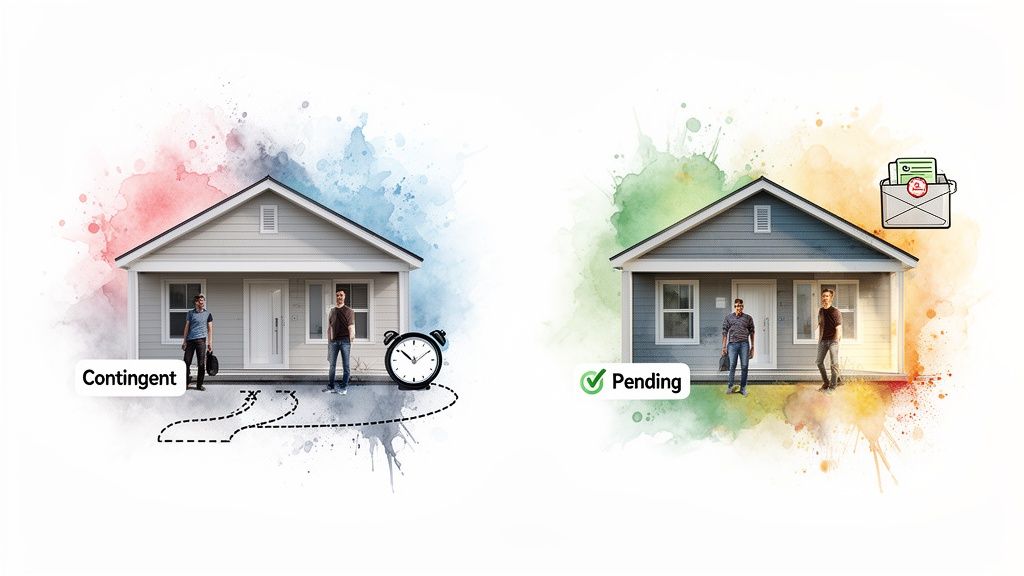
Let’s break it down with a simple dating analogy. Think of a contingent property as being “in a relationship.” Sure, they’ve signed a contract and things look serious, but there are still some big “what ifs”—the contingencies—that need to be sorted out before anyone commits for the long haul.
The Contingent Status: The Deal’s Still on Probation
A contingent listing means there’s a live deal, but it’s stuck in a trial period. The buyer is hustling to get inspections done, lock in their final loan approval, or make sure the appraisal comes in at value. This is when a deal is most fragile.
You’ll often spot a variation called “Active Under Contract.” This is a signal from the seller that says, “Yes, I have an offer, but I’m not closing the door.” They are actively encouraging showings and backup offers just in case the current buyer flakes.
For a buyer who missed out, a contingent status—especially Active Under Contract—is your cue to stay close. If even one of the buyer’s conditions falls through, that house can pop right back on the market.
The Pending Status: It’s Almost a Done Deal
If contingent is “in a relationship,” then pending is “engaged to be married.” All the big hurdles have been cleared, the conditions have been met, and everyone is just waiting for the closing date. All contingencies are gone, legally binding both buyer and seller to finish the deal.
At this point, the sale is about as solid as it gets. A deal rarely falls apart during the pending phase unless something catastrophic happens, like the buyer loses their job at the last minute or a massive title issue is discovered. You can technically still submit a backup offer, but your chances are next to zero.
Knowing the difference here is everything. A contingent listing is a deal with an escape hatch still open, offering a glimmer of hope for other buyers. A pending listing, however, is a deal that’s pretty much signed, sealed, and delivered.
How to Win with a Contingent Offer in Los Angeles
Let’s be real: trying to win in a market as savage as Los Angeles with an offer that has strings attached feels like a long shot. But this is where the art of the deal comes in. It’s a mix of raw strategy, a little finesse, and knowing the local scene inside and out. The goal isn’t to ditch your protections; it’s about making the rest of your offer so sweet the seller forgets their anxiety.

It all comes down to balancing your need for a safety net with the seller’s deep-seated craving for certainty. A sharp agent is your most powerful weapon here, someone who can craft terms that make your offer shine, even with contingencies.
Strengthen Your Offer Beyond the Price
When you’re making a contingent in real estate offer, you have to overcompensate by making every other term irresistible. You need to prove you’re a serious, motivated, and reliable buyer who isn’t going to flake.
Here are a few tactics that actually move the needle in the LA market:
- Go Big on the Earnest Money Deposit: Putting more skin in the game screams confidence. Offering 3% or more instead of the usual 1-2% is a powerful signal. It tells the seller you’re all in and won’t walk away over something small.
- Crush Your Contingency Timelines: Can your lender rush the appraisal and get it done in 14 days instead of 21? Can you line up inspectors to get everything done in a week? A tighter timeline shrinks the window of uncertainty for the seller, making your offer look much stronger.
- Write a Killer Offer Letter: This is a city built on storytelling, and your story can absolutely make a difference. Connect with the sellers. Tell them why you fell in love with their home and help them picture your life there. Sometimes, that personal touch is the tiebreaker.
Get Creative with Seller-Friendly Clauses
Another pro move is to build terms into the offer that protect the seller. It shows you get it—you understand their position and you’re willing to meet them halfway. One of the best tools for this is the “kick-out clause.”
A kick-out clause is a brilliant compromise. It lets the seller accept your contingent offer but gives them the right to keep marketing their property. If a better, non-contingent offer comes along, they give you a fixed amount of time (usually 24-72 hours) to either remove your contingencies or they can “kick you out” and take the new deal.
This gives the seller their own safety net, making them far more comfortable with the risk of your home sale or financing contingency. This strategy is especially smart as market dynamics shift. For instance, with some analysts expecting homeownership rates to dip while multifamily demand stays strong, understanding these broader investment trends is crucial. You can read more about these real estate outlooks to see how larger market forces might influence a seller’s thinking.
Winning with a contingent offer in Los Angeles is an art form. It takes a sharp strategy, crystal-clear communication, and an agent who knows exactly how to structure a deal that feels like a win for everyone at the table.
Common Questions About Real Estate Contingencies
Even with a solid game plan, the world of real estate contingencies can feel like it has a million little quirks. We get it. Here are the straight-up, no-fluff answers to the most common questions we hear from clients about navigating a contingent in real estate deal in Los Angeles.
This is your cheat sheet to clear up any lingering confusion so you can move forward with total confidence.
Can I Make an Offer on a House That Is Contingent?
Yes, and you absolutely should if you love the house. This is called a backup offer.
Think of it as officially calling “dibs.” If the first deal crashes and burns because a contingency isn’t met—which happens more often than you’d think—your offer can slide right into first place without the property ever hitting the market again.
In a competitive scene like LA’s, being the next in line with a strong, ready-to-go offer is a seriously smart play. A skilled agent can help you structure it to be irresistible to the seller while keeping your own essential protections locked in.
How Long Do Contingency Periods Usually Last?
While every deal is negotiable, there are some standard timelines here in Los Angeles.
The inspection period is usually the shortest, often around 7 to 10 days. A financing contingency needs more runway for the lender’s underwriting process, so that typically lands around 17 to 21 days.
The home sale contingency is the real wild card. It can stretch out for 30 to 60 days, sometimes even longer, depending on the market and how flexible the seller is feeling. Just remember, in a seller-favored market, buyers often propose shorter periods to make their offers more appealing and show they’re ready to move.
The key takeaway is this: time is money. A shorter contingency period reduces the seller’s uncertainty and risk, making your offer more powerful. It’s a negotiation tool, just like the price.
What Happens If a Contingency Is Not Met?
This is where these clauses prove their worth. If a contingency isn’t satisfied within the agreed-upon timeframe and you can’t work out a new solution with the seller, the buyer typically has the right to cancel the contract and get their earnest money deposit back, in full.
For example, if the appraisal comes in low and the seller refuses to drop the price, the appraisal contingency acts as your eject button. You can legally walk away without penalty. To get a better handle on this specific protection, you can learn more about what is an appraisal contingency in our detailed guide. It’s your contractual right to say, “The terms have changed, and this deal no longer works for me.”
Should I Waive Contingencies to Win a Bidding War?
This is the nuclear option. Waiving contingencies can make your offer feel like a cash deal—it’s incredibly powerful in a bidding war, but it is a very high-risk maneuver. You are essentially giving up all your safety nets and agreeing to buy the property no matter what.
Here’s what that really means:
- Waiving Inspection: You’re buying the property “as-is,” hidden cracks, faulty wiring, and all. Any problems discovered later are 100% your financial responsibility.
- Waiving Financing: If your loan gets denied for any reason at the last minute, you could be forced to forfeit your entire earnest money deposit, which could be tens of thousands of dollars.
This strategy should only ever be considered after a serious, in-depth conversation with your real estate advisor to fully understand and weigh the massive potential downsides.
Navigating the ins and outs of a contingent offer requires local expertise and a strategic mindset. At ACME Real Estate, we specialize in crafting deals that protect our clients while positioning them to win in LA’s dynamic market. If you’re ready to make your move, let’s talk. Visit us at https://www.acme-re.com to get started.
 ACME Real Estate | Los Angeles Boutique Real Estate Brokerage