
Deciding how much to offer on a house isn’t about pulling a number out of thin air. Forget the outdated advice about offering a certain percentage below asking—that just doesn’t fly in today’s market. A winning offer is a strategic blend of hard data, a cold, hard look at the property’s condition, and what your own finances can actually handle.
Decoding Your Perfect Offer Price

Figuring out the right offer can feel like a high-stakes guessing game, but it’s more science than chance. My goal here is to cut through the noise and give you a solid framework for making a smart, competitive bid—one that gets you noticed without throwing money away. It’s about shifting from an anxious buyer to a confident negotiator.
This process boils down to understanding a few key variables. Let’s ditch the myths and focus on what actually matters when you’re building an offer that reflects a home’s true value.
What Goes Into a Strong Offer?
Your offer price isn’t just a number. It’s the result of carefully weighing the factors that tell the real story of a property’s worth. A bid that gets accepted is always built on a foundation of solid research and realistic expectations.
Here’s what works time and again:
- Sharp Market Analysis: This is more than just glancing at the list price. It means digging into what similar homes in the same neighborhood have actually sold for recently. That’s your baseline.
- Honest Property Assessment: Every house has its perks and its problems. Your offer needs to account for the home’s current condition, including any repairs you’ll need to tackle right away or down the road.
- Your Financial Reality: This is the most important piece of the puzzle. What can you truly afford? That includes the purchase price, sure, but also closing costs, moving expenses, and a buffer for unexpected repairs.
A winning offer is an informed offer. The goal is to submit a price backed by evidence, one that makes the seller feel confident you’re a serious buyer who has done their homework.
Key Factors That Influence Your Offer
Before you land on a final number, it’s crucial to break down the different elements that can push your offer up or down. I’ve put together this table to give you a quick cheat sheet on what to analyze.
| Factor | What to Look For | Potential Impact on Offer Price |
|---|---|---|
| Comparable Sales | Recent sales (3-6 months) of similar homes (size, beds/baths, condition) in the same area. | Higher: If comps sold above asking. Lower: If comps sold below or sat on the market. |
| Property Condition | Outdated kitchen/baths, old roof, foundation issues, or visible deferred maintenance. | Lower: Account for the cost of immediate and future repairs. |
| Market Temperature | Days on market (DOM), number of offers, sale-to-list price ratio for the neighborhood. | Higher: In a hot market with low DOM. Lower: In a cooler market with high DOM. |
| Your Financing | Cash offer, conventional loan with a large down payment, or FHA/VA loan. | Higher: A strong cash or conventional offer provides more certainty for the seller. |
| Contingencies | Inspection, appraisal, and financing contingencies. | Higher: Fewer contingencies make an offer more attractive, but also riskier for you. |
Looking at these factors together gives you a much clearer picture. It transforms your offer from a guess into a well-reasoned proposal that you can confidently stand behind.
Thinking Beyond the Asking Price
It’s critical to think beyond just the list price. Sometimes, the structure of your offer can be just as compelling as the dollar amount. Exploring different financing avenues can give you an edge. For instance, non-traditional methods like Owner Financing can sometimes open up new possibilities, depending on the seller’s situation.
Ultimately, crafting the right offer is the first move in a much larger negotiation. It sets the tone for the entire transaction. For a deeper dive into the art of the deal, check out our complete guide on how to negotiate home price. It’s packed with strategies to give you an even greater advantage.
Using Comparable Sales to Anchor Your Offer

The real power behind your offer isn’t emotion or guesswork; it’s solid data. We’re talking about comparable sales, or “comps” as we call them in the business. This is the moment you shift from an aspiring homeowner to a market detective, building an ironclad, evidence-based case for the number you put on that contract.
For a minute, let’s completely ignore what the seller is asking. The only figure that truly matters is what similar homes have actually sold for. This isn’t about cherry-picking low sales to justify a lowball offer. It’s about uncovering the true market value so you can make a bid that’s both intelligent and competitive.
Finding True Comparables
The first move is to identify homes that are genuinely similar to the one you love. A good agent is your secret weapon here, with access to the Multiple Listing Service (MLS) and a street-level understanding of the market. But you need to know what you’re looking for to be a real partner in this process.
Your ideal comps should be:
- Recently Sold: We’re looking for sales within the last 3 to 6 months. Anything older is market history, not a reflection of today’s value.
- Geographically Close: Stay within the same neighborhood and school attendance zone. The closer, the better—think a half-mile radius in dense areas, maybe a mile in suburban spots.
- Similar in Style and Size: A two-story modern farmhouse is not a good comp for a single-story Spanish bungalow. Keep the square footage, bedroom count, and bathroom count as close as you can—usually within a 10-15% range.
An offer grounded in strong, recent comps is incredibly powerful. It tells the seller and their agent that you’re not just guessing—you’ve done your homework and your price reflects reality. This instantly elevates your credibility.
Adjusting for Differences
Here’s where the real art of pricing comes in. No two houses are identical, even if they share a property line. You and your agent need to analyze the differences between your target house and its comps and then make value adjustments, almost like an appraiser would.
Think of it this way: if a comp sold for $950,000 but has a brand-new, designer kitchen and your target house has one straight out of 1992, you can’t offer the same price. You have to subtract the value of that upgrade from the comp’s sale price to find a more accurate baseline for your offer.
These are the most common factors that require a tweak:
| Feature | How to Adjust Value | Real-World Example |
|---|---|---|
| Upgrades & Condition | Adjust up for superior features (remodeled kitchen, new roof) and down for inferior ones. | If a comp has a new $50,000 kitchen and yours doesn’t, you might adjust the comp’s value down by $25,000-$35,000. |
| Lot & Location | Adjust up for a premium lot (corner, cul-de-sac, better view) and down for a less desirable one (busy street, backing to commercial). | A home on a quiet cul-de-sac might be valued 5% higher than an identical model on a main thoroughfare. |
| Square Footage | Calculate a price-per-square-foot from comps, then apply it to the difference in size. Be cautious with this metric. | If comps average $700/sq ft and your target home is 100 sq ft smaller, adjust down by roughly $70,000. |
| Seller Concessions | If a seller gave a buyer credits for closing costs, the actual sale price was lower than what’s recorded. | A $1,000,000 sale with a $15,000 seller credit is really a $985,000 net price. |
Reading Between the Lines
Beyond the hard numbers, you have to look for the story behind each sale. A great agent can often dig up crucial details that aren’t on the MLS sheet.
For instance, was the comp a lightning-fast, all-cash sale to an investor? That price might be artificially low. Did it sit on the market for 90 days with multiple price drops? That tells you the initial asking price was a fantasy.
Understanding these nuances helps you build a compelling narrative for your offer. By analyzing comps this way, you’re not just picking a number out of thin air. You are constructing a logical argument for why your offer is fair, well-researched, and deserves to be accepted. This is the bedrock of any successful negotiation.
Gauging the Market and Property Condition

While strong comps give your offer a solid foundation, reality is what sharpens the final number. A winning offer is grounded in data but fine-tuned by the real-time pulse of the market and the actual state of the home. This is where you adjust your aim.
First, let’s talk market temperature. Real estate isn’t a single, monolithic thing; it’s a living ecosystem that shifts constantly. Knowing whether you’re in a buyer’s, seller’s, or balanced market is fundamental to understanding how much leverage you actually have at the negotiating table.
Reading the Market’s Vital Signs
To figure out how much to offer, you have to become a student of local market dynamics. A few key metrics will paint a vivid picture of who holds the power—you or the seller. Ignoring these signs is like driving blindfolded; you might get where you’re going, but it’s going to be a messy ride.
Here are the vital signs you and your agent need to be tracking:
- Days on Market (DOM): This is the average time it takes for a home in a specific neighborhood to go under contract. A low DOM (under 30 days) signals a hot market where you need to be aggressive. A high DOM (over 60-90 days) suggests you have more room to negotiate.
- Inventory Levels: Are there dozens of similar homes for sale, or is this the only game in town? Low inventory means more competition and upward pressure on prices. High inventory gives buyers choices and, by extension, more power.
- Price Reduction Trends: Are sellers in the area frequently dropping their asking prices? That’s a flashing neon sign of a cooling market where initial prices might be overly optimistic. It’s an invitation to come in with a well-researched but firm offer.
Understanding these dynamics is everything. We take a deeper dive in our guide explaining what is a seller’s market. In today’s wild environment, sellers of existing homes often reject offers more than 5% below ask due to scarcity, while the new-build market is seeing more inventory. It’s a complex picture.
Turning Inspection Issues into Negotiating Power
Now for the second piece of the puzzle: the property’s actual condition. This goes way beyond cosmetic stuff you don’t like. Your inspection report is the single most important tool for adjusting your offer based on the home’s physical health.
A crucial part of this is getting comprehensive pre-purchase building inspections. An inspector’s job is to find problems, but your job is to translate those findings into dollars and cents. A vague note like “the HVAC is nearing the end of its life” isn’t actionable. Knowing a new system costs $12,000 absolutely is.
Don’t see a problematic inspection report as a deal-breaker. See it as a negotiation toolkit. Every dollar you’ll have to spend on necessary repairs is a dollar that shouldn’t go to the seller.
Calculating Repair Costs
Once that inspection report is in your hands, it’s time for some math. Don’t just guess what repairs will cost. Take these concrete steps to build your case for a price drop or a seller credit:
- Prioritize Major Systems: Focus on the big-ticket items first—roof, HVAC, electrical, plumbing, and foundation. These are non-negotiable for a safe, functional home.
- Get Professional Quotes: For any significant issue, get at least two quotes from licensed contractors. This gives you documented, third-party evidence to back up your request. A $15,000 quote for a new roof is much harder for a seller to dismiss than your “best guess.”
- Factor in a Buffer: Repairs almost always uncover other small issues. It’s smart to add a 10-15% contingency to your total repair estimate to cover those nasty surprises.
When you present the seller with a list of needed repairs backed by professional estimates, you change the entire conversation. It’s no longer an emotional plea; it becomes a logical, business-based discussion about the home’s true, as-is value. This approach ensures your final offer isn’t just competitive, but realistic about the investment the property actually requires.
Crafting an Offer That Wins Bidding Wars
In a hot market, figuring out how much to offer is just the starting point. The real battle is won in the details. A lot of buyers think the highest price automatically takes the prize, but time and again, the smartest, most attractive offer beats the biggest number.
This is where we move beyond the simple math of comps and get into real strategy. Forget just bumping up your price by a few thousand. Your offer is a complete package. A slightly lower price with rock-solid terms can easily knock out a higher offer that’s full of contingencies and question marks.
We’re talking about the pro playbook: escalation clauses, beefed-up earnest money, and getting clever with contingencies. This is how you negotiate like you’ve done it a dozen times and give yourself a real shot when everyone wants the same house.
The Escalation Clause: Your Secret Weapon
An escalation clause is one of the most powerful tools you can pull out in a multiple-offer scenario. Think of it as your own automated bidding assistant. It’s an addendum that automatically raises your bid over competing offers by a specific amount, all the way up to a maximum price you’ve already decided on. It keeps you in the game without the frantic back-and-forth of resubmitting new offers.
Here’s how it plays out in the real world:
- You set the rules. Let’s say you offer $850,000 for a home. You’d add a clause saying you’ll beat any other legitimate offer by $2,500, but not to exceed a final price of $875,000.
- It requires proof. If another offer comes in at $860,000, your offer automatically jumps to $862,500. Crucially, the seller’s agent must show you proof of that competing offer to trigger your clause. No blind bidding.
- It protects your wallet. That ceiling you set is your safety net. You’ll never accidentally get swept up in the auction-like frenzy and bid more than you’re comfortable with.
An escalation clause tells a seller you’re serious and ready to compete, but it also stops you from making an emotional, overpriced decision. It’s an aggressive move with a built-in brake pedal.
Show Them the Money: The Power of a Strong Deposit
Your earnest money deposit is one of the most overlooked—and persuasive—parts of your offer. This isn’t just a box to check; it’s a massive signal of your commitment and financial health. While 1-3% of the purchase price is standard, going bigger can make all the difference when a seller is staring at a stack of offers.
Putting down a larger deposit—say, 5% or even 10%—sends a few clear messages to the seller:
- You are a serious, highly qualified buyer.
- You are confident that your financing is a sure thing.
- You aren’t going to get cold feet and walk away.
For a seller weighing multiple offers, that kind of certainty is often worth more than a few extra thousand dollars on the final price.
Winning with Contingencies (Or a Lack Thereof)
Contingencies are your escape hatches—clauses for inspections, financing, and appraisals that let you back out if something goes wrong. They protect you, but for a seller, they represent risk and delay. In a bidding war, tweaking these can make your offer irresistible.
Now, let me be clear: waiving contingencies entirely is a high-stakes gamble I rarely recommend. But you can strengthen them to show you mean business.
- Shorten the Timeline: Instead of the standard 10-14 days for an inspection, offer to get it done in 7. This tells the seller you’re on the ball and won’t drag your feet.
- Offer an “Informational Only” Inspection: This is a savvy move. It lets the seller know you won’t try to nickel-and-dime them over minor fixes, but you still have the right to walk if your inspector uncovers a deal-breaker like a cracked foundation.
- Include an Appraisal Gap Clause: In a frenzied market, it’s common for homes to appraise for less than the winning bid. An appraisal gap clause is your promise to cover that difference in cash up to a certain amount. To a seller, that is pure gold.
The goal is to present an offer that’s not just financially compelling, but also clean, simple, and low-risk for the seller. And before you hit send, it’s always a good idea to check out our complete guide on how to write a compelling offer letter to add that personal touch that can seal the deal.
It also helps to understand the bigger picture. Global house prices recently saw a 2.3% year-on-year increase, and 87% of markets are seeing prices climb. This trend, fueled by more accessible borrowing costs, means that lowball offers are dead on arrival. Even here in the US, where inventory has ticked up, it’s still far below what we’d consider a normal, balanced market. Sellers still hold a strong hand. This wider view just reinforces why a strategically built offer—not just a low price—is what wins today.
From Calculation to a Signed Contract
All the homework—the comps, the market analysis, the inspection reports—is just theory. Now it’s time to put it into practice. This is the moment where your careful calculations become a formal, legally binding offer that could land you the keys to your new home. This is where strategy meets the real world.
Let’s ground this with a tangible example. Say a house is listed for $950,000. Your research shows that comps of a similar size and in similar condition have recently sold for around $935,000. But your inspection uncovered a big-ticket item: the HVAC system is on its last legs, and you have a quote for $12,000 to replace it.
This isn’t just about pulling a number out of thin air. You’re building a logical case for your price.
Putting It All Together: A Real-World Scenario
Your starting point, based on the comps, is $935,000. From there, you subtract the unavoidable repair cost, bringing your evidence-backed price down to $923,000.
Now, you factor in the market. Is it a blazing-hot seller’s market with multiple bids expected? You might offer $930,000 and include an escalation clause. Or has the house been sitting on the market for 60 days? In that case, you might hold firm at $923,000 or even start a bit lower to kick off negotiations.
An offer isn’t just a number; it’s a story. Your goal is to tell the seller a compelling story backed by market facts and the property’s real condition, demonstrating that your price is fair and well-reasoned.
This data-driven approach takes the emotion out of it and grounds your offer in reality, making it far more likely to be taken seriously.
The Art of the Counter-Offer
Once you hit “send” on your offer, the ball is in the seller’s court. They can accept it, reject it, or—as is most common—come back with a counter-offer. Don’t get discouraged by a counter; it’s an invitation to negotiate, not a flat-out rejection. This is the negotiation dance, and your next move is critical.
Stay cool and analytical. Go over their counter with your agent. Did they meet you halfway? Did they barely budge? Their response tells you a lot about their motivation and where their head is at. Your next move should be just as calculated as your first.
This infographic breaks down the core pieces that can make an offer more attractive beyond just the price tag.
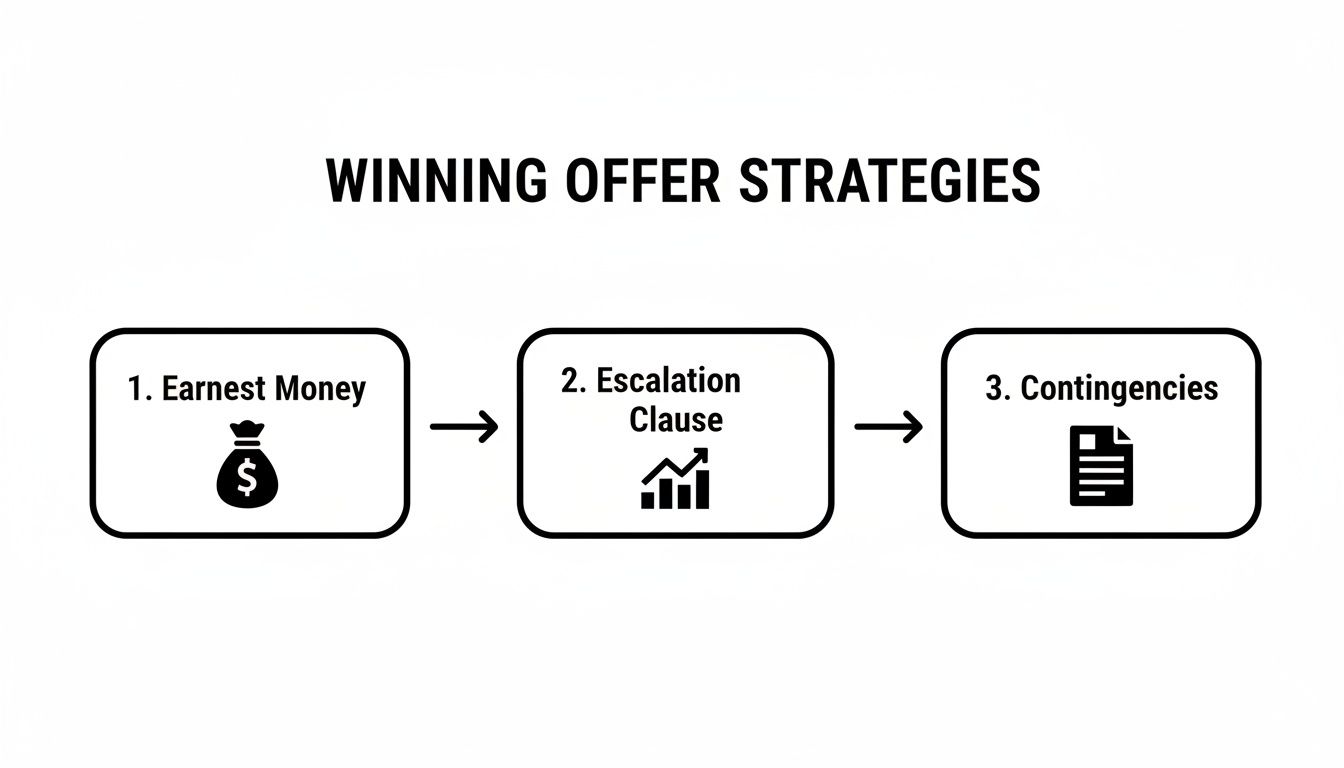
As you can see, things like earnest money, escalation clauses, and how you handle contingencies are powerful levers in your negotiation toolbelt.
From Handshake to Contract
This back-and-forth continues until both sides agree on all the terms—price, closing date, contingencies, and what stays or goes. Once you have a verbal agreement, your agent’s role becomes even more crucial. They are the ones who translate all these negotiated points into a clean, legally sound purchase agreement.
This final document is your shield. It protects your interests, outlines every single detail of the transaction, and defines what’s expected of both you and the seller. It’s the roadmap that guides everyone to the finish line: a signed contract and, finally, a successful closing.
It’s also worth keeping an eye on the bigger picture. The Bank for International Settlements reported a real terms decline in global house prices of 0.8% year-on-year in Q2. In a market like that, an offer 5-15% below asking could be a smart move. On the flip side, in areas with strong growth, like the euro area (3.1% growth), offers at or above asking price might be what it takes to compete.
Common Questions We Hear All the Time
Even after you’ve run the numbers and nailed down your strategy, the actual moment of making an offer can unleash a wave of last-minute questions. It’s completely normal. This is one of the biggest financial moves you’ll ever make, and the details matter.
Let’s cut through the noise and tackle the rapid-fire questions that come up right before our clients sign on the dotted line.
Is It Insulting to Make a Lowball Offer?
“Lowball” is a loaded term, and it’s all about context. If you’re in a white-hot seller’s market with ten other offers on the table, coming in 20% below asking isn’t just insulting—it’s irrelevant. They’ll just toss it aside without a second thought.
But what if a property has been sitting on the market for 90+ days and has already seen a few price drops? A lower offer can be a brilliant opening move. The trick is to justify it. An arbitrary low number feels like a slap in the face, but an offer backed by data—comps that support your price, quotes for needed repairs—is just business. A good agent will help you read the room and craft an offer that’s aggressive but not offensive.
How Much Earnest Money Is Enough to Look Serious?
Think of your earnest money deposit as your buy-in at a high-stakes poker game. The standard is usually 1-3% of the purchase price, but in a competitive market, “standard” rarely gets you noticed.
In a bidding war, a bigger deposit can be a total game-changer. Offering 5% or more sends a clear message: you’re a serious, financially sound buyer who isn’t going to get cold feet. It screams confidence. This money gets credited toward your down payment anyway, so while it shows you have the cash, it doesn’t actually change your total cost. Just make sure you understand exactly how and when that deposit could be at risk before you put it on the line.
A strong earnest money deposit doesn’t just show you’re serious—it proves you have the financial muscle to see the deal through to the end. It’s one of the fastest ways to build trust with a seller.
Should I Write One of Those Personal Letters to the Seller?
Ah, the “buyer love letter.” This is a classic “it depends” situation and a hot-button issue in real estate right now. A beautifully written letter can sometimes forge an emotional connection that pushes your offer over the top, especially when the numbers are close.
But here’s the problem: these letters are a legal minefield for potential Fair Housing violations. To avoid trouble, you have to focus strictly on your love for the house—the architecture, the garden, the light in the living room. You absolutely cannot reveal personal details that fall under protected classes (like race, religion, or family status). Because of the risk, many agents now advise against them. Always talk to your agent to figure out the best move for your specific situation.
What Happens if the Appraisal Comes in Lower Than My Offer?
An appraisal gap is a common headache in a fast market. If the appraiser decides the home is worth less than your offer price, the bank will only lend you money based on that lower value. That leaves you to cover the difference.
When this happens, you’ve got a few choices:
- Go back to the seller: You can try to renegotiate the price down to the appraised value.
- Bring more cash: You can pay the difference between the appraisal and your offer price out of pocket.
- Fight the appraisal: If your agent has solid comps the appraiser missed, you can submit a “reconsideration of value.” It’s a long shot, but sometimes it works.
- Walk away: If your contract has an appraisal contingency, this is your eject button. You can cancel the deal and get your earnest money back.
In competitive situations, many buyers include an “appraisal gap clause” in their offer, stating upfront they’ll cover a shortfall up to a specific amount. Sellers love this. It’s a massive confidence booster for them.
Making a smart offer takes more than just online calculators—it demands real-world expertise and an agent who knows the local market inside and out. The team at ACME Real Estate has been in the trenches with countless buyers, turning stressful negotiations into successful closings. If you’re ready to make a winning offer, let’s connect and build a strategy that gets you home. Start your journey with us today.
 ACME Real Estate | Los Angeles Boutique Real Estate Brokerage