
When you decide to sell your home, one of the first documents you’ll encounter is the listing agreement. The most common one you’ll see is an exclusive right to sell listing agreement. This is a contract that gives one real estate agent and their brokerage the sole authority to market and sell your property for a set period.
Think of it this way: you’re creating a powerful partnership where your agent is fully invested in getting you the best possible outcome. Why? Because this structure guarantees they earn a commission no matter who finds the buyer—whether it’s them, another agent, or even you. This motivates them to commit their full resources, time, and marketing budget to your sale.
Unpacking the Exclusive Right to Sell Agreement

Signing an exclusive right to sell agreement is like hiring a dedicated marketing firm for your most valuable asset. You’re not just sticking a sign in the yard. You’re bringing on a professional partner who is legally and financially committed to executing a comprehensive sales strategy for your home.
This contract lays the groundwork for your entire selling journey. It defines everyone’s responsibilities, sets clear expectations, and perfectly aligns your goals with your agent’s.
It’s the overwhelming industry standard for a reason. This agreement cuts through the noise and potential confusion of having multiple agents involved, creating a clear, focused effort to sell your home. It’s the framework that empowers your agent to pour their budget into professional photography, targeted digital ads, and extensive networking without worrying that their investment will be for nothing.
Key Features at a Glance
To quickly break it down, here are the core components of an exclusive right to sell agreement and what they mean for you as a seller.
| Feature | What It Means for the Seller |
|---|---|
| One Brokerage | You work with a single agent and their brokerage, creating a clear line of communication and accountability. |
| Guaranteed Commission | The listing agent earns a commission no matter who brings the buyer, ensuring they are fully motivated. |
| Set Time Period | The agreement is valid for a specific duration (e.g., 90 or 180 days), giving the agent a clear timeline to perform. |
| MLS Access | This is the key that unlocks access to the Multiple Listing Service (MLS), exposing your home to thousands of buyer’s agents. |
This structure is designed to protect both of you by ensuring your agent has every reason to work diligently to get your home sold.
The Power of Full Commitment
So, what makes this agreement so effective? It all comes down to incentives. When an agent knows their hard work will be rewarded, they go all-in.
- Maximum Marketing Investment: Your agent will confidently spend their own money on high-quality marketing materials—professional photos, video tours, social media ads—knowing they’ll recoup that investment when the home sells.
- Agent Accountability: With one agent in charge, there’s a single point of accountability. You know exactly who is responsible for scheduling showings, gathering feedback, and handling negotiations.
- Broader Exposure: This agreement is your ticket to the Multiple Listing Service (MLS). Getting your property on the MLS is critical because it exposes it to a massive network of buyer’s agents and their clients.
The core principle is simple: by granting exclusivity, you secure a fully committed partner. This alignment of interests is designed to protect you, the seller, and drive the most effective results in a competitive market.
The Global Standard for Selling Homes
The exclusive right to sell listing agreement isn’t just a local trend; it’s the most prevalent type of real estate contract used across the globe, especially in major U.S. markets. A single brokerage gets the exclusive right to market and sell the property, and they earn their commission regardless of who finds the buyer—the listing agent, another agent, or even you. You can get more details on the legal definition of this agreement at Barnes Walker.
This structure actually encourages cooperation among real estate professionals. Other agents are eager to bring their buyers because they know they’ll be compensated through a commission-sharing arrangement, which is clearly spelled out in the MLS.
Ultimately, this means more qualified buyers see your property, which gives you a stronger negotiating position and a smoother path to closing the deal. It’s the gold standard for a reason.
Why This Agreement Is the Industry Standard
Ever wonder why reputable real estate agents are so insistent on an exclusive right to sell agreement? It’s not a power trip. It’s about commitment. This contract is the gold standard because it aligns my financial success directly with yours. We’re both pulling the rope in the same direction, aiming for the same goal.

Think of it this way: would you rather hire a full-time, dedicated marketing director for your property, or a handful of unpaid interns who might show up? When an agent doesn’t have a secure agreement, they’re hesitant to pour their own money into a killer marketing campaign. Why would they? But with an exclusive right to sell, I have the confidence to go all-in from day one.
That all-in approach is what separates a fast, high-value sale from a property that just sits on the market, collecting dust. It’s how we unlock your home’s true potential, especially in a dynamic market.
Fueling the Marketing Engine
When I know my commission is guaranteed once your home sells, it gives me the green light to make serious upfront investments. I’m not just talking about a sign in the yard. I’m talking about a high-octane marketing blitz designed to grab every qualified buyer’s attention.
Here’s where that investment goes:
- Professional Photography & Videography: We hire the pros. Your home will look like it was ripped from the pages of a design magazine, with cinematic video tours to match.
- Targeted Digital Advertising: Forget just posting on the MLS. We run sophisticated ad campaigns on social media and Google that put your listing directly in front of people actively searching for a home just like yours.
- Immersive Virtual Tours: This lets buyers from across the city—or the globe—walk through your home virtually. It’s a game-changer.
- Expert Staging Consultations: We bring in experts to make your home look its absolute best, helping buyers see themselves living there from the second they walk in.
Without the security of an exclusive right to sell listing agreement, agents just can’t justify spending thousands of their own dollars on this stuff. This contract is the fuel that powers a modern, effective marketing strategy.
The Data-Backed Advantage
This isn’t just my opinion; the numbers don’t lie. Properties listed under an exclusive right to sell agreement consistently sell faster and for more money. Industry data shows these homes often see their time on the market cut by an average of 20% to 30% compared to other arrangements. When your property has been expertly marketed and is drawing a ton of interest, you’re calling the shots from a position of strength, not desperation. This almost always leads to better terms, fewer seller concessions, and more money in your pocket at closing.
It’s about turning a stressful transaction into a strategic partnership. By tying my success directly to yours, we create a shared mission: get the absolute best outcome possible. This powerful alignment is exactly why the exclusive right to sell agreement is the undisputed champion of the real estate world.
Navigating the Key Clauses in Your Contract
Signing a listing agreement can feel intimidating. All that legal language can make you feel like you’re trying to read a foreign language in the dark. But it doesn’t have to be that way. Think of this contract not as a trap, but as our shared playbook—it’s designed to protect both of us by getting all the expectations out on the table from day one.
Let’s pull back the curtain on the key pieces of a standard agreement. This isn’t going to be a lecture from a law professor. It’s a straightforward tour so you know exactly what you’re signing, no surprises.
This visual breaks down the three pillars of our agreement: how long we work together, the price we’re aiming for, and how I get paid for a successful sale.
These three elements—the timeline, the financial goal, and the compensation—are the foundation of our entire partnership.
The Big Three Terms You Must Know
At the heart of any listing agreement are a few critical terms that define our working relationship. Getting these right is the first step to a smooth, successful sale.
- The Listing Period: This is simply the length of our contract. Agreements typically run for 90 to 180 days. This gives us a realistic window to market your home properly, navigate offers, and get you to the closing table without rushing. Of course, this is always negotiable and we’ll set a timeline that makes sense for the current market.
- The Listing Price: We’ll land on this number together. I’ll bring a deep dive on the local market data and comps to the table, but you always have the final say. This becomes the official asking price we’ll broadcast on the Multiple Listing Service (MLS).
- The Commission Rate: This is the percentage of the final sale price that my brokerage earns for getting the job done. It’s important to remember commissions are not set in stone by law; they’re always negotiable. This fee covers the massive amount of work that goes into marketing, negotiating, and managing every detail of your transaction.
The commission is a big part of the financial picture, but not the only part. For a full breakdown, check out our guide on typical home seller closing costs.
Your Role and Our Fiduciary Duties
A strong partnership is a two-way street. The agreement will clearly outline your responsibilities, which are pretty straightforward: things like providing access for showings, keeping the home presentable, and being upfront about any known issues with the property.
In return, the contract legally binds me to my fiduciary duties. That’s a fancy legal term, but it means I am 100% obligated to act in your absolute best interest. My duties include loyalty, confidentiality, and a relentless commitment to getting you the best possible price and terms. It’s more than a handshake—it’s a professional promise backed by law.
The agreement is more than just a commission contract; it’s a formal commitment where I pledge my expertise and resources to achieve your goals, while you agree to cooperate in the sales process.
The All-Important Protection Period Clause
One clause that sometimes trips people up is the protection period, sometimes called a “safety clause.” It’s a standard feature in listing agreements, and it’s there to ensure fairness.
Here’s how it works: if our contract expires and you sell your home within a set timeframe (usually 30-90 days) to a buyer I originally brought to the table, I am still owed the commission. To make this happen, I have to give you a written list of these “protected” buyers the moment our contract ends.
What’s the point? It prevents a situation where a seller might try to wait out the clock on our agreement just to avoid paying for the work that actually generated the sale. It protects the agent’s marketing investment and time. It’s a standard of practice that keeps the playing field level for everyone involved.
Comparing Different Types of Listing Agreements
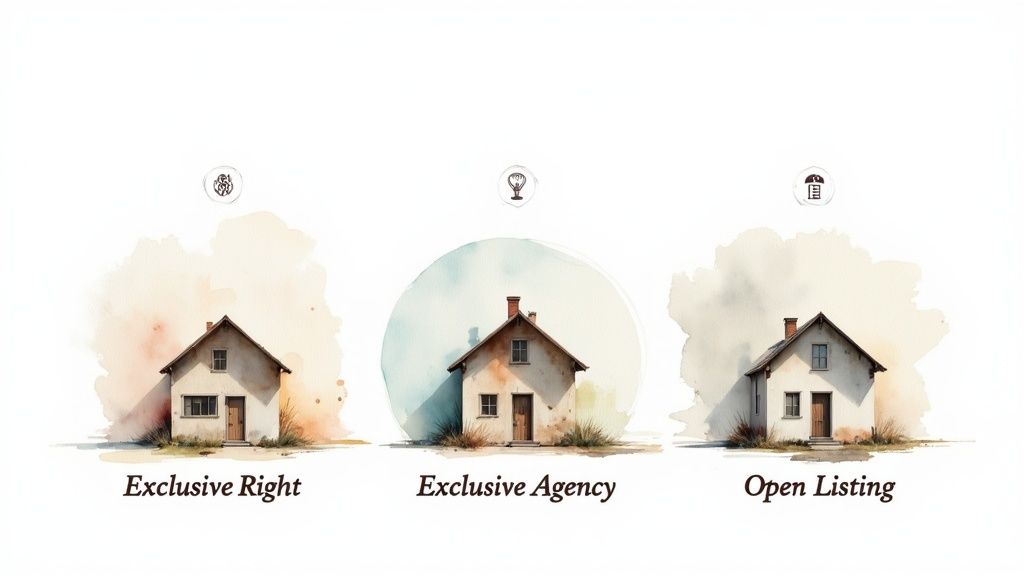
While the exclusive right to sell agreement is the undisputed heavyweight champ in real estate, it’s not the only fighter in the ring. You have to understand the alternatives to truly appreciate why it’s the go-to for serious sellers and top agents. The other options might sound tempting on the surface, but they often come with hidden trade-offs that can wreck your bottom line.
Think of it like hiring a personal trainer. An exclusive right to sell is like hiring a dedicated coach who designs your entire fitness plan, tracks your progress, and is fully invested because their paycheck depends on your results. The other agreements are more like getting a generic workout plan from a website—you might see some progress, but the commitment and personalized strategy just aren’t there.
Let’s break down the main contenders.
The Exclusive Agency Agreement
First up is the exclusive agency agreement. This one sounds similar, but there’s a crucial twist. You hire one agent and their brokerage, but you reserve the right to find a buyer on your own. If your cousin or a coworker ends up buying the place, you don’t owe the agent a commission.
On paper, this sounds like a win-win. You get an agent working for you but still have a shot at saving the commission. The reality? This “what if” scenario quietly guts an agent’s motivation. They know there’s a chance they could pour thousands into marketing your home only to walk away with nothing.
That means they’ll probably pull their punches on marketing spend and promotion. The agent is hedging their bets, which isn’t the all-in approach you want when selling your most valuable asset.
The Open Listing Agreement
Then there’s the open listing, which is the Wild West of real estate. Here, you can hire multiple agents from different brokerages all at once. The rule is simple: whoever brings the buyer that closes the deal gets paid. And if you find the buyer yourself, you pay no one.
This free-for-all approach sounds like it would create maximum competition, but it usually does the exact opposite.
With no guarantee of a paycheck, no single agent is truly committed. They’re not going to invest in professional photography, a robust digital ad campaign, or weekend open houses for a property another agent could sell tomorrow. An open listing almost always results in minimal effort from everyone.
Open listings also confuse the hell out of buyers. Seeing the same property listed by multiple agents can make it seem like something is wrong or that the seller is desperate, weakening your negotiating position from the start. A clear line of communication is essential, especially when complex situations like dual agency arise. To get the full picture, you can read our guide on what dual agency means in real estate.
Listing Agreement Types Compared
Seeing the options side-by-side makes the differences painfully clear. Each agreement creates a completely different dynamic between you and the real estate professionals you work with.
| Feature | Exclusive Right to Sell | Exclusive Agency | Open Listing |
|---|---|---|---|
| Agent Motivation | Maximum. The agent is guaranteed a commission, ensuring 100% commitment and investment. | Moderate. The agent is motivated but may hesitate to invest fully since the seller can find a buyer. | Low. Agents have little incentive to invest time or money due to intense competition and no guarantee of payment. |
| Marketing Effort | Comprehensive. Expect professional photos, video tours, digital ads, and full MLS exposure. | Standard. The agent will likely cover the basics but may hold back on a significant marketing spend. | Minimal. Typically just a basic MLS entry, if allowed, with little to no additional marketing. |
| Who Gets Paid? | The listing agent’s brokerage, no matter who finds the buyer. | The agent, unless the seller finds the buyer independently. | Only the agent who successfully brings the buyer who closes the deal. |
| Seller Experience | A dedicated partnership with one accountable point of contact and a clear, focused strategy. | A mix of professional help and DIY effort, which can sometimes lead to confusion. | Potentially chaotic, with multiple agents and a lack of clear accountability or strategy. |
While other options exist, the exclusive right to sell listing agreement remains the industry standard for a reason. It creates the strongest possible alignment, turning the sale into a true partnership where your agent is fully armed and completely focused on one thing: getting you the best possible outcome.
How to Negotiate Your Listing Agreement
Signing an exclusive right to sell listing agreement isn’t like mindlessly clicking “agree” on a new app’s terms of service. Far from it. This is a business partnership, and a critical one at that. A lot of sellers don’t realize this, but the agreement is a fully negotiable contract.
This is your moment to have a real, boots-on-the-ground conversation with your agent to build a fair deal that sets you both up to win. Think of it less like a tense negotiation and more like a strategy session. You’re defining the rules of the game so everyone knows exactly what’s expected.
A solid agreement upfront prevents the kind of misunderstandings that can derail a sale. It ensures you and your agent are on the same page about the three things that truly matter: the money, the timeline, and your escape hatch if things go sideways.
Mastering the Commission Conversation
Alright, let’s tackle the elephant in the room: the commission rate. It’s what every seller zooms in on, and for good reason. The most important thing to know is that real estate commissions are not fixed by law. They are always, always negotiable. Don’t be timid about bringing it up.
An agent’s proposed rate isn’t just a random number; it reflects their marketing war chest, their experience, and the level of service they bring to the table. Instead of just trying to chisel the number down, frame the conversation around value. Ask them to walk you through exactly what you’re getting for that percentage.
- What’s their precise marketing plan? Will they pay for professional photography, videography, and staging consultations?
- Do they have a proven track record of selling homes for top dollar in your specific area?
- How big is their network and how do they plan to get your home in front of the right buyers?
A top-tier agent with a killer marketing strategy might have a higher rate, but they could also sell your home for a price that makes their commission a rounding error. Smart negotiation isn’t just about cutting costs; it’s about maximizing what you walk away with. For more on this, check out our deep dive into real estate negotiation strategies.
Setting the Right Contract Length
Next up is the duration of the agreement. A typical listing period runs anywhere from 90 to 180 days. This gives your agent a fair shot at marketing your home properly without locking you into a long-term relationship you can’t get out of.
Be cautious if an agent is pushing hard for a contract of six months or longer, especially when homes in your area are moving quickly. Propose a shorter term, like 90 days, with an option to extend if you’re thrilled with their hustle. This keeps your agent hungry and gives you a natural point to reassess.
You can also negotiate a performance-based cancellation clause. This is a game-changer. It allows you to terminate the agreement early if the agent doesn’t meet specific, measurable goals—like holding a certain number of open houses or providing weekly marketing updates.
This isn’t about a lack of trust. It’s about building accountability right into the DNA of your exclusive right to sell listing agreement. It protects you and makes sure your agent stays on their A-game.
Carving Out Specific Exclusions
What happens if you’ve already been talking to a potential buyer before you hire an agent? Your cousin’s friend, maybe, or a neighbor who’s always loved your house. This is where a named exclusion clause is your best friend.
It’s a simple addition to your contract that lets you list, by name, any potential buyers you’ve already connected with. If one of those specific people ends up buying your home, you may not owe the full commission—or any at all, depending on what you negotiate.
For this to hold up, you have to do it right:
- Put it in writing. The exclusion has to be spelled out in the listing agreement before you sign anything.
- Name names. A vague description like “my co-worker” isn’t going to fly. You need to list the exact individuals.
- Set a deadline. The clause usually only applies for a limited time.
This move protects you from paying for a lead you brought to the table yourself. It’s a fair compromise that respects your efforts while still giving your agent every reason to go out and find a brand-new buyer who might pay even more.
Answering Your Top Questions
Even after you get the hang of how an exclusive right to sell listing agreement works, you’ll probably still have a few “what if” questions bouncing around in your head. That’s not just normal, it’s smart. This is a serious contract, and you should kick the tires on every part of it before you sign.
Let’s dive into the questions we hear most often from sellers. No fluff, just straight answers to give you the confidence you need.
What Happens If I Find the Buyer Myself?
This question gets right to the heart of the agreement. The answer is simple: even if your cousin, your college roommate, or the friendly neighbor from down the street decides they want to buy your house, your agent’s brokerage still earns their full commission.
It helps to stop thinking of the commission as just a finder’s fee. It’s not. That fee covers the agent’s upfront investment in marketing, the deep dive into pricing strategy, the countless hours spent coordinating showings, and the expertise needed to navigate the deal from offer to closing. The guarantee of payment is what buys you their 100% commitment.
The only way around this is to have a “named exclusion” written into the contract before you sign, specifically carving out an exception for a particular person you already have in mind.
Can I Cancel an Exclusive Right to Sell Agreement?
You can, but you can’t just rip it up and walk away. This is a legally binding contract with a set expiration date. Bailing early without a legitimate reason could put you in breach of contract, and you might still be on the hook for the full commission or other costs.
That said, good agents know that life happens. The smart move is to negotiate an “easy exit” or conditional termination clause before you even sign. This clause clearly states the terms under which either one of you can end the agreement without a penalty.
Many states have official forms, like the “Cancellation of Listing,” that are used to formally end the agreement when both parties agree. Always, always get any cancellation in writing. It’s your best protection.
What Is the Protection Period or Safety Clause?
The protection period, sometimes called a safety clause, is a critical detail that protects the agent’s work after your contract officially ends. It’s a specific timeframe, usually 30 to 90 days, that kicks in the day the listing agreement expires.
Here’s the scenario it’s designed to shut down: An agent shows your home to a great buyer. The buyer loves it but decides to wait until your contract with the agent expires, then comes directly to you hoping to get a discount by cutting the agent out. The safety clause ensures that if you sell to a buyer who was introduced to your home during the listing period, the agent still gets paid for their work.
For this clause to stick, the agent has to give you a written list of these “protected buyers” right after the agreement ends.
Is the Commission Rate Set in Stone?
Not a chance. Every seller needs to burn this into their brain: real estate commissions are not fixed by law and are always negotiable. Agents have their standard rates, of course, which reflect the quality of their service and marketing firepower. But you absolutely have the right to discuss that fee.
A top-tier agent won’t flinch. They’ll justify their rate by walking you through their entire marketing playbook, showing you their track record, and explaining the value they bring when it’s time to negotiate with buyers. Whatever rate you land on must be clearly spelled out in your exclusive right to sell listing agreement.
For agents reading this, getting the agreement signed is just one part of the puzzle. Growing your business means constantly finding new clients.
At ACME Real Estate, we believe a transparent agreement is the bedrock of a great sale. If more questions pop up or you’re ready to talk about selling your property, we’re here to give you the expert guidance you deserve. Let’s make it happen. Find out how at https://www.acme-re.com.