
Let’s cut to the chase. The whole "condo vs. house" throwdown boils down to one simple trade-off: condos deliver a low-maintenance, amenity-rich lifestyle, while houses offer total privacy and creative control. Your final call in Los Angeles hinges on what you crave more—the turnkey convenience of a DTLA high-rise or the freedom of your own backyard kingdom in a spot like Sherman Oaks.
Framing Your LA Real Estate Decision
Choosing between a condo and a single-family house in Los Angeles is so much more than a square footage calculation. It’s a full-blown lifestyle commitment. The right answer isn't universal; it's deeply personal and depends entirely on your priorities, your bank account, and the future you’re building for yourself.
This single choice will dictate everything from how you spend your weekends (sipping cocktails by a shared pool vs. tackling that rogue sprinkler head) to how you manage your cash (predictable HOA fees vs. those heart-stopping surprise repair bills). One path gives you a built-in community and a management team on speed dial; the other gives you complete autonomy and a slice of LA land to truly call your own.

What a Condo Really Means
Legally, "condo" is a type of ownership, not a building style. When you buy a condo, you're actually buying two separate assets:
- The interior space of your unit: You own everything from the drywall inward. Think of it as your personal box.
- A shared interest in the common areas: This includes the land, the building's exterior, the roof, hallways, and goodies like pools or gyms.
This entire operation is run by a Homeowners Association (HOA). They collect monthly dues to handle all the maintenance, insurance, and general upkeep of those shared elements. This is why you’ll sometimes see what looks like a classic house but is legally a "site condo" or "detached condo."
What Defines a Single-Family House
A single-family house is refreshingly straightforward. You own the structure and the chunk of land it sits on, period. This grants you total control and sole responsibility for every single thing, from the roof shingles down to the property line. You won't have shared walls and, usually, no HOA unless the home is part of a master-planned community.
To get your head in the game, here’s a high-level look at how condos and houses stack up in the wild world of LA real estate.
At a Glance: LA Condos vs. Houses
| Factor | Condo | Single-Family House |
|---|---|---|
| Ownership | You own the interior of your unit and share ownership of common areas and land. | You own the entire structure and the land it sits on. |
| Maintenance | The HOA handles exterior repairs, landscaping, and major systems. | You are solely responsible for all maintenance, repairs, and landscaping. |
| Monthly Costs | Mortgage, property taxes, insurance, and a mandatory HOA fee. | Mortgage, property taxes, insurance, and variable maintenance costs. |
| Autonomy | Limited by HOA rules (CC&Rs) on renovations, pets, and exterior changes. | Complete freedom to renovate, landscape, and use the property as you wish. |
| Amenities | Often includes access to shared pools, gyms, security, and clubhouses. | Amenities are private and must be built and maintained at your own expense. |
| Privacy | Varies, but often involves shared walls, floors, or ceilings with neighbors. | Typically offers more privacy with no shared walls and a private yard. |
| Price Point | Generally a more accessible entry point into desirable LA neighborhoods. | Higher upfront purchase price and overall financial responsibility. |
This table gives you the 30,000-foot view, but as with anything in real estate, the devil is in the details. Each of these factors has massive financial and lifestyle implications we need to unpack to figure out which path is your path.
Breaking Down the True Cost of LA Homeownership
The sticker price on a Zillow listing is just the opening act. The real story of affordability in Los Angeles unfolds in the monthly, annual, and gut-punch surprise expenses that hit you long after you get the keys. Understanding the full financial picture—from predictable fees to those "uh-oh" repair bills—is the only way to make a killer call in the condo vs. house debate.

Let's get past the mortgage payment and dig into the nitty-gritty costs that truly define owning a home in LA. What you don't know can absolutely wreck your budget.
The Predictability of Condo HOA Fees
When you buy a condo, you’re also buying into a Homeowners Association (HOA) and its mandatory monthly fee. This isn’t just another bill; it’s a strategic trade-off. You’re swapping cash for convenience and shared expenses.
Think of your HOA dues as a bundled payment that typically covers:
- Common Area Maintenance: This is the landscaping, hallway cleaning, lobby upkeep, and servicing amenities like the pool or gym.
- Shared Utilities: Water, trash, and sometimes even gas often get rolled into your HOA fee.
- Building Insurance: The HOA carries a master policy for the whole structure. You'll still need your own policy for the inside of your unit, but the big stuff is covered.
- Reserve Funds: A chunk of your dues goes into a savings account for major future repairs, like replacing the roof or repaving the parking lot.
A well-managed HOA gives your budget a sense of predictability. You won't get a surprise bill for a new roof, but you also have to accept that dues can—and often do—go up over time.
The Unpredictability of House Maintenance
Owning a single-family home makes you the CEO, CFO, and janitor of your property. No monthly dues, sure, but you are 100% on the hook for every single repair and maintenance task. This financial responsibility is far less predictable and demands a serious savings strategy.
Instead of a fixed HOA fee, your budget needs to absorb costs that are all over the map. A new roof on a Pasadena craftsman home can easily run $20,000 or more. Or imagine the specialized foundation work needed for a hillside home in the canyons—a project that can climb into the six figures.
Here’s a snapshot of potential house-specific costs you’re now responsible for:
- Exterior Upkeep: Painting, siding repair, window replacement.
- Major Systems: HVAC replacement ($8,000-$15,000), a busted water heater ($1,500+).
- Landscaping: Regular gardening, tree trimming, fixing the irrigation.
- Pest Control: Termite treatments and routine prevention.
Looking past the listing price and understanding all the potential expenses is critical. You can explore common hidden costs when buying a house to get a clearer picture of what might pop up after closing.
Property Taxes and Insurance: The Overlooked Variables
Property taxes are a huge ongoing expense for any homeowner in LA. While the tax rate is based on your home's assessed value, the final bill can be wildly different. Single-family homes, with their attached land value, almost always come with a higher property tax bill than a similarly priced condo.
Homeowners insurance also varies dramatically. For a house, you need a comprehensive policy covering the entire structure, the land, and your personal liability. A condo owner just needs an "HO-6" policy, which is way cheaper because it only covers the interior of your unit and your belongings. The HOA's master policy handles the building itself.
But here’s the catch: rising insurance costs in California, especially in high-fire-risk zones, are hitting both markets hard. Some condo associations are facing massive premium hikes, which get passed on to owners through higher dues or special assessments. For homeowners, just getting affordable, comprehensive coverage is becoming a major headache.
And remember, these are just a few of the expenses you'll face. You can learn more by checking out our guide to understanding all the closing costs for home buyers.
Comparing Lifestyle Freedom and Community
Forget the spreadsheets for a minute. The real difference between a condo and a house comes down to how you want to live your life in Los Angeles. This choice goes way beyond financials—it dictates your weekends, your social circle, and how much say you have over your own four walls.
One path offers a life of convenience with a built-in social scene; the other gives you absolute freedom and a patch of LA to call your own.

The trade-offs here are stark. Your decision will shape everything from your commute to your ability to own a certain breed of dog. Let's break it down.
The Condo Lifestyle: A Trade of Convenience for Control
Picture this: you live in a modern high-rise in Koreatown. Saturday morning means hitting the building’s gym, followed by an afternoon at the rooftop pool with friends before walking to a new spot for dinner. That’s the condo dream in a nutshell: an amenity-rich, low-maintenance lifestyle.
But that convenience comes with a major string attached: you're living by someone else's rules. The Homeowners Association (HOA) and its Covenants, Conditions & Restrictions (CC&Rs) have the final say on nearly everything.
HOA rules can be surprisingly specific, often dictating:
- Exterior Modifications: Thinking of painting your front door a fun color? Not without board approval. Want a different light fixture? Probably not.
- Pet Policies: Many buildings enforce strict limits on the number, breed, and size of pets. Your beloved 80-pound Golden Retriever might be a non-starter.
- Noise and Guests: To keep the peace in high-density living, expect rigid quiet hours and rules about overnight guests or parties.
- Rental Restrictions: If you plan to rent out your unit down the line, the HOA may have rules that make it difficult or even impossible.
The condo lifestyle is about outsourcing hassle. You trade personal autonomy for the freedom from mowing lawns, cleaning pools, and worrying about exterior repairs. It's a lock-and-leave existence perfect for busy professionals or frequent travelers.
The House Lifestyle: Total Freedom and Total Responsibility
Now, imagine a classic bungalow in a neighborhood like Mar Vista. You’ve got a private backyard—your personal oasis where you can build a deck, plant a garden, or finally build that outdoor kitchen you've been dreaming of. This is the heart of house ownership: complete autonomy to create a space that’s truly yours.
This level of creative control is a huge draw. Want to knock down a wall for an open-concept living room? Go for it. Need to convert the garage into a home office? As long as you follow city code, the choice is yours.
Of course, with great freedom comes the flip side: total responsibility. Every single thing that breaks, leaks, or dies is on you. There's no property manager to call about a leaky faucet or a dead tree in the front yard. You either learn to fix it yourself or keep a list of trusted contractors on speed dial. This lifestyle demands more of your time, effort, and a healthy emergency fund.
Community and Social Life
Your choice profoundly impacts your social world. Condo living often creates an instant, built-in community. You bump into your neighbors in the elevator, at the mailboxes, or by the pool. For many, especially those new to the city, this proximity makes it easy to build friendships and feel a sense of belonging.
Community in a single-family neighborhood is something you have to build more intentionally. You gain a ton of privacy, but that also means you might have to make a real effort to meet the people on your street. It’s on you to join the neighborhood watch, show up at the local block party, or just strike up a conversation while walking the dog. The vibe is different—less centralized, but often just as strong, built on shared local pride rather than shared amenities.
Analyzing Investment Potential and Resale Value
Every home purchase is a massive investment, whether it's your forever home or just the first step on the property ladder. When you're weighing a condo against a house, you have to put on your investor hat and think about how each property will perform over the long haul. This isn't just about finding a place to live; it's about building real wealth.
In Los Angeles, condos and houses follow two completely different investment scripts. A condo in a hot urban core can deliver some serious equity growth, but a single-family home almost always offers more stable value and the game-changing opportunity for "forced appreciation." Let's break down what this really means for your money.
The Appreciation Game: Condos vs. Houses
Historically, single-family homes have been the undisputed champions of appreciation. The reason is simple: you own the land it sits on. Land is a finite resource, especially in a city like LA, and its value just keeps climbing. This gives houses a bedrock of long-term value that a condo, where you only have a shared interest in the land, can rarely match.
That said, the right condo can be an equity-building machine. A sleek unit in a high-demand neighborhood like West Hollywood or Playa Vista can see its value shoot up, sometimes even outpacing houses in less desirable zip codes. The secret sauce is location and building desirability. A condo's value is inextricably linked to the financial health of its HOA, the quality of its amenities, and the overall vibe of the building itself.
When you buy a house, you’re betting on the enduring value of land. When you buy a condo, you’re betting on the desirability of a specific building and its hyper-local urban environment.
Forcing Appreciation and Building Equity
One of the most significant investment advantages of a single-family home is your ability to force appreciation. This means you can actively jack up your home's value through smart renovations and improvements. That kitchen remodel, ADU conversion, or backyard oasis isn't just for your personal enjoyment—it's a direct investment that can pay off big time when you decide to sell.
Condo owners have their hands tied. HOA rules usually forbid you from making any major structural or exterior changes. You can upgrade the kitchen and bath, sure, but your power to fundamentally increase the property's value is limited. Your investment's fate is mostly tied to market trends and how well the HOA runs the show, not your own sweat equity.
Before you make a move, you have to get comfortable with the numbers. Understanding the metrics for calculating property return on investment is non-negotiable for making a smart decision.
Navigating Current Market Dynamics
The current market has thrown a real curveball at the condo sector. A recent report uncovered a shocking trend: there are 72.3% more condo sellers than buyers across the country. That's more than double the surplus for single-family homes, signaling much weaker demand for condos right now. Experts point to out-of-control HOA fees, soaring insurance premiums, and a cooling rental market that’s pushing investors to cash out. You can get the full story on this condo market imbalance on Redfin.com.
For a buyer, this is a double-edged sword. More sellers usually means more room to negotiate and maybe a lower price tag. But for an investor looking long-term, it’s a red flag. The same high dues and insurance costs pushing people to sell today could hammer your future resale value and crater your cash flow if you plan to rent it out. For investors trying to make the numbers work, our guide on how to calculate cap rate for a rental property is essential reading.
Look, both property types can be fantastic investments, but they demand completely different playbooks. A house offers a more traditional, stable path to wealth built on land ownership and forced appreciation. A condo can be a faster, more location-driven play, but it comes with bigger risks tied to HOA politics and market volatility.
Navigating Financing and Market Complexities
When it comes to getting a mortgage, buying a single-family house is usually a straight shot. Lenders really only care about two things: your personal finances and the home's appraisal. Simple enough.
But when you're buying a condo, the game changes entirely. The lender isn't just betting on you anymore; they're betting on the entire building. This adds a whole new level of scrutiny that can catch a lot of buyers off guard.
Getting a loan for a condo means the lender is going to put the whole project under a microscope. They have to protect their investment from risks tied to the building's financial health and management. Deals can fall apart not because of the buyer, but because the building itself is a mess. A poorly run HOA can make a condo almost impossible to finance.
The Condo Association Deep Dive
Before they'll even think about approving your loan, lenders send a "condo questionnaire" to the HOA. They're digging for skeletons in the closet and looking for any red flags that signal a risky investment.
Here’s what they’re really looking for:
- HOA Financial Health: Are the books balanced? Is there a history of surprise special assessments hitting owners? A healthy reserve fund for future repairs isn't just a nice-to-have; for most lenders, it's non-negotiable.
- Owner-Occupancy Rate: Lenders get nervous when a building is mostly renters. They want to see a community of owners. If the renter-to-owner ratio gets too high (typically over 50%), it can make the entire project "unwarrantable," which is a kiss of death for traditional financing.
- Single-Entity Ownership: They also check if one investor owns too many units, usually more than 10% of the complex. If a single person or company holds that much power, it creates instability. What happens if they decide to dump their whole portfolio at once? Lenders hate that kind of risk.
- Pending Litigation: Is the HOA currently being sued? This is a massive red flag. Lawsuits, especially anything related to structural problems, can stop a loan dead in its tracks.
Securing a mortgage for a condo is a two-part approval process: you have to qualify, and so does the building. The financial health and governance of the HOA are just as important as your credit score.
The Warrantable vs. Unwarrantable Condo Problem
If the condo project fails to tick all the lender's boxes, it gets slapped with the label unwarrantable. This is a huge problem. It basically kicks you out of the world of conventional loans and pushes you toward specialized lenders who know they can charge you higher interest rates for the trouble.
The straightforward financing for a single-family home completely sidesteps this landmine. You don't have to worry about your dream home being un-financeable because of something a board member did five years ago.
Finding the right loan is always a process, but it's crucial to understand who you're working with. A good first step is to learn how to compare mortgage lenders to find someone who actually gets the nuances of the LA condo market.
Current Market Pressures on Both Sides
Today’s market is throwing another wrench in the works. We're seeing a real split in how these two property types are performing. While single-family homes are holding their value at near-record levels, thanks to solid demand, condo prices in many areas are actually dropping year-over-year.
Why the split? It's a perfect storm of soaring HOA dues, buildings becoming uninsurable in high-risk zones, and the tighter mortgage standards we just talked about. These issues are making both buyers and lenders extremely cautious about the long-term stability of condo investments.
While no property is immune to market forces, single-family homes have proven to be far more resilient. Their financing and market position offer a much more predictable and stable path for buyers trying to make sense of a complicated economic landscape.
Putting It All Together: Your Personal Decision Framework
Alright, let's land this plane. The endless condo vs. house debate is just noise until you apply it to your life. This is where we move from theory to a real, actionable decision that fits your specific situation in Los Angeles.
Forget generic pro/con lists. You need a framework that forces you to be honest with yourself. It boils down to a few tough questions that will cut through the confusion and point you toward the right door.
What’s Your Real Financial Picture?
First, get brutally honest about the numbers—and I don't just mean the mortgage payment.
- Cash Flow vs. Savings: Can your monthly budget really handle a fluctuating, sometimes hefty HOA fee? Or does the idea of a lower, fixed mortgage payment appeal more, allowing you to build your own war chest for when the roof inevitably needs replacing?
- Upfront Costs: Are you working with capital that makes a condo's lower price point a strategic entry into the market? Or are you prepared for the higher down payment and closing costs that usually come with a single-family home?
- Long-Term Equity Goals: Is your primary play to maximize appreciation through land value and sweat equity (hello, house)? Or are you focused on building equity in a high-demand, walkable neighborhood where a condo is the only realistic way in?
This simple decision tree gets right to the heart of the initial choice.
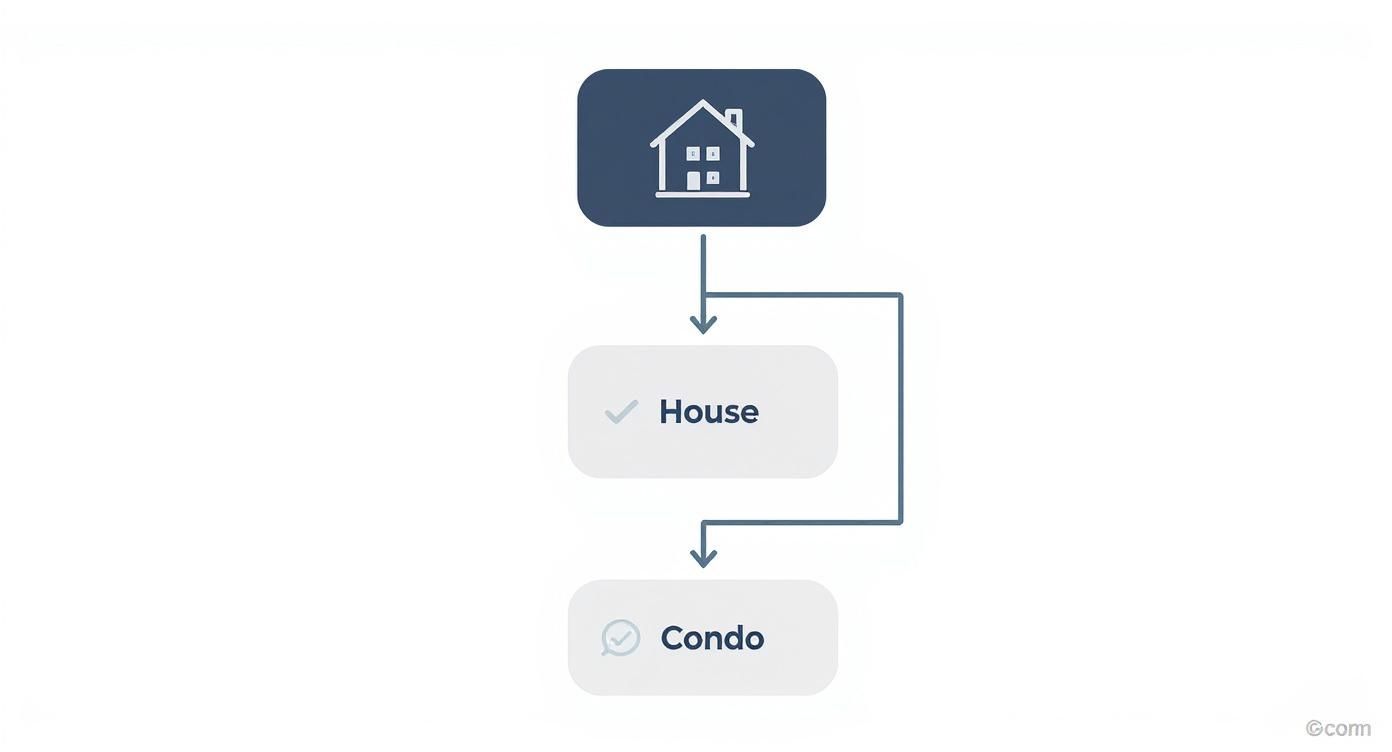
It highlights the fundamental fork in the road: are you signing up for shared rules or for total, solo responsibility?
How Do You Actually Want to Live?
Now for the lifestyle gut-check. This is where you have to be real about who you are, not who you think you should be.
Your home should serve your life, not the other way around. Prioritizing a turnkey lifestyle over a private backyard isn't a compromise—it's a strategic choice.
- Time & Effort: Do you genuinely enjoy spending your weekends on DIY projects and yard work? Or does the thought of coordinating contractors and mowing a lawn make you want to run for the hills?
- Control vs. Convenience: How much do you value the freedom to paint your front door bright purple, build an ADU, or knock down a wall on a whim? Are you willing to trade that absolute autonomy for a lock-and-leave lifestyle where the big stuff is someone else's problem?
- Community & Privacy: Do you get energized by the idea of a built-in social scene, bumping into neighbors at the pool or gym? Or do you crave the total solitude of your own space, with no shared walls and no one to answer to?
Answering these questions honestly won't just give you an answer; it will lead you to a decision that feels less like a gamble and more like coming home.
Answering LA Buyers' Toughest Questions
Let's cut through the noise. When you're trying to decide between a condo and a house in LA, a few key questions always come up. Here are the straight answers you need to hear.
House vs. Condo: Which Is the Smarter Money?
Historically, the single-family house has been the more reliable bet for long-term wealth. Why? You own the dirt it sits on. Land in a city like Los Angeles is a finite, ridiculously high-demand asset that almost always goes up in value. This gives houses a much stronger foundation for building real equity and offers more opportunities for "forced appreciation" through clever renovations.
But don't count the condo out. A well-placed condo in a hot neighborhood can be an absolute powerhouse, sometimes seeing explosive growth. Its success is hitched to the desirability of the block, the reputation of the building, and—critically—the financial health of its HOA. The "better" investment really comes down to your personal strategy. Are you betting on land or betting on location?
What's the Single Biggest Risk of Buying a Condo?
One thing: the Homeowners Association (HOA). A mismanaged HOA with empty reserve funds can blindside you with enormous, non-negotiable special assessments for major repairs. I'm talking six-figure bills for a new roof or seismic retrofitting. It's the silent killer of condo ownership.
Beyond the HOA nightmare, you're also looking at:
- Financing Roadblocks: Lenders put the building's HOA under a microscope, scrutinizing its finances, the percentage of renters vs. owners, and any active lawsuits. If the building gets flagged as "unwarrantable," finding a conventional loan becomes a near-impossible task.
- The Rules Can Change: The HOA board you love today might be gone tomorrow. A new board can suddenly decide to ban pets or restrict rentals, completely torpedoing your plans.
- Neighbor Roulette: Sharing walls means your peace and quiet is at the mercy of the person next door. One bad neighbor can make your life hell, and your options for dealing with it are frustratingly limited.
Why Do Condos Seem So Much Cheaper Than Houses?
It all comes back to the dirt. When you buy a house, you’re buying the structure and the plot of land it occupies. With a condo, you own the airspace inside your unit and a small, shared piece of the land along with everyone else. Owning just a fraction of the most valuable part—the land—is what makes the price tag so much lower.
There's also simple density economics at play. A developer can stack dozens of condo units on a piece of land that would only fit a single house. This lets them sell each unit at a price regular people can actually afford. It’s why condos are often the only way for first-time buyers to get a foothold in wildly expensive LA neighborhoods where a house is just a pipe dream.
Making the right call in the LA market isn't about pros and cons lists; it’s about having an expert on your side who understands the subtle realities of this city. The team at ACME Real Estate lives and breathes this stuff. We're here to help you dissect every angle, ensuring your final decision lines up perfectly with your money and your life. See what's possible with a team that gets LA by visiting us at https://www.acme-re.com.
 ACME Real Estate | Los Angeles Boutique Real Estate Brokerage