
Choosing a real estate brokerage is one of the biggest business decisions you'll ever make. It's a move that will literally define the entire trajectory of your career. This isn't just about finding a place to hang your license; it's about finding a true partner that gets your goals and has the financial structure, support, technology, and culture to actually help you reach them.
Your Brokerage Is Your Business Partner, Not Just a Brand
Let's kill a common myth right now: picking a brokerage isn't about whose logo looks best on your yard sign or which national brand has the most commercials. It’s about choosing a strategic partner.
Think of your real estate career as a high-performance vehicle. The brokerage is the engine. The right one propels you forward, giving you the power and reliability you need. A mismatch, on the other hand, can leave you stalled on the roadside wondering what went wrong.
This one decision impacts your daily operations, your earning potential, and frankly, your sanity. You have to look past the flashy recruitment pitches and promises of sky-high commission splits. You are, in essence, hiring a support system for your entrepreneurial journey.
The Four Pillars of a Great Brokerage Partnership
To make a smart choice, you need to dissect potential brokerages across four core pillars. Getting this right means finding a place that doesn't just hold your license but actively invests in your success.
- Financials: Forget just the commission split for a second. What are the real costs? We're talking desk fees, tech fees, marketing contributions, and transaction fees. All of it chips away at your bottom line.
- Support & Training: What happens the day after you sign the paperwork? A great partner provides ongoing, relevant training, accessible mentorship, and a managing broker who actually answers their phone and helps you solve real-world problems.
- Technology & Marketing: The tools a brokerage provides can be a massive advantage or a total waste of money. Does their CRM actually work? Do they provide professional marketing templates that help you win listings, or is it just a bunch of outdated clip art?
- Culture: This is the vibe of the office, and it's non-negotiable. Are you looking for a competitive, boiler-room environment or a collaborative, supportive team? Finding your professional tribe is absolutely crucial for your long-term happiness and success.
The industry is constantly shifting, and you need a partner who sees what's coming. Brokerage models are evolving fast, and the right partner isn't just great today—they're built for tomorrow. For a deeper look, check out our insights on the great real estate reset and the road ahead.
Ultimately, figuring out how to choose a real estate brokerage starts with self-awareness. It's about defining what you need to thrive. Are you a brand-new agent who needs intensive training and lead-gen support? Or are you a seasoned pro looking for better tech and a killer split?
By creating a personal scorecard based on these pillars, you can cut through the noise, objectively compare your options, and find the perfect fit to build your business.
Decoding the Dollars: Commission Splits and Hidden Fees
Let's talk about the money. When you're trying to figure out how to choose a real estate brokerage, the commission split is usually the first thing that catches your eye. A 90/10 split looks miles better than a 70/30 on paper, but I’ve seen enough agents get burned to know that headline number is rarely the whole story.
The real question isn’t, "What's my split?" It’s, "After everyone takes their cut, how much cash actually hits my bank account?" Hidden fees can gut a great-looking split, turning your expected payday into a huge letdown. You absolutely have to dig deeper.
Think of it like buying a car. That high split is the sticker price. What you actually care about is the "out-the-door" price after taxes, title, and all those baffling dealership fees. In real estate, those "dealership fees" are everywhere if you don't look closely.
Peeling Back the Financial Layers
Forget the split for a second. There’s a whole ecosystem of other costs that chip away at your gross commission. Before you even think about signing on, you need a full, itemized breakdown of every single charge you could possibly face.
Here are the usual suspects you need to grill them on:
- Desk Fees: This is basically office rent, a monthly fee you pay just for having a desk, whether you use it or not.
- Technology Fees: Charges for access to the company's CRM, transaction software like DocuSign, or a spot on their website.
- Franchise Fees: If you're joining a big national brand, expect to pay a percentage of your commission—often 5-8%—right off the top to the mothership.
- E&O Insurance: Errors and Omissions insurance is non-negotiable. You’ll pay for it either as a flat annual fee or a deduction from every single transaction.
This is why just looking at the split is a rookie mistake. As this infographic shows, the financials are just one piece of the puzzle.
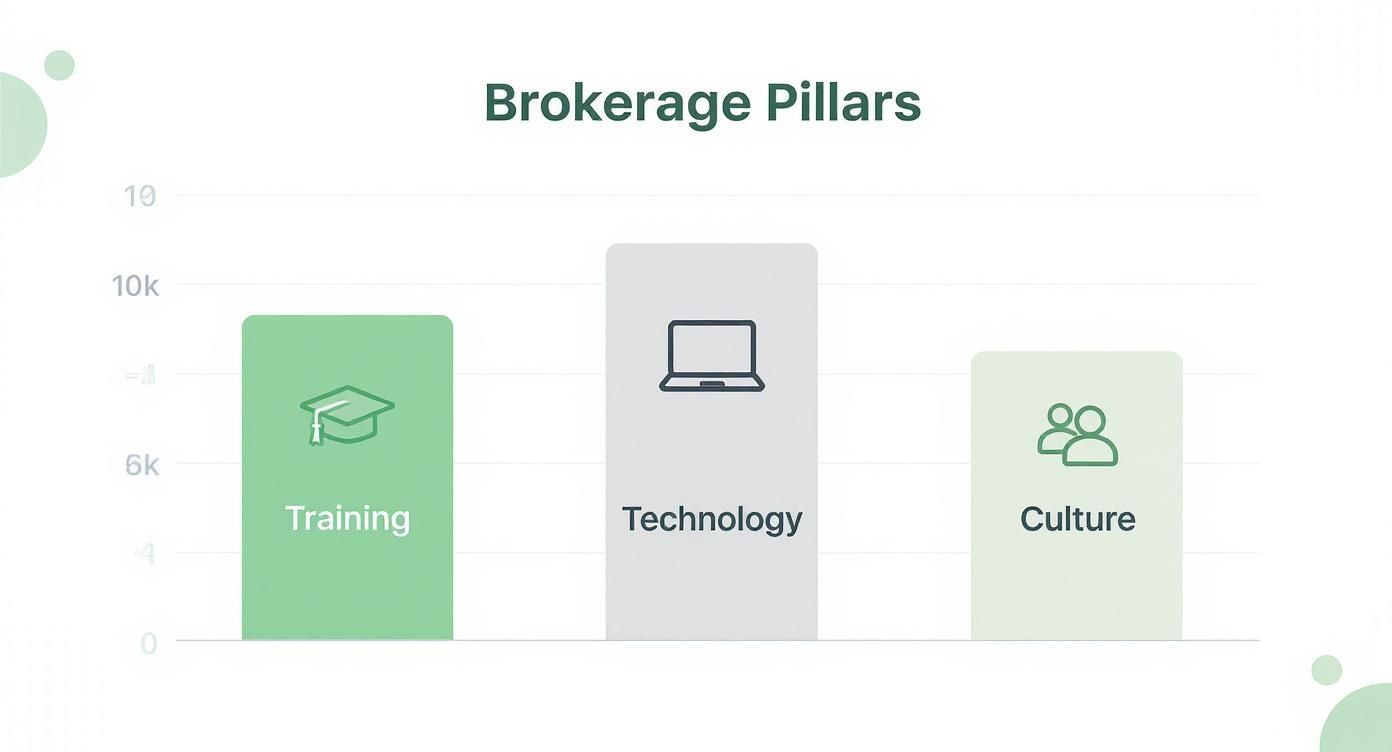
What this really highlights is the interplay between cost and value. A lower split might be an incredible deal if the brokerage is handing you qualified leads, providing top-tier training, and has a culture that genuinely helps you close more deals. It's all about your net, not your gross.
Brokerage Financial Model Comparison
The industry is finally moving away from the old one-size-fits-all approach to agent compensation. Recent regulatory changes are forcing more transparency, and as a result, brokerages are getting more creative with their financial models to attract and keep good agents. The ones offering clear, flexible options are the ones winning. You can read the full research about these market shifts to see where things are headed.
To help you navigate what's out there, here’s a look at the most common financial structures you'll run into.
| Model Type | Typical Split/Fee | Common Associated Fees | A Good Fit For |
|---|---|---|---|
| Traditional Split | 60/40 to 80/20, often with an annual "cap" you must reach. | Franchise fees, E&O per transaction, sometimes tech and marketing fees. | New agents who need training and support, or agents who benefit from a strong brand name. |
| 100% Commission | You keep all the commission. Sounds great, right? | High monthly desk fees and a flat transaction fee for every single deal. | Experienced, high-producing agents who are self-sufficient and generate their own business. |
| Salaried Model | A steady base salary plus bonuses for each closed transaction. | No direct fees to the agent, but bonuses are much smaller than traditional commissions. | Agents who crave stability and predictability, or those who prefer working in a structured team role. |
I've seen agents run the numbers and be completely shocked by the outcome. An agent on a 70/30 split at a brokerage with a killer lead-gen system can easily out-earn an agent on a 90/10 split who’s forced to pay for their own leads, marketing, and tech.
Pro Tip: Don't just ask for the fee schedule. Insist on seeing a sample "Commission Disbursement Authorization" (CDA) from a recently closed deal. This is the document that doesn't lie—it shows every single line-item deduction and reveals the true net payout.
Always, always calculate your potential net income. Your bank account doesn't care about your split; it only cares about what’s left after everyone else gets paid.
Beyond the Paycheck: Training, Support, and Mentorship
A high commission split is seductive. It's also one of the oldest tricks in the recruitment book. Let’s be clear: your license makes you legal, not successful. Especially for new agents, the quality of a brokerage’s training and mentorship is worth far more than a few extra percentage points on a deal you don't know how to get.
An 80/20 split means nothing if you have zero deals to split. The real money in this business comes from consistent, high-level training that actually teaches you how to generate leads, write clean contracts, and navigate the messy reality of negotiations. Choosing a brokerage on the split alone is like picking a personal trainer based on who’s cheapest. You get what you pay for.
The most valuable support systems go way beyond a library of pre-recorded, outdated online modules. Real development comes from live, interactive coaching and hands-on support from people who are actively succeeding in your market right now.
What Real Training Looks Like
When you’re trying to figure out which brokerage to hang your license with, you need to see tangible proof of their commitment to your growth. Vague promises of “great training” are a massive red flag.
Instead, look for specific, ongoing programs that build real skills.
- Hands-On Contract Workshops: Ask to see a calendar of workshops where they tear apart the residential purchase agreement line by line. This is where you learn to protect your clients and yourself from litigation.
- Live Lead-Generation Coaching: Do they teach you how to actually prospect, run effective ad campaigns, and convert online leads into appointments? Ask to see the materials or, even better, sit in on a session.
- A Non-Competing Managing Broker: This is huge. You need a manager whose entire job is to support you, not compete with you for business. When a deal gets complicated at 9 PM on a Saturday, you need a broker who answers the phone.
The industry is finally waking up to the fact that the old "sink or swim" model is a failure, which is why structured real estate apprenticeships are becoming the answer to the alarmingly high agent failure rate. A brokerage that invests in this kind of modern mentorship is investing in its own future.
Mentorship isn't just a buzzword; it's a lifeline. A great mentor accelerates your learning curve, helps you avoid costly mistakes, and provides the encouragement you need when deals inevitably go sideways.
Questions to Expose the Truth
Don't let a recruiter dazzle you with a slick presentation and call it a day. You need to act like an investigative journalist. Beyond the money, a brokerage's real value is its commitment to your growth. For more on this, check out these key principles for building a successful mentor-mentee relationship that you can apply to your search.
Here are the questions that will cut through the fluff and tell you if a brokerage is truly invested in your development or just trying to fill a desk:
- "Can I see your training calendar for the next 90 days?" Look for consistency and a mix of practical skills (contracts, tech) and business growth (prospecting, marketing). If it’s empty, that’s your answer.
- "What does your mentorship program actually entail for new agents?" Get specifics. Is it one-on-one? Is there a formal curriculum? How is the mentor compensated for their time? A mentor who isn't paid to help you has no skin in your game.
- "Who is my direct point of contact for deal-specific questions?" You need to know exactly who to call when you're in a pinch. If the answer is vague ("Oh, anyone can help!"), run.
- "Can I speak with a few agents who joined in the last six months?" This is the ultimate test. Their unvarnished experience will tell you everything you need to know about the reality versus the recruitment pitch.
Evaluating the Brokerage's Tech Stack and Marketing Muscle

In a market where deals are won and lost in minutes, your brokerage’s tech stack is your secret weapon. A modern brokerage arms you with tools that automate the grunt work and amplify your reach. A dated one leaves you fighting a modern war with a musket.
The global real estate brokerage market is on track to hit $1.55 trillion in 2025, and that growth isn't just about more transactions—it's fueled by technology. Brokerages pulling ahead are the ones investing in AI-powered lead scoring, cloud-based transaction management, and e-signature platforms that just work.
This isn't about having the fanciest new app. It's about having integrated systems that actually save you time and make you money. A clumsy, outdated tech suite is a direct tax on your productivity, plain and simple.
Auditing the Agent Toolkit
When you interview a potential brokerage, don't just ask, "Do you have a CRM?" That's the bare minimum. You need to demand a full demo. A powerful tech stack should feel like a cohesive ecosystem, not a junk drawer of random software subscriptions you have to piece together yourself.
Here’s what a competitive tech stack looks like in the real world:
- A User-Friendly CRM: Does it help you manage your pipeline intuitively, or does it feel like you need a PhD to operate it? A good CRM should automate follow-ups and nurture leads without you having to live inside the platform.
- Transaction Management Software: You need systems that smooth out the process from contract to close. Digital signature capabilities and automated compliance checks aren't perks anymore; they're the standard.
- Lead Generation Platforms: Does the brokerage provide a system that generates actual, qualified leads? Ask for the data. What are the conversion rates? Where do the leads come from? See if their platform has any real horsepower.
- Modern Presentation Tools: The ability to create a stunning CMA or a compelling virtual tour is non-negotiable. If you're curious what top agents are using, check out our guide on the best virtual tour software for real estate.
And don't forget about newer tools. Understanding how to use things like those covered in the ultimate real estate chatbot guide can give you a massive leg up. These tools aren't just extras; they are fundamental to competing in a crowded marketplace.
Does Their Brand Have Real Power?
Beyond the software, you have to evaluate the brokerage’s marketing muscle. In a city like Los Angeles, does their brand actually open doors for you, or are you building your entire reputation from scratch? A strong brokerage brand should act as a tailwind, not an anchor.
Key Takeaway: A brokerage's marketing support is a direct reflection of their investment in you. Ask to see their marketing collateral. If their templates look like they were designed in 1998 on Microsoft Publisher, that tells you everything you need to know about their commitment to your success.
Look at their digital footprint. Are they running targeted ad campaigns that generate real business for their agents? Are their social media channels active and engaging, or are they a ghost town? A brokerage that doesn't invest in its own brand is unlikely to invest properly in yours.
You're looking for a partner, one that provides sleek, customizable marketing materials that make you look like the professional you are from day one.
Finding Your Professional Tribe Through Brokerage Culture

You can't quantify culture on a spreadsheet, but make no mistake—it has a bigger impact on your daily happiness and long-term success than any commission split ever will. The “vibe” of an office isn’t a fluffy perk; it’s the operating system for your business.
It dictates how you feel walking in the door, who you can turn to when a deal gets weird, and whether you feel energized or drained by your work environment. This is your professional tribe. Choosing the right one is everything.
Think of it like choosing a workout partner. Some people need a drill sergeant screaming in their ear, while others thrive with a supportive friend who celebrates small wins. There's no single "best" culture, only the one that fits you.
Are you looking for a high-energy sales floor with leaderboards and friendly competition? Or do you prefer a collaborative, boutique environment where agents share strategies over coffee? Being brutally honest with yourself about what motivates you is the first step.
How to Decode a Brokerage's True Vibe
Recruiters are paid to sell you their culture, but what they’re showing you is the highlight reel. Your job is to get past the pitch and see the day-to-day reality. You have to become a cultural detective.
- Ask to Sit in on a Team Meeting: This is the ultimate litmus test. Is it a genuine strategy session where agents are engaged and sharing, or a one-sided lecture from management? The energy in that room will tell you everything you need to know.
- Observe the Office Dynamics: Don’t just take the tour. Ask to hang out for an hour at a guest desk. Do agents actually talk to each other? Is there a buzz of collaboration, or is everyone isolated in their own silo with headphones on?
- Read Between the Lines: Pay attention to the language the managing broker uses. Do they talk more about "team wins" and "support," or is the focus entirely on "top producers" and "individual volume"? Their words reveal their priorities.
The most appealing cultures are built on support, not just sales figures. A brokerage where agents genuinely root for each other creates an environment where everyone elevates their game. This collaborative spirit is often the secret sauce behind top-performing offices.
The Undercover Coffee Meeting
Here’s a pro move: get the real story when the manager isn’t around. After your interview, ask for the names of a few agents who recently joined. Then, reach out and offer to buy one of them a coffee.
Get them talking with questions they can’t give a canned answer to:
- "What’s been the biggest surprise—good or bad—since you joined?"
- "Honestly, how accessible is the managing broker when you have a real problem?"
- "What's one thing you wish you'd known before you came over?"
Their unfiltered feedback is pure gold. It’s the inside scoop no recruitment pitch will ever give you. Finding your tribe means finding a place where you feel supported, challenged, and genuinely excited to build your business. It’s worth the extra effort to get it right.
Making Your Final Decision with Confidence
Okay, you’ve done the legwork. You’ve sat through the presentations, asked the tough questions, and probably have a messy spreadsheet comparing commission splits, tech stacks, and office vibes. It’s time to land the plane.
But this isn't about just going with your gut. This is a hard-nosed business decision. The most effective way to cut through the recruitment hype is to put your top two or three brokerages in a head-to-head matchup. Create a simple scorecard for each one, rating them on the four pillars we’ve covered: Financials, Support, Tech, and Culture. This forces you to look at the raw data you've gathered, not just the glossy promises.
The Final Due Diligence
Before you even think about putting pen to paper, there are a few final, non-negotiable steps. This is where you protect yourself and make sure every promise made during the interview process is locked in.
- Scrutinize the Independent Contractor Agreement (ICA): This is your contract. Read every single word. Seriously. Better yet, spend a few hundred bucks and have a real estate attorney give it a once-over. Pay close attention to the fee structures, your expected duties, and any sneaky non-compete clauses.
- Get the Exit Policy in Writing: What happens if this is a disaster in six months? Ask for the brokerage’s departure policy upfront and get it in writing. You need to know exactly how your active listings and pending deals will be handled if you decide to bounce.
- If It’s Not in Writing, It Doesn’t Exist: Did the managing broker offer you a special commission split? Promise a certain number of leads each month? If it's not in the ICA, it's just talk. Insist on an addendum that details every single verbal commitment made to you.
Remember, you're also aligning with a brand and its market position. The size and clout of a brokerage can say a lot about its stability and the resources it offers. In the US, the top firms have seen massive growth because agents are finding real value there. Bigger brokerages often give you better exposure and a more powerful network right out of the gate. To see how the major players stack up, you can discover more insights about brokerage market share on realestatealmanac.com.
A great brokerage relationship is a partnership built on clarity and mutual respect. If a managing broker hesitates to put their promises in writing, consider it a giant red flag. Transparency from the start is the foundation of a successful business relationship.
This final check is your last line of defense. By digging into the contract and confirming every promise, you eliminate nasty surprises down the road. You’re not just joining an office; you're choosing the platform to launch the next phase of your career. Signing that contract with total confidence is the only way to start.
Ready to explore a brokerage that values transparency, growth, and agent success in the Los Angeles market? At ACME Real Estate, we believe in building true partnerships with our agents. Discover the ACME difference and see if our tribe is the right fit for your career goals at https://www.acme-re.com.
 ACME Real Estate | Los Angeles Boutique Real Estate Brokerage