
Buying a house in Los Angeles isn’t a single event; it’s a full-on campaign. You’ll move through a few key battlegrounds: shoring up your finances, mastering the local market, winning the offer, and then surviving the closing process. But let’s be clear—getting your financial house in order is the non-negotiable first step. It’s what separates the window shoppers from the serious contenders.
Building Your Financial Foundation for the LA Market
Before you even think about scrolling through listings, you need to do a deep, honest dive into your numbers. In a market as cutthroat as LA, sellers and their agents don’t have time for buyers who aren’t ready to pull the trigger. They can smell financial uncertainty from a mile away.
The down payment is usually the biggest mountain to climb. The national median home price hovered around $420,000 in 2023, but let’s face it, that number feels like a fantasy in most LA neighborhoods. A 20% down payment is still the gold standard, helping you avoid private mortgage insurance (PMI). But plenty of buyers, especially first-timers, get in the game with FHA loans requiring as little as 3.5% down.
Just don’t forget to budget for closing costs. They’re the sneaky expense that bites unprepared buyers, typically adding another 2% to 5% of the purchase price to your bill at the end.
Your Credit Score and DTI Ratio
When you ask a lender for hundreds of thousands of dollars, they’re going to look at your financial life under a microscope. Two numbers matter more than anything else: your credit score and your debt-to-income (DTI) ratio.
- Credit Score: Think of this as your financial report card. A stellar score—ideally 740 or higher—unlocks the best interest rates, which can save you tens or even hundreds of thousands over the life of your loan. If you’re not there yet, start now: pay every bill on time, every time, and chip away at those credit card balances. For international buyers using an ITIN, proving your creditworthiness is just as critical. A great first step is learning how to check your ITIN credit score.
- Debt-to-Income (DTI) Ratio: This is simple math with huge consequences. Lenders add up all your monthly debt payments (car, student loans, credit cards) and divide it by your gross monthly income. They want to see a DTI of 43% or lower, and that includes your future mortgage payment. Figuring this out early gives you a brutally honest look at what you can actually afford in a lender’s eyes.
Key Takeaway: Financial readiness isn’t just a big savings account. It’s the whole package: a strong credit history, a low debt load, and verifiable income that convinces a lender you’re a safe bet.
Before you start your home search, it’s essential to have a clear picture of these financial milestones. This table breaks down what you need to know.
Your Home Buying Financial Checklist
| Financial Milestone | Why It Matters | Typical LA Target |
|---|---|---|
| Credit Score | Unlocks better interest rates and loan options. | 740+ for the best rates |
| Down Payment | The initial cash you bring to the deal. | 3.5% – 20%+ of purchase price |
| Closing Costs | Fees for loan origination, title, appraisal, etc. | 2% – 5% of purchase price |
| Debt-to-Income (DTI) | Shows lenders you can handle a mortgage. | 43% or lower (including mortgage) |
| Mortgage Pre-Approval | Proves to sellers you are a qualified buyer. | A formal letter for your max loan amount |
Getting these ducks in a row transforms you from a dreamer into a buyer who can make a credible offer.
The Power of a Pre-Approval Letter
Once you’ve got your finances sorted, it’s time for the final boss of financial prep: the mortgage pre-approval. This isn’t some quick online calculator guess. This is a formal letter from a lender who has painstakingly reviewed your pay stubs, tax returns, and bank statements and has agreed to lend you a specific amount of money.
In Los Angeles, submitting an offer without a pre-approval letter is like showing up to a gunfight with a water pistol. It will be ignored. Period. This single piece of paper is your ticket to the game. It proves to sellers you’re serious, you’re qualified, and you can actually close the deal.
Ready to take that step? Our guide on how to get pre-approved for a mortgage will walk you through it.
Finding Your Footing in LA’s Diverse Neighborhoods

Here’s the thing about Los Angeles: it’s not really one city. It’s a sprawling collection of communities, each with its own vibe, rhythm, and personality. Trying to pick one can feel like staring at a thousand-item menu when you’re starving. The secret isn’t to try a bite of everything—it’s to figure out what you’re in the mood for before you even sit down.
This is where you stop looking at spreadsheets and start getting real about your life. You need to draw a hard line between your absolute must-haves and your nice-to-haves. And you have to be brutally honest with yourself. Is a 30-minute commute a non-negotiable deal-breaker? Do you need access to certain amenities, no exceptions? Is the entire point of this move to get a yard for your dog?
These answers become the guardrails for your search. Instead of drowning in a sea of irrelevant listings, you’ll have a focused, manageable target area that actually fits the life you want to live.
Beyond the Zillow Rabbit Hole
Online portals are great for getting a baseline on pricing and what’s out there, but they don’t tell you the whole story. Not even close. To really get a feel for a place, you have to put your boots on the ground. Go spend a Saturday morning there. Grab a coffee, walk the streets, and just absorb the energy.
- Do a time-of-day check: A neighborhood at 8 AM on a Tuesday is a completely different world than the same spot at 8 PM on a Friday. See both.
- Test the commute for real: Don’t just trust Google Maps. Actually drive it or take the train during rush hour. You need to know if you can stomach that daily reality.
- Live a little: Check out the grocery stores, the parks, the local restaurants. These are the places that will become the fabric of your routine.
This is how you go from being a tourist to a potential local. It’s about connecting with a neighborhood’s actual character. For a deeper look at what makes different parts of the city unique, take a look at our guide on some of the great neighborhoods to live in Los Angeles.
Pro Tip: Never, ever decide on a neighborhood after just one visit. The vibe can change with the weather, a street festival, or even just the time of day. You need multiple visits to get the full picture.
The Agent Advantage: Your Local Expert
This is where a good agent becomes your most valuable asset. They’re not just there to open lockboxes; a great agent is your strategic partner, your fiercest advocate, and your source for the kind of on-the-ground intelligence you’ll never find online.
They provide the context that data misses. They know the subtle differences between two blocks, which condo buildings have a reputation for chaos, and can often hear about properties before they ever hit the market. They are your guide, steering you toward those hidden gems that actually line up with your must-have list.
The home-buying game is wildly different depending on where you are. Over in the UK, for instance, the average house price in England and Wales was £295,000 in 2023, with buyers putting down 10% to 15%. Their government even has programs to help first-timers. You can get more perspective from the global real estate outlook on jll.com. Here in LA, your agent is the one who helps you navigate our own unique, and often complicated, landscape.
Crafting an Offer That Wins in a Competitive Market
You’ve done it. After what feels like a lifetime of touring properties, you finally walk into one that just clicks. It feels like home. Now comes the intense, nail-biting part: shifting from just looking to actually trying to buy the place by making an offer.
This isn’t just about throwing out a number. It’s about building a compelling case that convinces the seller you’re the right buyer.
A purchase agreement has a few key levers you and your agent can pull. The price is what everyone focuses on, but it’s just one piece of the puzzle. Other critical parts are your proposed closing date, the size of your earnest money deposit, and—most importantly—your contingencies. Think of contingencies as your safety net; they’re the clauses that let you walk away if something goes sideways, like a disastrous inspection or your loan falling through.
How to Land on the Right Offer Price
This is where your agent becomes your most valuable player. They’ll pull “comps”—a deep dive into recent sales of similar homes right in that neighborhood. This isn’t a wild guess; it’s a data-backed strategy to figure out what the market is willing to pay right now. Using these comps, you’ll craft an opening offer that’s strong enough to get the seller’s attention but still makes sense for your wallet.
A winning offer isn’t always the highest—it’s often the strongest and most reliable. A seller might choose a slightly lower offer with fewer contingencies from a buyer with solid financing over a higher offer that looks like it could fall apart.
The Art of the Deal
Don’t be surprised when the seller doesn’t just accept your first offer. In fact, you should expect a counteroffer. This is where the real negotiation starts. They might push for a higher price, tighter contingency periods, or other tweaks to the terms.
Don’t take it personally; this is just the dance of the deal. Stay level-headed and lean on your agent to navigate the back-and-forth.
Writing a clean, professional offer is non-negotiable. While a personal “love letter” to the seller can sometimes add a human touch, a meticulously structured agreement often speaks louder. Our guide on how to write an offer letter breaks down exactly how to make your proposal stand out from the pack.
It’s also helpful to have some perspective. The property buying process varies wildly around the world. For instance, in Australia, where the median house price hit AUD 850,000 in 2023, buyers are usually expected to put down a 20% deposit, which comes out to a hefty AUD 170,000. On top of that, costs like stamp duty can add another 4% to 6% to the final price. It’s a good reminder that while the local rules change, the fundamentals of a strong, well-financed offer are universal.
Navigating the Escrow Process from Start to Finish
Getting your offer accepted is a huge milestone, but hold the champagne. You’re not at the finish line yet; you’ve just started the final lap. Welcome to escrow.
This is the crucial 30-to-45-day sprint where everything becomes official. Think of escrow as a neutral third party, a secure holding area for all the money, documents, and promises. No one gets a dime and no keys change hands until every single condition in the contract has been met.
The escrow officer is the referee in this match, making sure your team, the seller’s team, and your lender all play by the rules and hit their deadlines. Behind the scenes, it’s a whirlwind of activity. Your main job? Be ready to sign documents and answer questions the second they come in.
This whole journey, from getting pre-approved to making a winning offer, is what gets you to this point.
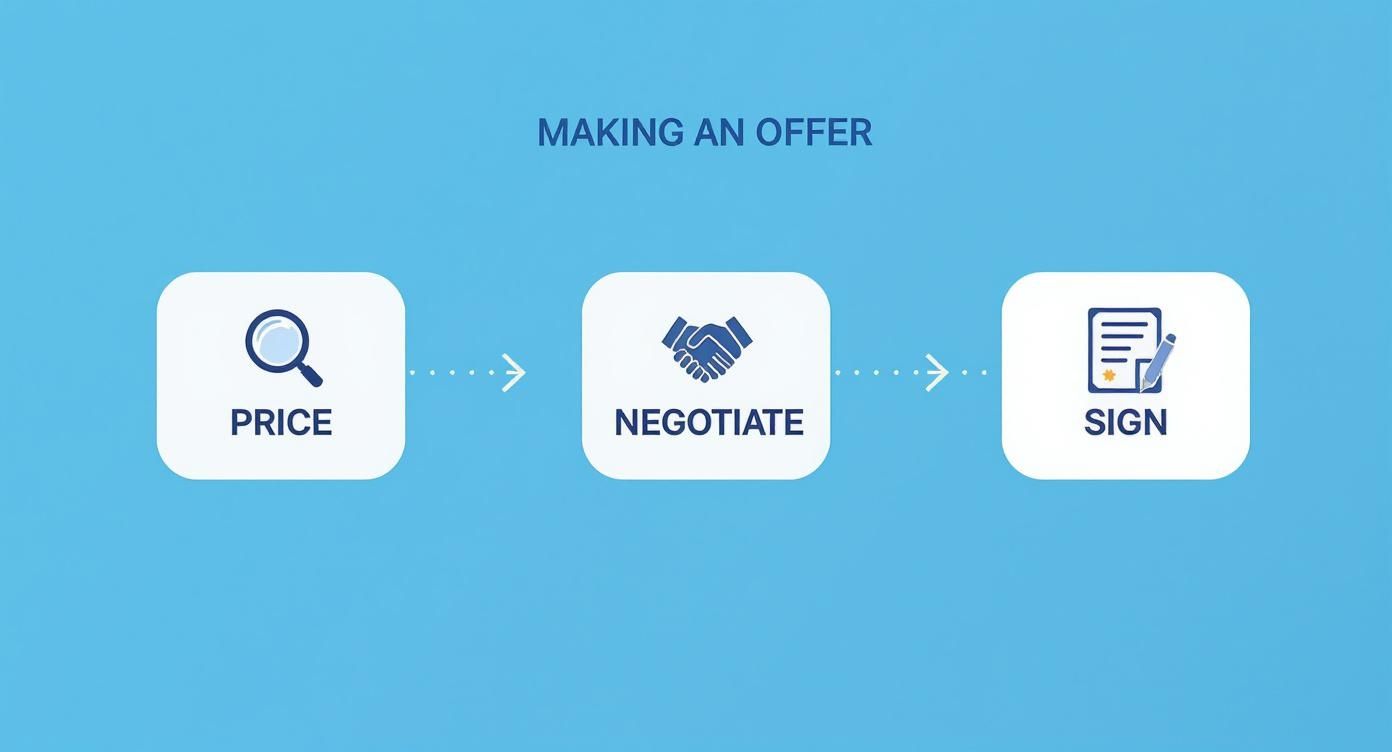
A successful offer isn’t just one move—it’s a series of strategic steps involving smart pricing and tough negotiation that all lead to the signed agreement that kicks off escrow.
Key Milestones During Escrow
Once you’re officially “in contract,” a few critical checkpoints have to be cleared. This is your time for due diligence—your last chance to make sure the property is exactly what you think it is. Don’t rush this part. It’s where you can uncover potential deal-breakers before it’s too late.
- The Home Inspection: Don’t just go with any inspector. Hire your own—and I mean someone who is notoriously thorough, even a little nitpicky. You want the person who will climb into the tightest crawl spaces and test every single outlet. A few hundred dollars spent on a top-notch inspection can easily save you tens of thousands in repairs you never saw coming.
- The Appraisal: Your lender will order an appraisal to make sure the home is actually worth the price you agreed to pay. If that appraisal comes in low, it can create a financing problem. This is where your agent earns their commission—they’ll help you renegotiate with the seller, figure out if you can cover the difference, or even challenge the appraisal itself.
- Reviewing Title and Disclosures: Get ready for a mountain of paperwork. You’ll get a preliminary title report, which confirms the seller legally owns the property and reveals any liens or claims against it. You’ll also get the seller’s disclosures. Read. Every. Single. Page.
Crucial Insight: Think of the escrow period as your safety net. Your contingencies—like the inspection—are there to protect you. If a huge, undisclosed problem surfaces, you have the contractual right to negotiate for repairs or, if necessary, walk away from the deal with your deposit safe and sound.
This whole phase is about verification. You made an offer based on what you saw and were told. Now, you confirm that reality matches the promise. Stay organized, keep in constant communication with your agent, and never hesitate to ask questions. This is the diligence that gets you to the closing table with total confidence, ready for the best part: getting those keys in your hand.
Closing the Deal and Getting Your Keys
You’ve made it to the finish line. The marathon of searching, negotiating, and waiting ends at the closing table. This is the moment where all the paperwork, planning, and patience finally pay off. It’s less of a wild party and more of a tightly scripted legal event, but the outcome is the same: you get the keys to your new home.
One of your last official acts before signing your life away is the final walkthrough. Don’t treat this as a quick formality. This is your absolute last chance to make sure the property is in the condition you agreed to buy it in.
You’re checking that all the negotiated repairs were actually done, the appliances still work, and the seller didn’t punch a hole in the wall while moving their couch out. If you find any new problems, tell your agent immediately. It rarely kills the deal, but it might result in a last-minute credit from the seller to cover a quick fix.
What Really Happens on Closing Day
The closing meeting is where the magic happens—ownership officially changes hands. Expect to be in a room with a small crowd: your agent, maybe your attorney, the seller’s people, and an escrow or closing agent running the show. Prepare yourself for a signing marathon. You’ll be initialing and signing what feels like a mountain of documents.
Make sure you bring a government-issued photo ID and a certified or cashier’s check for your remaining down payment and closing costs. Your lender is required to give you a Closing Disclosure form at least three days beforehand, which breaks down every single fee. Go through it carefully so there are no last-minute financial surprises.
The big moment comes when you sign the deed. This is the document that officially puts the property title in your name. Once it’s signed, witnessed, and notarized, the home is legally yours. As soon as the funds clear and the deed is recorded, you finally get the keys.
You’re a Homeowner—Now What?
Congratulations, you did it. The deal is done, but there are a few loose ends to tie up to make your transition smooth.
Here’s your immediate to-do list:
- Handle Utilities: Get the electricity, water, gas, and internet transferred into your name before move-in day. The last thing you want is to be unpacking in the dark.
- Change Your Address: File the official change with the post office, and don’t forget to update your address with your bank, employer, credit cards, and any subscriptions.
- Organize Your Paperwork: Find a safe, accessible spot for all your closing documents—the deed, title policy, loan paperwork. You’ll need these for taxes and if you ever sell or refinance.
- Prep for Your First Payment: Your first mortgage payment is usually due about a month after closing. Mark the date on your calendar and confirm how and where to send it.
With the paperwork signed and these first few tasks out of the way, you can finally pop the champagne. Welcome home.
Common Questions About Buying Property in LA
The road to buying a home is a long one, and you’re going to have questions. Everyone does. We’ve covered the major steps, but it’s often the smaller details that create the most anxiety. Here are some straight-up, no-fluff answers to the questions we get all the time from LA buyers.
How Long Does It Really Take to Buy a House?
There’s no magic number here, but a realistic timeline from when you start seriously searching to the day you’re holding the keys is usually about two to four months.
The search is the wild card. Finding the right place can take a few weeks if you’re lucky, or a few months if inventory is tight and your wish list is specific. But once your offer gets accepted, the timeline gets much clearer. The escrow process typically runs a predictable 30 to 45 days.
Want to know the single biggest time-saver? Get your mortgage pre-approval done before you even look at a single property. Seriously. It puts you in the driver’s seat.
What Are Contingencies and Which Ones Are Most Important?
Think of contingencies as your safety net—your contractual escape hatches. They’re conditions you write into your offer that have to be met for the deal to move forward. In a market as cutthroat as LA, a few are absolutely non-negotiable.
- Inspection Contingency: This gives you a window of time to bring in pros to inspect the property. If they find a cracked foundation or a nightmare electrical system, you can walk away with your deposit or go back to the seller to negotiate repairs or credits.
- Appraisal Contingency: This is crucial. It protects you from overpaying. If the bank’s appraiser decides the home isn’t worth what you offered, this clause lets you renegotiate or back out without losing your deposit. It ensures your lender will actually fund the loan.
- Loan Contingency: This protects you if your financing hits a snag and falls through at the last minute. Life happens. Without this, you could lose your entire earnest money deposit if the bank doesn’t give final approval.
Your agent’s real value shines here. They’ll help you write an offer with contingencies that protect you without making you look like a weak buyer. It’s a strategic dance, especially when you’re up against multiple offers.
Can I Buy Property if I Have Student Loan Debt?
Yes. Absolutely. Let’s kill this myth right now. Lenders aren’t scared off by student loans; they see them every single day. What they care about is your ability to manage that debt while paying a mortgage.
It all comes down to your debt-to-income (DTI) ratio. Lenders look at all your monthly debt payments—student loans, car payments, credit cards—plus your potential new mortgage. As long as that total doesn’t gobble up too much of your gross monthly income (the magic number is usually around 43-50%), you’re in the game.
Are There Programs for First-Time Buyers in California?
Yes, and they can be a total game-changer, especially in a high-cost area like LA. California has several programs designed to help first-time buyers get over the hump.
The main player is the California Housing Finance Agency (CalHFA). They offer a whole suite of loan programs that can help with both your down payment and your closing costs. The best part is that you can often stack these on top of a standard FHA or conventional loan, which dramatically cuts down the amount of cash you need to close the deal. It’s a must-do to look into these programs or, even better, find a lender who specializes in them.
Navigating the LA real estate market is a journey, and having the right guide can make all the difference. At ACME Real Estate, we’re here to provide the local expertise and dedicated support you need to turn your property goals into a reality. https://www.acme-re.com