
Let’s be real: the era of relying on static photos is toast. Virtual tour software for real estate has officially graduated from a “nice-to-have” gimmick to an essential weapon in your marketing arsenal. It’s your 24/7 digital open house, letting buyers walk through a property from their couch, in their pajamas, at 2 AM. And that’s a powerful thing.
The New Reality of Real Estate Marketing
A few glossy photos and a weekend open house just don’t cut it anymore. Today’s homebuyers live online, and they expect instant, immersive information before they’ll even consider scheduling a showing. This isn’t a trend; it’s the new standard, pushing virtual tour software from the sidelines to the center of any serious real estate strategy.
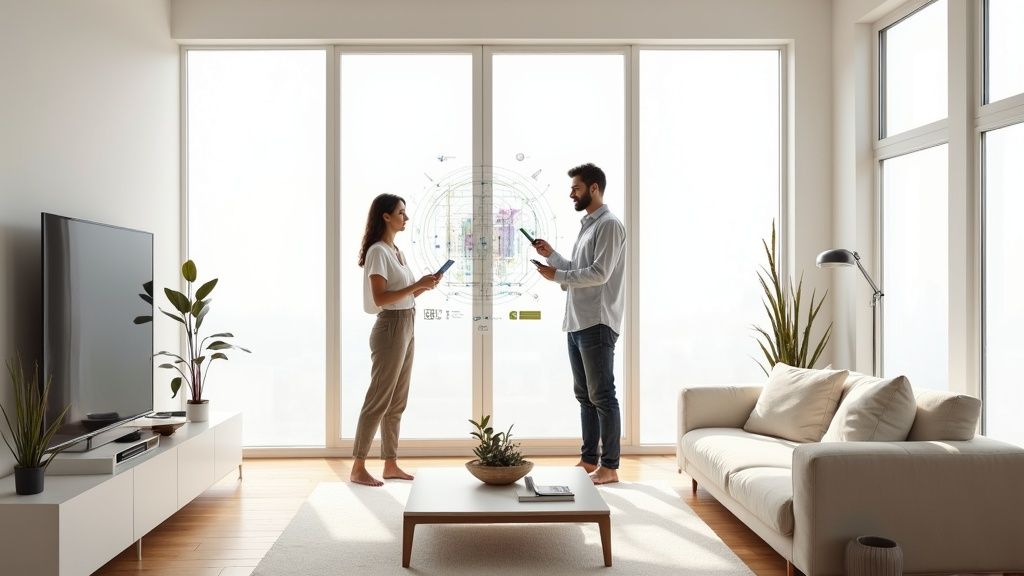
This is more than just cool tech; it’s a fundamental shift in how people connect with a home. When you give someone an immersive, self-guided tour, you’re empowering them to explore on their own terms. That immediate access builds a level of trust and transparency from the very first click, setting you and your client up for a smoother transaction.
Why Virtual Tours Give You a Serious Edge
In a crowded sea of online listings, you have to do more than just show up—you have to stand out. Listings with virtual tours grab more attention and hold it for longer. It’s that simple. The tech also acts as a powerful filter, separating the serious buyers from the casual “Zillow surfers.” By the time someone books an in-person viewing, you can feel confident they’re genuinely interested.
A virtual tour doesn’t just show a property; it sells an experience. It lets a buyer virtually “walk” through their potential new home, get a true sense of the layout, and feel the flow of the space in a way static images never could.
This efficiency is a win for everyone. Sellers get higher-quality leads and less foot traffic from unqualified lookers. Buyers save a ton of time by pre-qualifying homes from their couch. And agents? You get to focus your energy on prospects who are ready to make a move. It’s about working smarter to get better results.
The Market Is Exploding for a Reason
The industry’s rapid embrace of this technology shows up in the numbers. The global market for real estate virtual tour software hit about USD 434.1 million in 2024 and is projected to blast past USD 1,156.1 million by 2032. Right now, North America is leading the pack with a 42.36% market share.
This isn’t happening in a vacuum. It’s part of a much bigger tech shift in property marketing. Understanding trends like how AI is revolutionizing real estate marketing is critical if you want to stay ahead of the curve. Using these tools is no longer optional—it’s what separates the top players from everyone else.
How Virtual Tour Software Actually Works
Alright, let’s ditch the tech-speak and talk about what virtual tour software for real estate really does. Think of it as creating a private Google Street View just for your listing. It hands the digital keys to a potential buyer, letting them look up, down, and all around a property without ever leaving home.
At its core, the software grabs a bunch of panoramic or 360-degree photos and stitches them together into a seamless digital bubble. Once you link these bubbles—say, from the living room to the kitchen—you’ve created a path for someone to “walk” through. It’s a massive leap from a flat, two-dimensional photo gallery into a space someone can actually explore.
It’s More Than Just a String of Photos
This is where the real magic kicks in. It isn’t just about linking images; it’s about building a spatial map of the home. This is the critical difference between a virtual tour and a simple video walkthrough. A video is passive. It forces you to watch what the camera person decided to show you, at their pace.
A virtual tour is active. It gives the buyer total control.
They can spend ten minutes checking out the tile in the primary bathroom or just glance into a spare bedroom. That kind of self-directed exploration creates a much stronger emotional connection to a property. They start to feel what it’s like to live there.
The Two Flavors of Virtual Tours
Not all virtual tours are created equal. You’re generally looking at two main types, and knowing the difference helps you understand what you’re paying for.
- 360° Photo Panoramas: This is the most common and accessible option. The software links a series of spherical photos, creating a tour where users click on arrows or “hotspots” to jump from room to room. It’s effective, doesn’t break the bank, and is a world away from static pictures.
- 3D ‘Dollhouse’ Models: This is the next level up. Using specialized cameras that capture depth information, the software builds a full 3D model of the property. This gives you that stunning “dollhouse” view, letting a buyer see the entire layout from above and grasp how the spaces connect.
The 3D model offers an incredible understanding of a home’s flow. A buyer can immediately see how the kitchen opens up to the family room or where the kids’ bedrooms are in relation to the primary suite. It removes all the guesswork.
A standard photo gallery shows you rooms. A 3D virtual tour shows you a home. It gives buyers the context they need to truly imagine themselves living in the space, something a video can never fully replicate.
In the end, both types of tours have the same goal: digitize a physical space and make it explorable from anywhere on the planet. By stitching images together and mapping them onto a floor plan, the technology creates an interactive blueprint that gives buyers a real sense of presence before they ever set foot inside.
Key Features That Drive Real Results
Diving into the world of virtual tour software for real estate can feel like you’re drowning in options. Every platform promises the moon, but let’s be real—most of it is just noise. The software that actually moves the needle isn’t about flashy gimmicks; it’s about specific, powerful features that help you sell a property.
Think of it this way: a basic tour shows the house, but a feature-rich tour sells the house. It anticipates buyer questions and turns a passive click-through into an active, engaging experience. Your goal isn’t just to create a “walkthrough.” It’s to build a tool that generates actual leads.
Interactive Elements That Convert
The features that pack the biggest punch are the ones that let buyers get their hands dirty, digitally speaking. These tools empower them to explore the details that matter most, turning a simple viewing into a genuine discovery. A static tour is forgettable. An interactive one creates a connection.
You want software that lets you embed clickable “info tags” right into the tour. Imagine a buyer tapping on the kitchen island to see it’s made of Carrara marble or clicking the oven to see it’s a high-end Wolf appliance. You’re not just showing them a room; you’re proactively building value right before their eyes.
Beyond the Visuals: Backend Tools You Need
While the buyer’s front-end experience is critical, the back-end features are what make this software a true business asset. These are the tools that give you priceless insights into what buyers are thinking and help you sharpen your marketing strategy.
Look for platforms with solid analytics. You need to see which rooms get the most views, how long people are sticking around, and where they tend to drop off. This data is gold. It tells you exactly what parts of the home are hitting the mark and what might need a different approach.
Exceptional virtual tour software does more than just display a property; it acts as a digital salesperson. By embedding lead capture forms and offering detailed analytics, it turns passive viewers into active, qualified leads you can actually follow up with.
Essential vs. Advanced Feature Checklist
When you’re comparing software, it’s easy to get lost in a sea of features. To cut through the clutter, here’s a checklist that separates the absolute must-haves from the nice-to-have upgrades. This will help you see what truly matters for your business.
| Feature Category | Essential Feature | Why It Helps You Sell |
|---|---|---|
| Lead Capture | Embeddable contact forms | Grabs high-intent leads at their peak interest, right inside the tour. |
| Engagement | Digital measurement tools | Lets buyers measure walls for their furniture, removing key buying objections. |
| Quality | High-resolution image support | Ensures your brand looks professional and the property shines on any screen. |
| Accessibility | Broad device compatibility | Your tour must work flawlessly on phones, tablets, and desktops. No excuses. |
| Staging | Virtual staging capabilities | Turns empty, cold rooms into inviting homes buyers can connect with emotionally. |
| Analytics | Viewer engagement data | Shows you which rooms are popular and where buyers lose interest. |
| Customization | Brandable interface | Lets you add your logo and colors, keeping your brand front and center. |
Think of the “Essential” column as your non-negotiables. Any serious platform should offer these right out of the box. The “Why It Helps” column connects each feature directly back to what matters most: closing the deal.
One of the most impactful tools is often a built-in virtual home staging app, which can single-handedly transform empty spaces into homes people can see themselves living in.
This feature lets you digitally furnish a vacant property, helping buyers make that crucial emotional connection. It shows them the potential of a space without the massive cost and headache of physical staging. It’s a seriously powerful way to make a listing feel like a home.
Choosing the Right Software for Your Agency
So, you’re on board with virtual tours. Awesome. Now for the tough part—picking the right virtual tour software for real estate without drowning in a sea of marketing hype and feature lists. Let me be blunt: there is no single “best” software. The right software is the one that fits your business, your brand, and your workflow.
Think of it like buying a car. A solo agent running lean just needs a reliable sedan—something simple, efficient, and cheap to run. A high-end boutique firm? They need the luxury SUV with all the tech and premium finishes to wow their clients. And a big, multi-office brokerage? They need a fleet of work vans that can scale and keep the whole operation moving. Your business has its own DNA, and your software needs to match.
Define Your Mission Before You Shop
Before you even look at a single demo or pricing page, you need to get brutally honest about what your agency actually needs. Nail this down upfront, and you’ll save yourself a world of pain later. It’s the difference between buying a tool that makes you money and buying a subscription that just drains your bank account.
Start with these three questions:
- How do you pay for things? Are you a “pay-as-you-go” shop, or do you prefer a predictable monthly bill? Some platforms charge per tour, which is perfect if you only have a few listings at a time. Others offer unlimited tours for a flat fee, which is a no-brainer for high-volume teams.
- What’s your tech tolerance? Be honest. Are you the type who loves tinkering with new gadgets, or do you need something that just works the second you turn it on? Some software is built for simplicity, while others are powerful but come with a steeper learning curve.
- Where does it need to connect? This is non-negotiable. The software has to plug directly into your MLS, website, and CRM. If you’re manually copying and pasting links in this day and age, you’re wasting time you don’t have.
Software Scenarios for Different Agents
Let’s make this real. I’ve seen hundreds of agents and teams adopt this technology, and they usually fall into one of three buckets. Figure out which one sounds like you, and you’ll know where to start looking.
The Solo Agent:
You’re a one-person army. Every dollar and every minute counts. You need a tool that lets you create a professional-looking tour with your smartphone, get it live in under an hour, and doesn’t cost a fortune. Your priorities are speed, simplicity, and affordability.
For the solo agent, the right software is a force multiplier. It gives you the marketing firepower of a bigger team without the overhead. It has to be simple, reliable, and fast—no excuses.
The Boutique Brokerage:
You serve a niche, often high-end, market where brand perception is everything. Your marketing can’t just be good; it has to be impeccable. You’re looking for software with white-glove features like custom branding, high-resolution 3D models, and the kind of deep analytics that impress sophisticated sellers. You’re ready to invest more for a top-shelf result.
The Large Team or Brokerage:
You’re juggling dozens, maybe hundreds, of listings at once. Your world revolves around scalability, collaboration, and consistency. You need a platform that supports multiple agent accounts, enforces brand standards with templates, and gives you a central dashboard to see everything at a glance. You need an industrial-strength system built for volume.
Once you know which profile fits your business, you can cut through the noise. You’ll stop comparing apples to oranges and start focusing on the specific virtual tour software for real estate that was actually built to solve your problems—helping you work smarter, win more listings, and close more deals.
Creating Virtual Tours That Actually Sell Houses
Having powerful virtual tour software for real estate is a great start, but it’s only half the battle. The software itself is just potential in a box. The real magic happens in the execution—turning a collection of 360-degree images into a story that makes a buyer feel like they’re already home.
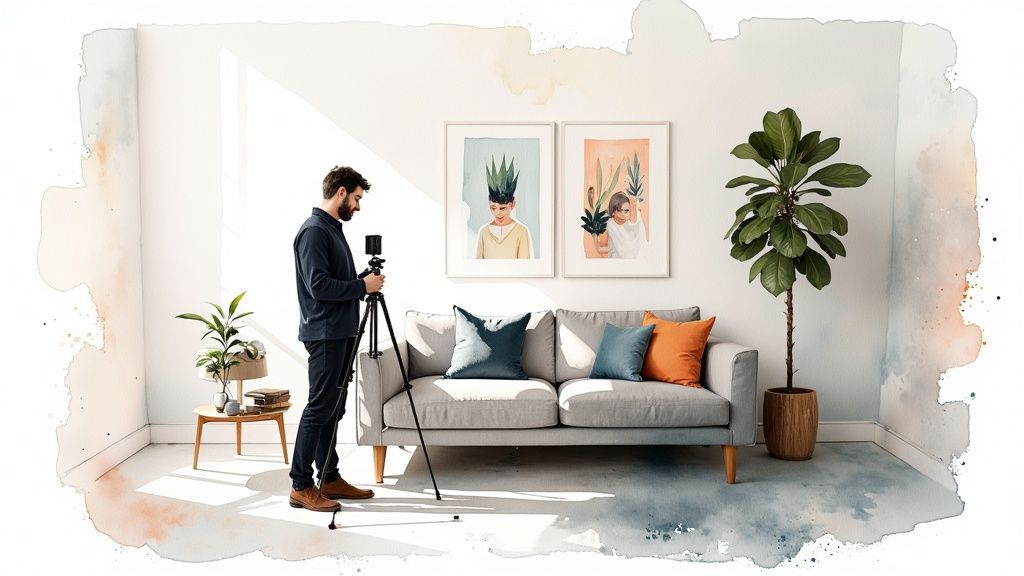
This is your playbook for making tours that look sharp, professional, and almost unfairly persuasive. It all begins long before you even touch the camera. The absolute most important step is prepping the property. Because a high-tech tour of a cluttered, poorly lit house is still just a tour of a cluttered, poorly lit house.
Staging the Scene for the Camera
Your camera will see everything, so the prep work has to be borderline obsessive. This isn’t just about a quick tidying up; it’s about curating a space specifically for a digital audience. Your goal is to create a bright, inviting, and neutral canvas that lets buyers mentally move their own furniture in.
Start by being ruthless with the decluttering. Personal photos, kids’ artwork, refrigerator magnets, and that extra armchair that cramps the living room—it all has to go. You’re selling the space, not the seller’s life.
Next, chase the light. Open every blind, pull back every curtain. Natural light is your best friend, making rooms feel bigger and more welcoming. Then, turn on every single light in the house, even in broad daylight. This eliminates harsh shadows and keeps the brightness consistent from room to room.
Think of yourself as a film director, not just an agent. Every room is a new scene, and your job is to set it perfectly. The camera captures exactly what you give it, so make sure every detail tells the right story.
To really make your visuals stand out, check out these game-changing real estate photography tips that apply just as much to tours as they do to static photos.
The Technical Playbook for a Flawless Tour
With the house looking its best, it’s time to get technical. This is where you build the seamless “walking” experience that separates the pros from the amateurs. It all boils down to a logical path and smart camera placement.
First, map out your shot list. Plan a route that flows naturally, just like someone would walk through the home during an in-person showing. Start at the front door, move through the main living areas, into the kitchen, then bedrooms, and finish with any outdoor spaces. A logical flow is non-negotiable.
Now for the camera. Always, always use a tripod. This keeps your shots perfectly level and stable. Position the camera around chest height (about five feet) in the center of each room or scan point. This gives the most natural, true-to-life perspective and avoids warping the room’s proportions. For tight spaces like bathrooms or walk-in closets, setting the camera just inside the doorway can help capture everything without making it feel claustrophobic.
Common Mistakes That Will Sabotage Your Tour
Even with the best gear and software, a few rookie mistakes can completely kill the vibe for a potential buyer. Avoiding these pitfalls is just as critical as everything else we’ve covered. Here’s a quick rundown of what not to do.
- Inconsistent Lighting: Jumping from a sun-drenched living room to a dark hallway is jarring. Aim for consistent brightness by shooting at a time of day with good, even light and using all the interior lights to fill in the gaps.
- A Disjointed or Illogical Flow: Don’t make people leap from the master bedroom to the basement and back to the kitchen. A confusing path makes it impossible for them to build a mental floor plan of the house.
- Visible Clutter or Personal Items: A stray dog toy, a stack of mail, or your own reflection in a mirror instantly breaks the illusion and screams unprofessional. Do one final walkthrough of every single room right before you start shooting.
- Poor Camera Angles: Setting the camera too low makes furniture look giant and intimidating; too high makes it feel like a security camera feed. Stick to that consistent, level, chest-high placement for a perspective that feels natural and accurate.
Turning Virtual Tours into Business Wins
So, you’ve invested in the tech and figured out how to create those slick, immersive tours. Great. Now comes the important part: turning that cool-looking tour into a strategic asset that actually wins you more business. Using virtual tour software for real estate is about way more than just showing off a property; it’s about making it work for you to grow your bottom line.
Think of this tool as the new centerpiece of your listing presentation. When you sit down with potential sellers, showing them a stunning virtual tour of a property you just sold is a world away from just talking about your marketing plan. You’re showing them, not telling them. You’re demonstrating a high-value service that makes their home look incredible and puts it in front of a global audience, 24/7.
From Cool Feature to Conversion Tool
Your virtual tour needs to be a workhorse, not just a show pony. To get real results, it has to be woven into every single piece of your marketing. The goal is simple: make it impossible for an interested buyer to miss.
Start by making the tour the star of your online presence. Get it embedded right at the top of the listing page on your website and the MLS. Then, start building entire campaigns around it.
- Social Media: Don’t just post the link. Chop up the tour into short, dynamic video clips for Instagram Reels or Facebook Stories. Use these as teasers to drive people back to the full experience.
- Email Newsletters: Make the virtual tour the main event in your “New Listing” emails. A big, bold “Tour the Home Now” button is going to get a ton of clicks from your buyer database.
- QR Codes: This is a brilliant move. Put a QR code that links straight to the tour on your ‘For Sale’ signs and property flyers. Now, anyone driving or walking by can take a full tour right from the curb.
The real power of a virtual tour is its knack for turning passive lookers into active leads. It’s not just another marketing piece; it’s a lead-gen machine that qualifies buyers and wows sellers before you even shake their hand.
The Undeniable Return on Investment
This isn’t just about looking tech-savvy. The numbers prove that this technology has a direct, measurable impact on your sales. Listings with high-quality 3D virtual tours have been shown to sell for 4% to 9% more and can close deals up to 31% faster.
Even better, a massive 74% of agents report that they’ve won more listings specifically because they offer these immersive tours. It’s a clear competitive advantage.
This is about more than closing deals faster—it’s about building a stronger, more modern brand. Of course, an amazing tour starts with an impeccably presented home. Our complete guide on how to stage a home gives you the perfect playbook to make your virtual tours truly pop. When you combine killer staging with powerful tech, you create a one-two punch that helps you win more listings and sell them for top dollar.
Common Questions About Virtual Tours
Whenever a new tool hits the market, agents naturally have questions. It’s smart to be skeptical. Let’s cut through the noise and tackle the big questions I hear all the time about virtual tour software for real estate.
No jargon, no fluff—just straight answers to help you decide if this is the right move for your business.
Do I Need an Expensive Camera to Get Started?
Absolutely not. People think they need to drop a grand on a fancy 360° camera to get started, but that’s a myth. While those pro cameras give you that super crisp, high-end look, the top software today is built to work seamlessly with the phone already in your pocket.
If you’re just dipping your toes in, your smartphone is more than enough to create a tour that wows buyers. The software does all the heavy lifting—stitching the images together and making it look smooth—so you can just focus on capturing the home’s best angles.
How Much Does Virtual Tour Software Usually Cost?
The pricing usually breaks down into two camps, and which one you choose really depends on your deal flow.
- Subscription Plans: These typically run from $20 to over $100 a month. If you have a steady pipeline of listings, this is almost always the way to go. You get a set number of tours, sometimes unlimited, for a flat fee. It’s predictable and cost-effective for active agents.
- Pay-Per-Tour: Some platforms let you buy tours one at a time. This is a great option if you work with fewer, higher-end properties and want to avoid another monthly bill. You just pay for what you use.
A high-volume agent or team will save money with a subscription, hands down. A solo agent who handles a couple of big listings a year might find the pay-as-you-go model makes more sense for managing cash flow.
Will Virtual Tours Replace In-Person Showings?
Let’s clear this one up right now: virtual tours don’t replace showings. They upgrade them. Think of a virtual tour as the world’s most effective filter for your leads.
It lets serious buyers walk through the property from their couch, getting a real feel for the layout and flow. They can quickly decide if the home is a true contender, which saves you—and them—a ton of wasted time driving all over town.
A virtual tour makes sure that when a buyer finally books a showing, they’re not just curious. They’re already invested. Your in-person showings stop being speculative first glances and become high-intent second visits, pushing serious buyers toward an offer much faster.
This completely changes the game. You spend less time with tire-kickers and more time with people who are actually ready to write a check. It’s not about replacing handshakes; it’s about making sure the ones you have really count.
Ready to elevate your listings and win over more clients? The expert team at ACME Real Estate uses cutting-edge tools to make your property stand out. Discover the difference at https://www.acme-re.com.
 ACME Real Estate | Los Angeles Boutique Real Estate Brokerage