
To calculate cost per square foot, you simply divide the property’s price by its total square footage. It sounds dead simple, but the real skill is reading between the lines and understanding the variables lurking behind those numbers. It’s a foundational metric for comparing properties and estimating project costs with a shred of real confidence.
Decoding Cost Per Square Foot
Cost per square foot is one of the most-used numbers in real estate, but it’s also one of the most misunderstood. Think of it less as a final grade and more as a single clue in a much larger mystery.
Real estate agents, builders, and appraisers all lean on this number, but often in slightly different ways. For a homebuyer, it helps compare a downtown condo to a sprawling house in the suburbs. For a builder, it’s the bedrock of any project estimate. In new construction, for instance, the median cost to build a custom home in the U.S. recently hit $166 per square foot.
Why This Metric Matters (and How to Use It)
Getting a handle on cost per square foot goes way beyond simple math; it’s about seeing the strategic angles. It lets you:
- Compare Apples to Apples: Evaluate similar properties in a neighborhood to spot potential deals or overpriced listings.
- Budget Renovations: Get a ballpark figure for new additions or remodels based on regional construction costs.
- Analyze Market Health: Track how cost per square foot changes over time to understand where the local market is heading.
This metric is a starting point, not the finish line. A low cost per square foot could signal a steal—or a property needing a ton of work. A high number might reflect luxury finishes, an unbeatable location, or sometimes, just an overly ambitious seller.
To help clarify what goes into this calculation, here’s a quick breakdown of the core components.
Core Components of the Calculation
This table gives a quick look at the two essential variables for the cost per square foot formula and what they typically include.
| Component | What to Include | Common Pitfalls |
|---|---|---|
| Property Price or Total Cost | Sale price, land acquisition, permits, labor, materials, subcontractor fees. | Forgetting “soft costs” like architectural designs, financing fees, or landscaping. |
| Total Square Footage | Finished, livable, and conditioned space (heating/cooling). | Including unfinished basements, garages, or outdoor patios, which skews the number. |
Getting these two inputs right is what separates a useful estimate from a misleading one.
Ultimately, this calculation is just one key piece of the puzzle. It works alongside other crucial factors when you work to determine home value with accuracy. For serious project cost projections, many pros use a construction estimating software to dial in the details.
Learning to use this metric strategically helps you see past a surface-level price tag to understand a property’s true potential.
Applying the Formula to Real Properties
Alright, let’s get our hands dirty and put the core formula—Total Cost ÷ Total Square Feet—into action. Knowing the formula is one thing, but using it to make smart decisions is where the real money is made or saved.
Imagine you’re looking at a 2,000-square-foot home listed for $500,000. The math itself is straightforward:
$500,000 ÷ 2,000 sq. ft. = $250 per square foot
This number is your starting point, your baseline. The real magic happens when you start comparing it.
If a similar house next door, with comparable finishes and condition, is priced at $280 per square foot, your first property suddenly looks like a solid deal. On the flip side, if the neighbor’s home is going for $220 per square foot, that’s a huge red flag. It’s time to put on your detective hat and figure out what’s driving that price down.
Shifting Gears to Construction Projects
The formula works just as well for construction, but pinning down your “Total Cost” is a much bigger puzzle. You aren’t just looking at a sticker price; you’re building it from the ground up, piece by piece.
Your total cost has to include absolutely everything that goes into the project before you can divide by the square footage. This means you need to get granular and account for:
- Hard Costs: Think tangible things—lumber, concrete, drywall, and the direct labor to put it all together.
- Soft Costs: These are the “paper” costs like architectural plans, engineering fees, and pulling all the necessary building permits.
- Finishing Costs: This is the final stretch, covering things like landscaping, installing appliances, and adding the final light fixtures and hardware.
The type of material and labor you choose can dramatically swing the final numbers. For example, a high-end standing seam roof will have a completely different cost profile than standard shingles, a detail you’d see broken down in a good metal roof installation cost guide.
This infographic really breaks down how a contractor bundles all those different expenses to land on an accurate total project cost.
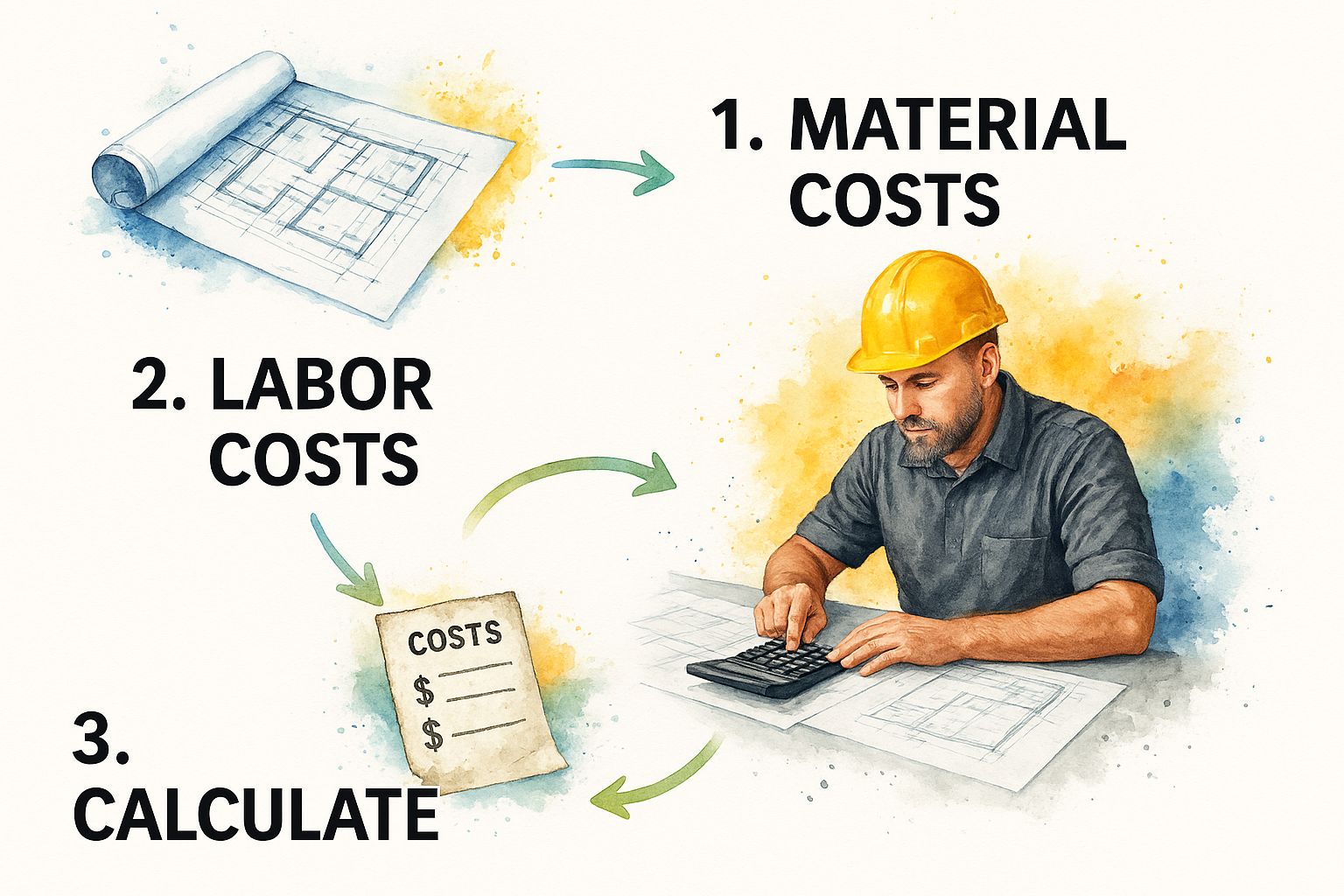
As you can see, it highlights that both direct expenses like materials and indirect costs like project management fees are crucial for an accurate calculation. Mastering this gives you the confidence to run the numbers on any property or project that comes your way.
What Actually Counts as Square Footage
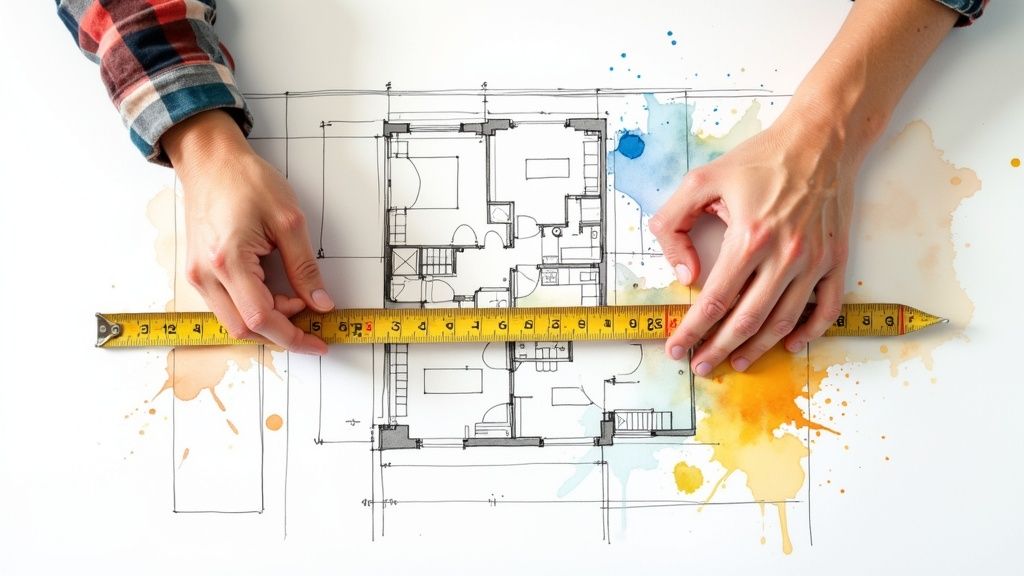
This is where so many people get it wrong. A home’s official square footage isn’t just the total space under its roof. It’s a very specific, rule-based measurement, and getting this number right is the only way to get a cost per square foot that means anything.
The industry standard that appraisers live by is called Gross Living Area (GLA). Just think of GLA as the finished, livable space inside a home that’s permanently heated and cooled. An inflated square footage number can make a property seem like a steal by artificially lowering the cost per square foot, when in reality, you’re not getting the deal you think you are.
Distinguishing GLA from Total Area
So, what makes the cut? It’s not just about having walls and a roof. For a space to be included in the official GLA, it has to meet a few key criteria.
Here’s a quick rundown of what’s in and what’s out:
- Included in GLA: This is your core living space. We’re talking about living rooms, bedrooms, kitchens, and hallways that are properly finished and have climate control.
- Excluded from GLA: Garages, unfinished basements, screened-in porches, and attics without a permanent HVAC source don’t count.
A pristine two-car garage or a massive, bone-dry basement absolutely adds value to a property. No question. But they shouldn’t be part of the core calculation you use when you’re comparing homes on a per-square-foot basis.
It’s also crucial to remember that local building codes and market customs can tweak these definitions. This is a big reason why construction cost estimates are so sensitive to location and timing. You can see how this plays out on a bigger scale with commercial properties, where these factors are magnified.
Always, always verify the official square footage from public records or appraisal documents. If you really want to get granular, learning how to read a property survey will give you the most precise dimensions possible. This step ensures you’re always comparing apples to apples.
The Numbers Don’t Tell the Whole Story
Relying on cost per square foot alone is a classic rookie mistake. I’ve seen it a thousand times. You can have a sleek downtown condo and a rambling suburban home with the exact same square footage, yet their price tags are worlds apart. Why? Because context is everything, and this simple metric is just the beginning of the conversation, not the end.
The final number gets pulled in a dozen different directions by hidden variables. Things like the raw value of the land, the quality of the construction, and high-end amenities can completely warp the equation. That gourmet kitchen with Viking appliances or the brand-new roof? They will absolutely inflate the cost per square foot, and for good reason—they add real, tangible value.
Location and Land Value
We’ve all heard it: location, location, location. The crazy thing is, the land beneath a house is often one of its most valuable assets, yet it has zero square feet. A tiny bungalow in a vibrant neighborhood can have an astronomical cost per square foot simply because the dirt it sits on is worth a fortune.
This isn’t just a local thing; it’s a global reality.
International construction cost reports show just how dramatic the differences are from one city to the next. High-demand hubs like Geneva or London have bloated costs because of labor shortages and strong currencies, while other places see wild spikes from inflation. It proves that local economics, policies, and market demand make cost per square foot a constantly moving target.
This kind of data, often found in resources like the International Construction Cost Yearbooks, hammers home a critical point: where a property is located is just as important as how big it is.
Quality, Upgrades, and Finishes
Let’s get one thing straight: not all square footage is created equal. A home built with premium materials and custom finishes will always command a higher price than a basic builder-grade box. The real value is often in the details that the simple math completely ignores.
Think about the variables that can make a huge impact:
- Recent Upgrades: A new HVAC system, an updated electrical panel, or energy-efficient windows add immense value and peace of mind.
- High-End Finishes: I’m talking about real hardwood floors, marble countertops, and custom cabinetry—the stuff that makes a house feel special.
- Desirable Amenities: A swimming pool, a professionally landscaped yard, or even just being a block away from a popular park can skew the numbers way up.
These qualitative factors are what separate a good analysis from a bad one. In today’s market, buyers are rejecting conformity. I’ve seen firsthand how the end of cookie-cutter real estate is changing valuations. The key is to use cost per square foot as a starting point for a much deeper dive, not as the final word on what a property is truly worth.
Common Calculation Mistakes to Avoid
It’s shockingly easy to get this calculation wrong, and a bad number can lead to a disastrous investment. Knowing the formula for cost per square foot is only half the battle. The real skill is avoiding the common traps that make the metric useless.
Let’s break down the missteps I see all the time.
The single biggest mistake? Comparing completely dissimilar properties. Trying to measure a brand-new custom home against a century-old fixer-upper is like comparing a sports car to a pickup truck. Their construction quality, features, and fundamental value are worlds apart. A simple cost-per-square-foot comparison just doesn’t hold water in these scenarios.
Forgetting What’s Outside the Walls
Another classic blunder is ignoring the land value. The lot a house sits on is a massive part of its total price, but it doesn’t have “square feet” like the structure does. A tiny house on a huge, valuable piece of land will have a wildly inflated cost per square foot, making it look overpriced when the real value is in the dirt it sits on.
Just as bad is using old data. Real estate moves fast. Last year’s comps might as well be from another decade in a hot market. You absolutely have to use the most recent sales data to make sure your numbers reflect what’s happening right now.
Getting the Square Footage Straight
Never, ever take the listed square footage at face value without checking it. It’s not always about deception; different sources just measure things differently. A seller might include a finished basement or a three-season porch that an appraiser would legally have to exclude from the official Gross Living Area.
The most reliable numbers almost always come from official sources. Your best bet is to cross-reference the listed square footage with public tax records or, even better, the most recent appraisal report. This ensures your entire calculation is built on a solid, defensible foundation.
Making these checks a mandatory part of your process will keep your numbers sound and your decisions smart. No cutting corners here.
Common Questions About Cost Per Square Foot
Let’s dig into some of the questions that always come up when you start running the numbers on cost per square foot. Getting the nuances right here is what separates a smart analysis from a costly mistake.
Why Is the Cost Per Square Foot Different for Two Homes on the Same Street?
It’s a classic scenario: two houses, side-by-side, with wildly different values. What gives?
The answer almost always comes down to the details. A home’s condition, the quality of its finishes, recent renovations, lot size, and specific features like a pool or a finished basement can create massive swings in value. A house with a brand-new kitchen and high-end materials will naturally command a higher cost per square foot than its neighbor with original fixtures from the 70s. It’s never just about the address.
Can I Trust the Square Footage Listed by the Seller?
Use the seller’s number as a starting point, but always verify it. A listing might sneak in areas that an appraiser would never count, like a sunroom without permanent heating or a finished garage. For a truly accurate calculation, you have to get your hands on official documents.
To get the real story, check these sources:
- The county tax assessor’s public records.
- The latest property appraisal report.
These professionals use standardized measurement rules, which means your numbers will be solid and reliable.
A suspiciously low cost per square foot isn’t always a bargain—it can be a major red flag. It might signal a property needing tens of thousands in repairs, or it could be in a less desirable location.
Does a Lower Cost Per Square Foot Always Mean a Better Deal?
Absolutely not. While it’s a useful comparison tool, this metric should never be the only factor you consider. A bargain-basement price per square foot often points to underlying issues that will cost you far more in the long run.
Always look at the complete picture. You need to weigh the property’s condition, location, and overall features before deciding if you’ve found a diamond in the rough or just a lump of coal.
Ready to explore what Los Angeles has to offer? At ACME Real Estate, we believe that buying or selling property isn’t just a transaction—it’s a life-changing milestone. Contact ACME Real Estate today and discover why we’re the name locals trust when it matters most.