
You’ve probably seen a listing price that looked almost too good to be true, only to notice the words “short sale” tucked into the description. So, what exactly does that mean? Buying a short sale home is a completely different beast than a typical purchase. It means you’re buying a property directly from a homeowner for less than they owe on their mortgage, but only if their lender agrees to it.
It’s a unique path to homeownership, one that can land you a killer deal. But it’s not for the faint of heart. This is real estate on hard mode, and you need a game plan.
Decoding the Short Sale Puzzle

Let’s cut through the jargon. The “short” in short sale has nothing to do with the timeline—in fact, these deals are notoriously long. It means the sale price will fall short of what the homeowner still owes on their mortgage.
This usually happens when a homeowner hits a major financial snag, and at the same time, their home’s value has tanked. They’re “underwater,” owing more than the house is worth, and can no longer make the payments. The short sale is their last-ditch effort to avoid foreclosure.
Instead of the bank going through a long, expensive foreclosure process, they agree to take a hit and accept a lower payoff. For a buyer, this is where the opportunity lies. You can step in and potentially snag a home for a serious discount.
Why Would a Bank Ever Agree to This?
It seems totally backward, right? Why would a massive financial institution willingly lose money? It all comes down to a cold, hard business calculation. Foreclosures are a nightmare for banks—a money pit of legal fees, property upkeep, and security costs.
A short sale, while not their first choice, is often the lesser of two evils. Here’s why they play ball:
- They cut their losses faster. A short sale gets a non-performing loan off their books much quicker than a foreclosure auction, which can drag on for a year or more.
- It costs them less. Foreclosing is expensive. They avoid massive legal fees, court costs, and the expenses of maintaining a vacant property.
- It reduces their risk. An empty, bank-owned house is a magnet for vandals, squatters, and neglect. A short sale property is usually still occupied, meaning it’s being cared for right up until closing.
Think of a short sale as a complex negotiation with three key players at the table: the seller, you (the buyer), and the seller’s lender. Ultimately, the bank holds all the cards. Their approval is the final green light that makes the entire deal possible.
The Big Trade-Off for Buyers
The number one reason to even consider this gauntlet is the price. The potential to get a home for significantly under market value is very real. A recent Zillow report, for instance, found that short sales in the U.S. sold for an average of 10–12% below their list price. You just don’t see discounts like that in a normal sale.
But here’s the catch. That financial upside comes with a hefty price tag of its own: time and risk. You absolutely must have the patience of a saint. Getting the lender to approve your offer isn’t a matter of days or weeks; it can easily take three to six months, sometimes longer. And there’s no guarantee they’ll say yes.
On top of that, these homes are almost always sold “as-is.” The seller is broke, and the bank isn’t fixing a leaky faucet, let alone a cracked foundation. What you see is exactly what you get.
Before you jump in, you have to weigh that potential reward against the very real risks and the long, uncertain wait.
Short Sale vs. Traditional Purchase At a Glance
To put it all in perspective, here’s a quick breakdown of how a short sale stacks up against your everyday home purchase.
| Key Factor | Short Sale Purchase | Traditional Purchase |
|---|---|---|
| Approval Process | Requires approval from the seller and their lender(s). | Requires approval from the seller only. |
| Timeline | Highly unpredictable; typically 3–6+ months to close. | Predictable; typically 30–60 days to close. |
| Negotiations | Complex, three-way negotiation. The bank has the final say. | Direct negotiation between buyer and seller. |
| Property Condition | Almost always sold “as-is.” Repairs are the buyer’s issue. | Repairs are often negotiable. |
| Price | Potential for a significant discount below market value. | Price is based on current market value. |
| Certainty of Sale | Low. The deal can fall through at any stage. | High. Once an offer is accepted, it usually closes. |
This table really highlights the core trade-off: you’re exchanging the speed and certainty of a traditional purchase for the possibility of a much lower price.
Building Your Expert Short Sale Team
Let me be blunt: trying to navigate a short sale on your own is a terrible idea. It’s like performing your own dental work after watching a YouTube video. You’re not just dealing with a seller; you’re going head-to-head with a bank’s loss mitigation department, a bureaucratic machine with its own set of arcane rules. You need a specialized crew.
This is not the time to call up your cousin who just got their real estate license. You need pros who’ve been in these trenches before, who know the playbook, and who understand the players. Putting this team together is probably the single most important thing you’ll do.
Your Short Sale Quarterback: The Real Estate Agent
First up, your agent. The right one is your guide, your advocate, and your project manager. When you’re vetting agents, don’t hold back. You’re hiring for a high-stakes, high-stress job.
Look for agents with specific credentials that prove they know this niche inside and out. Designations like Certified Distressed Property Expert (CDPE) or a Short Sales and Foreclosure Resource (SFR) certification are good signs. It means they’ve invested real time and money to master these brutal deals.
When you interview them, hit them with the tough questions:
- How many short sale deals have you actually closed in the last 12 months?
- What’s your success rate getting offers approved by the bank?
- Walk me through the process. What are the biggest roadblocks you expect us to hit?
- How do you manage communication with the seller’s agent and the bank’s asset manager?
A great short sale agent doesn’t just show you houses. They anticipate the bank’s next move and help you build an offer package so solid it’s practically bulletproof. They run the whole play.
The Legal Eagle: Your Real Estate Attorney
Even if it’s not required in your state, bringing a real estate attorney onto your team is one of the smartest moves you can make. Short sales are littered with legal landmines—think hidden liens or title defects that can detonate your deal weeks or even months in.
Your attorney’s only job is to protect you. They’ll go through the purchase agreement, title report, and every piece of lender paperwork with a fine-tooth comb to make sure you’re not walking into a trap. They can also step in to negotiate specific terms and build contingencies into your contract that protect you if the bank stalls or tries to move the goalposts.
Think of your attorney as your defensive line. Their whole purpose is to spot trouble before it sacks the deal, ensuring that when you finally get the keys, that property is yours—free and clear of the seller’s financial ghosts.
The Money Maven: A Savvy Loan Officer
Financing a short sale is a different beast entirely. The timelines are unpredictable and long. The seller’s bank will demand absolute proof that your financing is a done deal before they even consider your offer. A generic call-center lender just doesn’t have the patience or expertise for this game.
You need a loan officer who gets it. Someone who understands the approval process could drag on for months and won’t be annoyed when they have to update your pre-approval letter for the third time. You want someone proactive and ready to sprint the moment the bank finally gives the thumbs-up. For more on this, check out our guide on how to compare mortgage lenders to find someone who can handle the heat.
The Final Piece: A Great Inspector
Last but not least, you absolutely need a top-notch inspector on your team. Short sale homes are sold strictly “as-is,” which is industry code for “what you see is what you get, problems and all.” A thorough pre-purchase building inspection is your only real chance to find out what’s lurking behind the walls.
This inspection uncovers the big-ticket disasters—a failing roof, a cracked foundation, ancient plumbing—so you know exactly what you’re walking into before your deposit is non-refundable and it’s too late to walk away.
How to Make an Offer the Bank Will Notice
This is where the rubber meets the road. Making an offer on a short sale isn’t about just lobbing a number out there and seeing what sticks. You’re not trying to impress the seller; your real audience is a busy, skeptical asset manager at the bank who has seen it all before.
Think of your offer less as a bid and more as a business proposal. Its job is to make their decision to say “yes” as easy as possible. A clean, comprehensive, and compelling offer can jump to the front of the line, even over others that might be a few thousand dollars higher.
Crafting a Bulletproof Offer Package
Your offer needs to be professional, thorough, and leave zero room for questions. A flimsy, incomplete package gets tossed to the bottom of a very tall pile, where it can sit and collect dust for weeks.
Here’s the essential trifecta your agent should be putting together for you:
- A Solid Purchase Agreement: This is standard, but the price needs to be rooted in reality. Lowball offers are an absolute waste of everyone’s time in a short sale. The bank has already done its homework and has a pretty good idea of what the property is worth.
- Proof of Funds: If you’re coming in with cash, this means recent, clean bank statements showing you have the full amount ready to wire. No mysteries, no excuses.
- A Strong Pre-Approval Letter: This is non-negotiable. I’m not talking about a flimsy “pre-qualification” printout. You need a full-blown pre-approval from a reputable lender who gets the long, drawn-out timelines involved in a short sale.
Without these three documents, your offer is dead on arrival.
The Seller’s Side of the Story
Beyond your own financials, the bank needs the full story on the seller’s hardship. This is what legally justifies their decision to approve the short sale and accept a loss. Your agent has to work closely with the seller’s agent to make sure this “short sale package” is complete and compelling.
It’s a collection of the seller’s personal documents, typically including:
- Hardship Letter: A signed, detailed explanation of why they can no longer afford their mortgage payments.
- Financial Statements: Pay stubs, bank statements, tax returns—the whole picture.
- Authorization to Release Information: A critical form that gives the bank permission to talk to the agents, attorneys, and anyone else involved in the deal.
When the asset manager sees a complete package from both the buyer and the seller, it sends a powerful message: this deal is organized, serious, and ready to close. It’s a massive green flag. Having a strong team in your corner is the only way to make this happen smoothly.
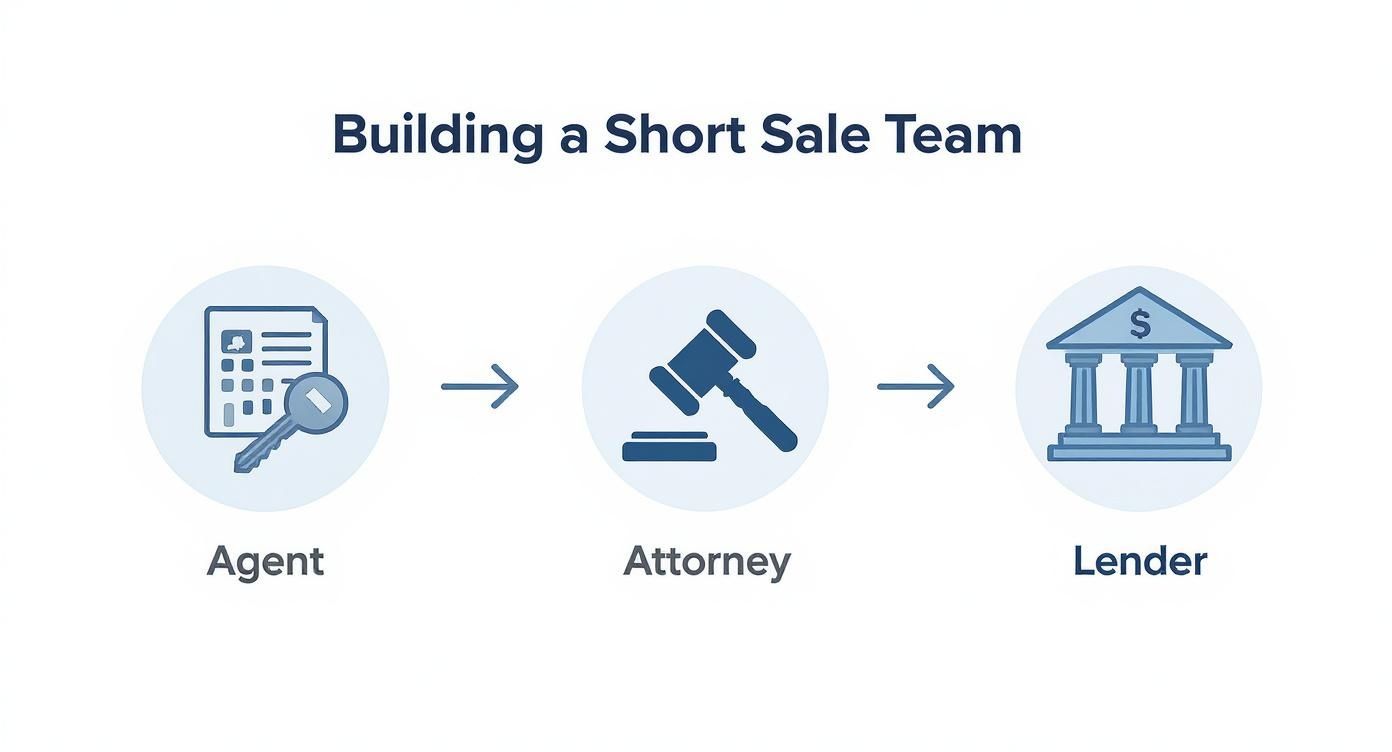
This is why a coordinated team is so critical. The agent, attorney, and lender each own a piece of the puzzle, and if one piece is missing, the whole thing falls apart.
Understanding the Bank’s Playbook
Once your neatly assembled offer is submitted, it disappears into the bank’s internal review system. And this is where the infamous waiting game begins. The bank isn’t just glancing at your offer price; they’re running their own numbers to see if it makes financial sense for them.
Their number one tool for this is the Broker Price Opinion (BPO). The lender hires an independent real estate agent to do a quick valuation of the property. This isn’t a full appraisal; often it’s just a drive-by where they look at recent comparable sales and give the bank an estimated market value.
The BPO is everything. If your offer comes in wildly below the BPO value, the bank will almost certainly reject it outright or hit you with a harsh counteroffer. Your agent’s real job is to anticipate that BPO number and help you craft an offer that’s competitive.
This is where a skilled, experienced agent earns their commission. They can run their own comparative market analysis (CMA) to get ahead of the BPO, helping you write an offer that is both a good deal for you and realistic enough for the bank to take seriously. If you want to get into the weeds on this, our guide on how to write an offer letter breaks down even more detailed strategies.
Think of your offer as the opening move in a long chess match. Your goal is to be strategic, patient, and completely prepared. Presenting a buttoned-up, well-supported package is the single best way to get the bank’s attention and start the negotiation on the right foot.
Mastering the Art of the Waiting Game
You’ve submitted a killer offer package. Now comes the worst part: the silence.
In the world of short sales, patience isn’t just a virtue—it’s your most powerful weapon. The time between sending your offer and hearing anything back can feel like an eternity. But this isn’t passive waiting. This is a strategic period where a good agent proves their worth.
While you’re checking your phone every five minutes, the lender’s internal gears are grinding. They’re digging into the seller’s finances, poring over appraisals, and weighing your offer against the massive headache of foreclosure. It’s a bureaucratic marathon, and the first word you get back probably won’t be a simple “yes” or “no.”
Decoding the Bank’s Counteroffer
When the bank finally does respond, it’s usually with a counteroffer. Don’t panic. This isn’t bad news; it’s the official start of the real negotiation. The tricky part is that a short sale counter can come from a few different players, and you need to know who you’re talking to.
- The Seller: This is rare, but a seller might counter on things like the closing date. It’s usually a minor point and easy to handle.
- The Primary Lender: This is the main event. Their counter is all about the bottom line—the price. They’ve crunched their numbers and are telling you exactly what they need to make the deal pencil out.
- A Second Lien Holder: Here’s where things get complicated. If the seller has a second mortgage or a HELOC, that lender gets a vote, too. They might demand a specific payout to release their lien, throwing another layer of negotiation into the mix.
Your agent’s job is to dissect this counter and tell you how to play it. A sharp agent will have already been building a rapport with the bank’s asset manager, giving them a feel for how much—or how little—wiggle room you really have.
Negotiating an As-Is Property
Let’s be crystal clear: short sales are sold “as-is.” This is a non-negotiable part of the deal.
You can’t ask the bank to fix a leaky roof. You can’t ask them to replace the 30-year-old water heater. They won’t. The seller is broke, and the lender isn’t about to get into the home renovation business.
So, what can you negotiate?
Your only real leverage is the net price. If your inspection uncovers a cracked foundation that’s going to cost $15,000 to fix, you don’t ask for the repair. Instead, you use that inspection report as ammunition to justify a lower offer. You go back to the bank and make the argument that the property’s true value, considering the defect, is lower than their assessment.
You can also get creative with things like closing cost assistance. Sometimes a lender is more willing to kick in a few thousand dollars toward your closing costs than they are to drop the price by the same amount. It’s a psychological game, and an experienced agent knows which levers to pull.
The key is to frame every negotiation point around the lender’s net proceeds. Your argument must always answer the bank’s silent question: “How does this make financial sense for me?”
Keeping the Deal Alive
During this long waiting period, the biggest danger is that the deal just dies from inertia. Another buyer could pop up, the seller could get fed up and walk, or the bank’s priorities could just change. A proactive agent is your only defense against this.
Here’s how a great agent turns passive waiting into an active strategy:
- Consistent Follow-Up: They aren’t just sitting by the phone. They are in regular, professional contact with the bank’s negotiator, making sure your offer stays at the top of the pile.
- Managing Seller Anxiety: They keep the seller’s agent in the loop, constantly reassuring them that you’re a serious, patient buyer who is in it for the long haul.
- Updating Your Financing: If the approval drags on for months, your mortgage pre-approval could expire. A sharp agent and loan officer work together to keep your financials fresh and ready to go at a moment’s notice.
This time is also critical for you. Once the bank gives its final blessing, the closing process moves at lightning speed. You’ll be thrown into the final phase, which means opening escrow. If you want to get a jump on things, understanding this stage is a huge advantage. You can learn more about what that entails by exploring our detailed guide on what is the escrow process and what you can expect.
Ultimately, winning the waiting game is about staying engaged without being a pest. It’s about letting your expert team handle the back-and-forth while you stay prepared, patient, and focused on the finish line.
Avoiding Common Short Sale Deal Killers
You’ve navigated the offer, survived the waiting game, and the finish line is in sight. Don’t celebrate just yet. This is precisely the stage where promising short sale deals often collapse under the weight of last-minute problems.
I’ve seen too many buyers get this far only to watch their dream evaporate over a preventable issue. Knowing where the landmines are buried is the only way to avoid stepping on one.
The As-Is Reality Check
Let’s get brutally honest about what “as-is” truly means in a short sale. It means the seller is completely tapped out financially, and the bank has zero interest in spending a dime on repairs. That peeling paint, the ancient furnace, or that funky smell in the basement? It’s all yours now.
This is why a thorough home inspection isn’t just a good idea; it’s your number one defense against buying a money pit. The inspector is your expert on the ground, hired to uncover the expensive, deal-breaking issues you can’t see during a walkthrough.
- Foundation Cracks: Is it a minor cosmetic issue or a sign of major structural failure? Your inspector will know the difference.
- Outdated Electrical Systems: Can the panel handle modern life, or is it a fire hazard waiting to happen?
- Hidden Water Damage: A small leak can lead to widespread mold and rot, turning a cheap house into a costly nightmare.
Remember, that inspection report isn’t a repair list for the seller. It’s your decision-making tool. If the report uncovers a $20,000 roof replacement, your only real move is to take that report back to the bank and negotiate a price reduction. For anyone eyeing a fixer-upper, learning how to plan a kitchen remodel or other major projects is key to budgeting correctly.
Surprise Title and Lien Issues
One of the most common—and infuriating—deal killers is a messy title. A homeowner in financial distress often has more than just the primary mortgage weighing them down. There could be a whole cast of other creditors with a claim on that property.
A title search can unearth a nasty hornet’s nest of problems that absolutely must be resolved before you can close:
- Second Mortgages or HELOCs: These “junior” lienholders also have to agree to the short sale, and they’ll fight for their piece of the pie.
- Mechanic’s Liens: An unpaid contractor can slap a lien on the property for work they did.
- Judgment Liens: Other creditors who won a lawsuit against the homeowner can have a claim, too.
- Unpaid Property Taxes or HOA Dues: These always get paid first, and the bank factors this into their bottom line.
Your real estate attorney is the hero here. Their job is to ensure the title is “clean and clear” before you sign anything. Without a clear title, you can’t get title insurance, and without title insurance, no lender will give you a mortgage.
This part is completely non-negotiable. A clouded title means you could end up legally responsible for the seller’s old debts. Your great deal just became a financial catastrophe. The entire short sale hinges on the bank’s ability to deliver a property free and clear of all these other claims.
The Dreaded Low Appraisal
Even after the seller’s bank finally approves your offer, your own lender will order a formal appraisal. This is where things can get dicey. If that appraiser decides the home’s market value is less than your agreed-upon price, your financing can grind to a halt.
It’s a classic last-minute roadblock. The seller’s bank approved the sale based on their numbers (often a quick BPO), but your lender’s approval depends entirely on this official appraisal. If it comes in low, you’ve got a valuation gap.
You’re left with three options:
- Come up with the difference in cash yourself.
- Go back to the seller’s bank and try to renegotiate the price.
- Walk away from the deal entirely.
A sharp agent can sometimes challenge a low appraisal by providing the appraiser with better comparable sales data they might have missed. But if the value simply isn’t there, you’ve got a tough call to make. Anticipating these potential deal killers transforms you from a hopeful buyer into a strategic one, ready to clear the final hurdles to the finish line.
Answering Your Questions About Buying a Short Sale
Even with the process laid out, you’re bound to have questions. Buying a short sale isn’t your typical real estate transaction, and the nuances can make or break a deal. Let’s dig into some of the most common things that come up when buyers first step into this arena.
Think of this as the rapid-fire round, meant to cut through the noise and give you clarity.
Can I Get a Mortgage for a Short Sale
Yes, you absolutely can. The mortgage process itself is the same, but the timeline is the real killer. Your pre-approval letter will almost certainly expire while the seller’s bank is dragging its feet.
This is why you need a loan officer who gets short sales. They need to be ready to reissue your paperwork at a moment’s notice and understand that this is a marathon, not a sprint. A lender’s patience is just as crucial as yours.
Are Short Sales Still a Good Deal Today
The main draw is still the potential for a bargain. The massive discounts we saw back in the 2008 housing crisis are mostly a thing of the past, but short sales still tend to trade below market value. But the “deal” isn’t just the price tag.
You have to bake in the cost of repairs. A home priced 10% below the comps is no bargain if you find out it needs a $30,000 roof and a full repipe. A rock-solid inspection is the only way to figure out your true all-in cost and decide if the deal actually pencils out.
Why Do So Many Short Sales Fall Through
It’s true—the failure rate is much higher than a standard sale. The whole thing is a house of cards, with so many parties involved that it can collapse at any point.
Here are the usual suspects for a deal going sideways:
- Lender Rejection: The bank looks at your offer, decides it’s too low, and would rather roll the dice on foreclosure.
- Second Lien Holder Drama: If there’s a second mortgage, that lender might refuse the tiny payout they’re offered and blow up the entire sale.
- Buyer Burnout: The buyer simply gets sick of waiting in limbo for months on end and walks away.
- Seller Goes MIA: The seller stops providing the bank with the financial documents they need, and the process grinds to a permanent halt.
This is precisely why you don’t attempt a short sale without a seasoned agent. They’re the project manager keeping all these spinning plates from crashing down, constantly pushing the deal forward when it stalls. It’s a non-negotiable.
Are Short Sales a Good Option for First-Time Buyers
They can be, but it all comes down to your personal situation and stomach for risk. For a first-time buyer getting priced out of the market, the lower entry point of a short sale can feel like a lifeline. In a market this tough on affordability, that’s a huge pull.
The data shows just how hard it is out there. The percentage of first-time buyers in the U.S. recently hit its lowest point since 1981, making up just 24% of all home purchases. With saving a down payment getting tougher, that short sale discount looks better and better. You can find more real estate stats and insights on resimpli.com.
But here’s the reality check: a first-time buyer needs to be ready, both financially and mentally, for an “as-is” property and a long, uncertain wait. If you have a flexible living situation and a healthy repair fund, it can be an incredible way to gain instant equity. If you have a lease ending on a specific date and a tight budget, a traditional sale is a much safer bet.
Your Los Angeles real estate journey is unique, and having the right guide makes all the difference. Whether you’re exploring a short sale or a traditional purchase, ACME Real Estate has the local expertise and proven track record to help you succeed. Let’s make your property dreams a reality. Contact us today!
 ACME Real Estate | Los Angeles Boutique Real Estate Brokerage