
So, you’re thinking about moving to Los Angeles. The fantasy is all sunshine and celebrity sightings. The reality? It demands a rock-solid game plan—one built on a realistic budget and a boots-on-the-ground scouting mission before you even glance at a moving box. This isn’t just changing your zip code; it’s a major life upgrade that demands serious prep.
Crafting Your Los Angeles Relocation Strategy
Dreaming of palm trees is the fun part. Turning that dream into your new address means getting brutally honest about the financials and logistics. LA is a city of incredible opportunity, but it’s also a place where sticker shock can kill a dream fast. Think of this as your pre-flight checklist, designed to ground you in the financial realities of the city.
Forget what you think you know about moving costs. A move to LA demands an “LA-sized” budget. We’re not just talking about first month’s rent; we’re talking about a whole different level of upfront expenses.
Building Your Financial Foundation
Before you lose yourself in apartment listings, you need to get real about your money. Los Angeles has a notoriously high cost of living, and it hits you from day one.
- Security Deposits: In LA’s competitive rental market, it’s common for landlords to ask for a security deposit equal to two months’ rent for an unfurnished place. Find an apartment for $2,500/month? You could need $7,500 cash upfront just to get the keys ($2,500 first month + $5,000 security deposit).
- Vehicle Expenses: Bringing a car? The California DMV requires you to register it within 20 days of becoming a resident. These fees can be shockingly high, often running several hundred dollars depending on your car’s value.
- The “Everything Else” Fund: Don’t just budget for the moving truck. You need a cushion for all the hidden costs: utility setup fees, new furniture because your old stuff doesn’t fit, and an emergency fund to cover at least three to six months of living expenses. Trust us, you’ll need it.
To get you started, here’s a look at the initial hit your wallet will take.
Your Initial Los Angeles Relocation Budget Checklist
This isn’t about your daily coffee; this is the big-ticket stuff you need to have saved up before you land at LAX.
| Expense Category | Estimated Cost Range (One-Time) | Key Considerations |
|---|---|---|
| First Month’s Rent | $2,000 – $4,500+ | Varies wildly by neighborhood and apartment size. This is a conservative starting point for a 1-bedroom. |
| Security Deposit | $2,000 – $9,000+ | Can be equal to 1-2 months’ rent. Some landlords may ask for more if you have pets or a lower credit score. |
| Moving Company/Truck | $1,500 – $10,000+ | Depends on distance, amount of stuff, and whether you hire full-service movers or drive a U-Haul yourself. |
| Car Registration & Fees | $200 – $800+ | Based on your vehicle’s value. Don’t forget the cost of a California driver’s license and smog check. |
| Utility Deposits | $100 – $500 | Some power, gas, and water companies require a deposit to start service, especially if you’re new to the area. |
| Initial Stock-Up | $500 – $1,000 | Think groceries, cleaning supplies, and all the little things you need to make an empty apartment feel like a home. |
| Emergency Fund | 3-6 months of expenses | Non-negotiable. This is your safety net for unexpected job gaps, car trouble, or medical bills. |
This table is your reality check. Add these numbers up, and you’ll see why having a deep financial cushion isn’t a luxury—it’s a necessity for moving here.
The Power of a Scouting Trip
A well-planned visit before you commit is non-negotiable. This is not a vacation; it’s a research mission. Your goal is to experience the city like a local, not a tourist.
Your scouting trip is about understanding the city’s true character. You need to feel the traffic, walk through potential neighborhoods at different times of day, and see how far your budget will actually go.
During your visit, focus on the daily grind. Drive your potential commute during rush hour. A 20-minute drive on Google Maps can easily become a soul-crushing 90-minute crawl. Go to the grocery stores, check out the parks, and just hang out in a few different areas you’re considering. This is how you get a gut feeling for a place that no blog post can give you.
This trip helps you answer the real questions:
- Can I really live without a car in this neighborhood, or am I kidding myself?
- Does the vibe here match my lifestyle, or will I feel completely out of place?
- How does that commute actually feel after a long day at work?
By investing in a scouting mission, you swap assumptions for facts. This groundwork turns a high-stakes gamble into a calculated decision, ensuring that when you finally land, you’re arriving somewhere that feels less like a foreign city and more like your next home.
Finding Your Niche in the LA Housing Market
Once you’ve built your financial runway, it’s time to tackle the main event: finding a place to live in Los Angeles. Apartment and house hunting here isn’t just a search; it’s a high-speed, competitive sport. To win, you have to be more prepared than the next person in line.
The rental market moves at a dizzying pace. Desirable listings get dozens of applications within hours of posting. If you’re not ready to pounce, you’ll miss out. Plain and simple.
Be Ready to Strike
Before you even start scrolling through Zillow, get your application packet assembled and digitized. Landlords and property managers expect you to have everything ready to go the moment you see a place you like. Procrastination is the enemy here.
Your packet should be a single, well-organized PDF file ready to email at a moment’s notice. Think of it as your rental resume. Here’s what it absolutely must contain:
- Proof of Income: Most landlords want to see that your gross monthly income is at least three times the monthly rent. Have your last two pay stubs, an offer letter from your new LA job, or the last two years of tax returns if you’re self-employed.
- Credit Report: Run your own credit report beforehand. Plenty of services offer this for free. A score of 700 or higher is a strong benchmark, but having the full report ready shows you’re transparent and organized.
- Bank Statements: Your last two months of bank statements prove you have the funds for the deposit and first month’s rent. Black out your account numbers for security, but leave your name and the balances visible.
- Copy of Your ID: A clear scan of your driver’s license or passport.
- Reference Letters: Letters from previous landlords are gold. If you don’t have one, a letter from a recent employer can also make a huge difference.
Having these documents ready to go isn’t just a suggestion; it’s the difference between getting a call back and being ghosted. In a market this fast, the most prepared applicant almost always wins.
Finding Your Community, Not Just an Apartment
Now for the fun part—discovering where you actually want to live. Los Angeles isn’t one single city; it’s a sprawling collection of unique neighborhoods, each with its own personality, rhythm, and price tag. Don’t chase the idea of a “best” neighborhood. Focus on finding the right fit for your lifestyle, budget, and needs.
Get honest with yourself about what truly matters. Is it a short commute? Walkability to coffee shops? Easy access to hiking trails? A vibrant nightlife? Answering these questions will narrow your search from overwhelming to manageable.
For instance, living in Santa Monica offers incredible beach access and that relaxed, coastal vibe, but your rent will absolutely reflect that proximity to the ocean. On the flip side, a neighborhood like Silver Lake provides a creative, energetic feel with indie boutiques and a dynamic food scene, but it comes with a different pace and traffic pattern. Your scouting trip should have given you a feel for this, but now it’s time to dig deeper.
For a detailed breakdown of different areas, you can explore our full Los Angeles neighborhood guide to see what resonates with you.
Dodging the Scams and Securing Your Spot
Unfortunately, LA’s competitive rental market is a magnet for scammers. Be extremely wary of listings that seem too good to be true—they almost always are. Red flags include demanding a deposit before you’ve even seen the property or refusing to meet in person.
Never, ever wire money for a security deposit. Always meet the landlord or property manager and see the inside of the unit with your own two eyes.
When you do find a legitimate place you love, act fast. Submit your application packet immediately. If they like what they see, they’ll send you a lease. Read every single word of it. Make sure you understand the terms regarding rent increases, maintenance requests, and the process for breaking the lease if you have to.
Finally, as you get serious about the housing market, it’s smart to understand your potential insurance needs, whether you plan to buy or rent. You can explore various Los Angeles home insurance options to protect your new place and your belongings right from the start. It’s a critical step in securing your financial well-being as you settle into your new LA life.
Mastering the Logistics of Your Cross-Country Move
You’ve got a plan, you’ve picked a neighborhood… now it’s time to face the beast. The physical move. This is where the sunny LA dream gets very real, very fast. It’s a messy puzzle of boxes, deadlines, and decisions, but if you tackle it right, you can get yourself and your life here without losing your mind.
Let’s be blunt: there is no single “right” way to do this. Your choice boils down to a classic trade-off between money and effort. You can either throw cash at the problem for a completely hands-off experience or roll up your sleeves and save a ton of money by doing it yourself.
Choosing Your Moving Method
This decision really comes down to your personality and your bank account. Are you a meticulous planner who finds Zen in a perfectly packed box, or does the thought of coordinating all this make you break out in a cold sweat?
- Full-Service Movers: This is the premium, white-glove option. A team shows up, packs every last thing, loads it, drives it across the country, and unloads it in your new LA spot. The biggest pro is the sheer convenience. The con? It’s expensive, easily running into the thousands.
- DIY with a Rental Truck: The budget-friendly warrior’s path. You rent a truck, you pack the truck, and you drive the truck. You’ll save a significant amount of money, but you’re trading that cash for long hours of physical labor and the stress of navigating a massive vehicle through unfamiliar territory.
- Moving Containers: A solid middle ground. A company drops off a storage container, you pack it on your own time, and then they pick it up and ship it to your new address. It’s way more affordable than full-service movers but far less demanding than a full DIY move.
For a move this big, a lot of people find a hybrid approach works. Maybe you hire movers just for the heavy furniture but pack and move your personal items yourself. The key is to get multiple quotes—at least three for any service you’re considering—to make sure you’re getting a fair price. If you are upgrading from a smaller space, check out our guide on moving from an apartment to a house for extra tips on managing a larger move.
The Purge and Pack Timeline
Procrastination is the absolute enemy of a smooth move. Start downsizing and organizing at least eight weeks before your moving date. Go room by room and be ruthless. Every single item you get rid of is one less thing to pack, move, and pay for.
Don’t pay to move things you don’t absolutely love or need. The cost to ship that old bookshelf across three states is probably more than it would cost to just buy a new one from a local shop in LA.
Once you’ve purged, it’s packing time. Label every single box with the room it belongs in and a quick description of what’s inside. This small step feels tedious in the moment but will feel like a stroke of genius when you’re exhausted and just trying to find your coffee mugs on that first morning.
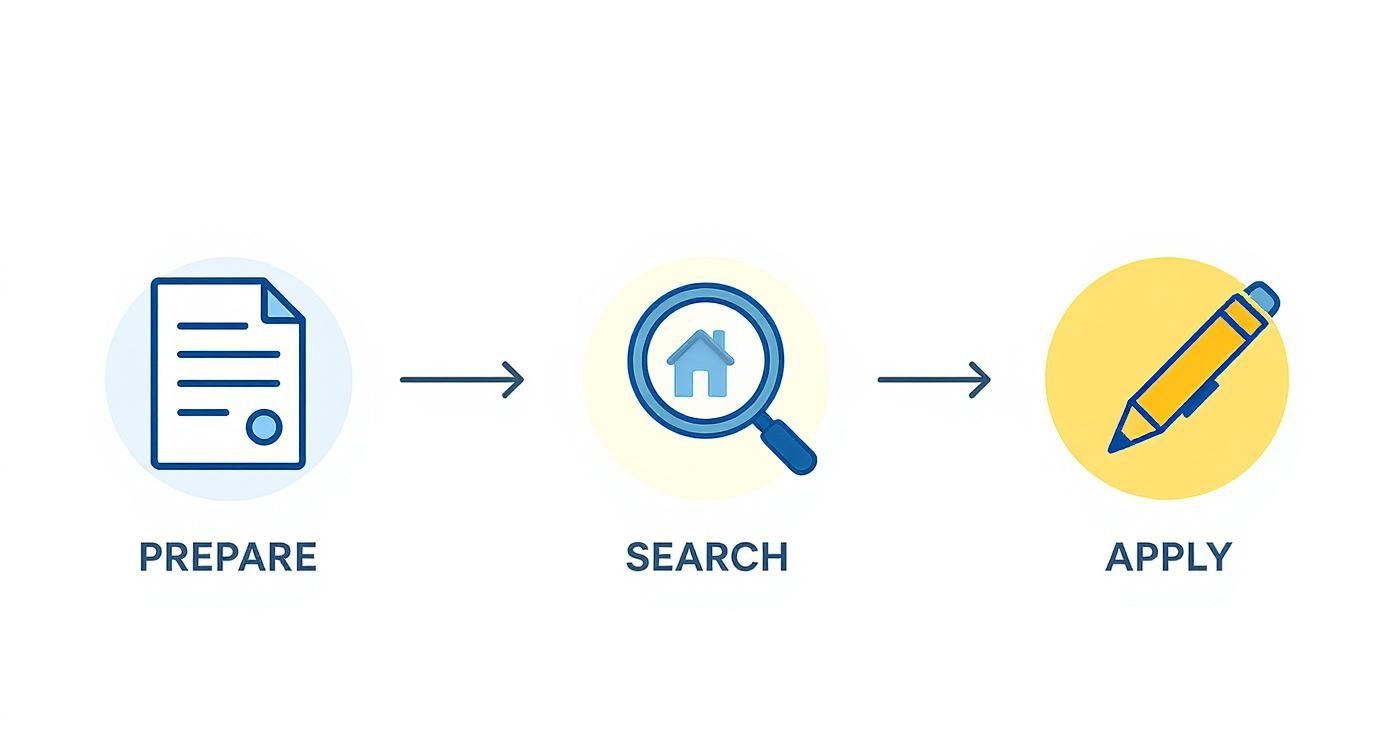
Core actions—preparation, searching, and applying—that are crucial for landing a place in LA’s fast-moving market.
Navigating LA-Specific Challenges
Finally, remember that arriving in Los Angeles comes with its own set of logistical headaches. If you’re driving a moving truck, you need to know that many residential streets here are narrow, hilly, and have ridiculously tight corners. Plan your route carefully and check for any parking restrictions before you even get close.
Timing is everything. Try to schedule your arrival for a weekday during off-peak hours (think 10 AM to 2 PM) to avoid the worst of the city’s infamous gridlock. Showing up mid-day can make that final leg of your journey so much smoother and less stressful.
Your First 30 Days: Navigating Life in LA
The boxes are in, the movers are gone, and the adrenaline from that long drive has finally worn off. Welcome to Los Angeles. The real adventure is just beginning, and your first month will be a blur of crucial errands mixed with the thrill of getting to know your new city.
Think of this as your roadmap to not just survive, but start thriving from day one.
First, let’s talk about the quintessential Angeleno rite of passage: the California DMV. You have 10 days to get a California driver’s license and 20 days to register your car. Don’t sleep on this. Book an appointment online way in advance, get all your paperwork together, and just mentally prepare for a uniquely Californian bureaucratic experience. It’s a small price to pay to make it official.
Beyond the DMV, you’ve got to get your new place up and running. This means utilities, which can sometimes take a few days to get scheduled.
- Electricity: The Los Angeles Department of Water and Power (LADWP) handles most of the city.
- Gas: SoCalGas is your go-to.
- Internet: You’ll have options like Spectrum or AT&T Fiber, but availability is hyper-local. Check who services your specific address before you commit.
Schedule these services the minute you have a signed lease. Nothing kills the new-apartment buzz faster than realizing you have no Wi-Fi or hot water.
From Errands to Exploration
Once the essential life infrastructure is in place, you can shift from logistics to actually living here. Use this first month to build your new routines. It starts small—finding your go-to grocery store, a great coffee shop, and a dry cleaner who won’t lose your favorite shirt.
This is also when you start to learn the local rhythm. You’ll quickly find out about street cleaning days (and the expensive tickets that come with forgetting), the unspoken rules of parking in your neighborhood, and the exact time you need to leave to avoid soul-crushing traffic.
Your goal for the first 30 days isn’t to see all of LA; it’s to make your little corner of it feel like home. Get to know your local barista, find a good taco truck, and figure out the quickest route to the freeway.
This is your chance to build a real life here. While tons of people are still just figuring out how to relocate to Los Angeles, you’re already on the ground making it happen. Embrace the small wins, like navigating a new freeway interchange without a GPS panic attack or discovering a hidden park.
Start Building Your Community
Los Angeles can feel isolating if you let it. People move here for their careers, but it’s the connections you build that will make you want to stay. The city is a wild mix of people coming and going.
Sure, you hear about people leaving, often because of the cost. But at the same time, LA is a magnet for talent from all over the world. International migration alone brought around 150,000 new people to California between 2023 and 2024. This influx of students, professionals, and families is driven by the city’s economic and cultural pull.
The constant flow means the city is always full of people looking to connect. So, how do you find them?
- Lean into Your Hobbies: Are you a hiker? Join a group on Meetup. A ceramicist? Find a local studio. LA has a niche for literally every interest you can imagine.
- Explore Your Neighborhood on Foot: Ditch the car for an afternoon and just walk. You’ll discover gems—a tiny bookstore, a community garden, a friendly pub—that you’d never spot from behind a windshield.
- Just Say Yes: A coworker invites you to a concert? Say yes. Your neighbor mentions a farmers market? Go. Be open to new things, even if you’re exhausted from unpacking.
Your first 30 days will be a whirlwind. You’ll be tired, maybe a little overwhelmed, but also completely energized. You’re building your foundation. Tackle the must-do tasks quickly, then make a real effort to explore and connect. That’s how you go from feeling like a visitor to feeling like you actually belong here.
Embracing the Angeleno Lifestyle
You survived the move, conquered the DMV, and figured out which day is street cleaning. Now comes the real work: making Los Angeles actually feel like home. This isn’t just about existing in a new city. It’s about actively shaping your life here and finding your rhythm in a place that has a million different beats.
To really embrace the Angeleno lifestyle, you have to learn its quirks, from the freeway culture to its famously sprawling geography. This is your moment to go from newcomer to a local who knows how to make this city work for them.
Decoding LA Traffic and Transit
Let’s get one thing straight: you will spend time in your car. But learning to navigate LA traffic isn’t a dark art—it’s a skill you build. The first rule is to know the freeway names and numbers. Locals will always say “the 405,” “the 10,” or “the 101,” and knowing both will make directions make sense.
Next, timing is everything. A drive that takes 20 minutes at 10 AM can easily stretch to 90 minutes at 5 PM. Use apps like Waze or Google Maps religiously. Don’t just use them for directions; use them to understand traffic patterns. You’ll quickly learn that sometimes, the winding surface streets are your best friend.
Don’t just fight the traffic—learn to work with it. If you can, adjust your schedule to avoid peak rush hour. Even shifting your commute by 30 minutes can save your sanity and give you back hours of your week.
And don’t write off public transport entirely. The Metro system keeps expanding and can be a game-changer for certain commutes, especially to Downtown LA or events at major venues. Check out your transit options—it might just unlock parts of the city you’d otherwise avoid.
Discovering LA, Your Way
Los Angeles is a city that rewards exploration. The real magic isn’t in the tourist traps; it’s in the neighborhood taco trucks, the hidden staircases of Silver Lake, and the free concerts at Grand Park. The key is to get out and be curious.
Your life here will be defined by the niches you carve out for yourself. It’s about finding your spots—that coffee shop with the perfect patio, the hiking trail with the best sunset view, or the farmers market with the freshest produce. This is how a massive, intimidating city starts to feel like a collection of familiar, welcoming villages.
Here’s how to start making LA your own:
- Embrace the Outdoors: One of the amazing perks of living here is the access to nature. From the sandy shores of Malibu to the rugged trails of Runyon Canyon, there are endless ways to get outside. Weekend hikes and beach days are part of the culture for a reason.
- Explore the Food Scene: LA’s culinary landscape is legendary. Go beyond the fancy restaurants and dive into the street food culture. Find your favorite food truck, explore the Grand Central Market, and don’t be afraid to try that tiny Koreatown spot with a line out the door.
- Build Your Community: This is the final piece of the puzzle. Join a local sports league, take a class, volunteer for a cause you care about, or connect with people through neighborhood groups. It’s these connections that ultimately make a relocation feel like a success.
This city isn’t a place you passively experience. It’s a place where you actively create a life. By navigating its challenges with a bit of strategy and exploring what it offers with an open mind, you’ll soon find your own version of the Angeleno lifestyle.
Lingering Questions About Your LA Move
Even the most organized person has a few nagging questions when planning a move to a city as sprawling and unique as Los Angeles. It’s a place with its own rhythm and its own rules. Here are the straight-up answers to the questions we get asked all the time.
Do I Absolutely Need A Car in LA?
The short answer is… probably. Look, LA is making some decent progress with its Metro system, but at its core, this is a city built for cars. Whether you truly need one boils down to two things: where you live and where you work.
If you somehow manage to live and work in a dense, walkable pocket like Downtown LA, Koreatown, or certain parts of Santa Monica, you might be able to pull it off. For everyone else, a car is freedom. It’s how you explore, run errands, and just deal with the sheer scale of the city. Trust us, relying only on rideshare apps will drain your bank account faster than you can say “surge pricing.”
What Is The Job Market Really Like?
LA’s job market is massive and incredibly diverse, but don’t mistake that for easy. It’s competitive. The big players are entertainment (obviously), tech, aerospace, fashion, and international trade. Landing a job before you get here is the ideal scenario. It makes apartment hunting a thousand times easier and gives you a financial runway from day one.
Moving here without a job? You need to be ready for a relentless, focused search. Networking is everything in this town. Get active on LinkedIn, find industry meetups, and don’t be shy about asking for informational interviews. And please, have a serious financial cushion—we’re talking at least six months of living expenses saved up.
Are There Any Rent Control Rules I Should Know About?
Yes, and this is a big one. LA’s Rent Stabilization Ordinance (RSO) can be a total game-changer for renters. It generally applies to multi-family rental buildings constructed on or before October 1, 1978. If your apartment is under RSO, your landlord is limited in how much they can raise your rent each year.
In a city where housing costs are always climbing, this is huge. Before you even think about signing a lease, ask if the building is covered by the RSO. Knowing your rights as a tenant is critical here. You should definitely get familiar with Los Angeles rent control laws to see exactly how they might protect you.
How Much Should I Factor in For Taxes?
This is the one that catches so many newcomers by surprise. California has one of the highest state income tax rates in the nation, and it can take a serious chunk out of your paycheck. It’s a progressive system, so the more you earn, the higher your tax rate.
As you’re building your LA budget, you absolutely cannot treat this as an afterthought. You have to factor in state taxes from the get-go. Get a clear picture by understanding California’s income tax rates so you know what to expect. It’s a major part of your financial life in this state.
Your LA journey starts with the right partner. At ACME Real Estate, we provide the local expertise and personalized service to help you find your place in this incredible city. Whether you’re buying, selling, or investing, we’re here to make your transition seamless.
 ACME Real Estate | Los Angeles Boutique Real Estate Brokerage